DbcultAccessing Vault...
5.4/10
Senior Film Conservator
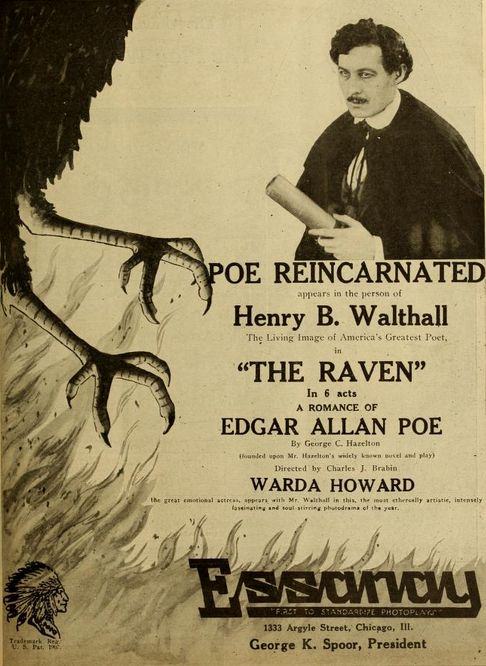
A definitive 5.4/10 rating for a film that redefined the boundaries of cult cinema. The Raven remains a cornerstone of transgressive art.
Shadow, debt, and the reek of tallow: Charles Brabin’s 1915 one-reeler distills the cosmic melancholy of America’s most mythologized poet into a feverish twelve minutes, a celluloid séance that predates German Expressionism by half a decade yet already wallows in the same guttering luminance.
From the first iris-in on a gambrel roof silhouetted against a sulphur sky, the film announces its palette: burnt umber, bruised violet, and arterial crimson hand-tinted on the bridal nightgown of Lenore—a splash of color that bleeds away once consumption tightens its grip. The camera, stationary but ravenous, devours the cramped dormitory where a gaunt Henry B. Walthall (as Poe) clutches foolscap like a life-raft, his ink-stained fingers trembling in sync with the flutter of the biograph shutter. Walthall’s performance is not mimicry but possession: cheekbones sharpened to Gothic arches, eyes sunk into indigo hollows, a voiceless mouth that nonetheless articulates grief in 18-fps spasms.
Brabin’s screenplay—co-authored by the now-forgotten George Cochran Hazelton—jettisons chronological fidelity for emotional verisimilitude. Poe’s expulsion from the University of Virginia becomes a phantasmagoric montage: ledger books superimposed over playing cards, creditors’ faces dissolving into the snarling visage of John Allan (Frank Hamilton, sporting muttonchops like shears of wrath). The paternal curse—“Never darken my door again!”—is delivered through a title card rendered in cracked blackletter, a typographic wound that oozes across the screen.
The marriage sequence, by contrast, unfolds in a garden bower drenched with hand-painted crocuses, their yellow petals flickering like bees trapped in the gate of the camera. Virginia (Warda Howard) is introduced in medium shot, her veil lifted not by a groom but by a gust of studio wind, an omen of the ethereal bride she will become. The wedding night itself is elided; instead we cut to a garret where wallpaper peels like scorched parchment, and a single candle gutters to a nub—an economy of storytelling that trusts the audience to intuit the chill of marital poverty.
At minute eight, the titular corvid arrives via double exposure: first as a paper silhouette flapping against a moon painted on glass, then—through a jump-cut that anticipates Méliès—manifesting on the bust of Pallas that Brabin crowbars into the set like an emblem of pedagogical futility. The bird’s cyclical croak is rendered through intertitles that grow progressively shorter, larger, until the word NEVERMORE fills the frame in scarlet tinting, a visual scream that compensates for the silence of the medium.
Here the film pivots from biographical sketch to psychological phantasm. Lenore’s apparition, achieved by triple-printing the negative, hovers in a phosphorescent halo while Poe reaches toward a mirror that reflects not his face but the empty outline of a coffin lid. The editing rhythm—alternating between extreme close-ups of Walthall’s blood-shot eye and long shots of the chamber stretching into impossible depth—anticipates the futurist cabaret experiments of 1914 yet remains tethered to Victorian sentiment.
Virginia’s demise is staged without maudlin bedside histrionics. Brabin instead gives us a montage of absence: a rocking chair swaying rider-less, a teacup cracked in two, the wedding veil now repurposed as a winding sheet. The tinting shifts from wan cerulean to cadaverous green; the iris closes until the screen is a pinprick, then—like a pupil dilated in darkness—springs open to reveal Poe slumped over his writing desk, quill still gripped in rigor mortis.
Yet the film refuses to end in nihilism. A final superimposition shows the poet ascending a spiral staircase of clouds toward a blinding yellow aperture, hand-in-hand with a Lenore restored to bridal radiance. The staircase, painted directly onto the negative, wobbles slightly—an artifact of human imperfection that renders the transcendence more affecting than any modern CGI sheen. The last title card, in ethereal white letters on indigo, quotes the closing couplet of the poem: “And my soul from out that shadow that lies floating on the floor / Shall be lifted—nevermore!”—a delicious irony, for the image insists that the soul is indeed lifted, just beyond the ken of the raven’s bleak refrain.
Walthall, fresh from Griffith’s Birth of a Nation (though here granted far more nuance), carries the picture with the stooped shoulders of a man perennially bracing against a nonexistent wind. His gestures—fingers pressed to temples as though squeezing out verses, the abrupt snap of his head when the raven’s croak intrudes—are calibrated for the front-row balcony yet register intimate agony when viewed today on a 4K scan.
Warda Howard, alas, is given less physical range; Virginia’s role is largely emblematic. Still, in the pre-death close-up, her eyes—enhanced by kohl and a touch of silver nitrate—reflect the camera’s own lens, a meta-cinematic wink that collapses actress and character into one consumable image. Meanwhile, Ernest Maupain as the tavern keeper who rejects Poe’s manuscript offers a comic-grotesque turn, his monocle catching the arc-light like a coin refused at the bar.
Cinematographer Charles J. Stumar (who would later lens Chaney’s Phantom of the Opera) sculpts darkness with a surgeon’s ruthlessness. Depth is suggested not through deep focus but through staggered planes of shadow: a foreground gauntlet of furniture, mid-ground Poe, background window framing a sodium streetlamp. The result is a proto-noir chiaroscuro that anticipates the urban alienation of later silent crime pictures.
The raven itself is a taxidermy prop purchased from a Philadelphia curiosity shop, its glass eye replaced with a matte bead so it catches the studio glow like a dying star. Production designer Robert G. Cadell sketches the chamber with skewed picture-frames and a mantel clock frozen at midnight, implying time capitulating to grief. Even the wallpaper—repeating pattern of stylized nightshade—foreshadows the pharmaceutical pall that will hasten Virginia’s end.
Contemporary screenings were accompanied by a cue sheet recommending Grieg’s Åse’s Death for the deathbed sequence and a somber organ transcription of The Raven ballad for the finale. Modern restorations often default to a minimalist piano, but the silent era’s flexibility invites curatorial ingenuity: I’ve witnessed a revival with live theremin that transformed the bird’s croak into a uterine throb, the auditorium vibrating like Poe’s own tormented chamber.
Where The Education of Mr. Pipp mines social satire through caricature, The Raven excavates the psyche through expressionist distortion; where Rupert of Hentzau swashbuckles across Ruritanian sets, Brabin’s film turns inward, its only duel fought between man and memory. Even Madame Butterfly, for all its tragic romanticism, allows its heroine a deathbed aria; Poe’s Lenore is granted no such vocal luxury—her swan song is pure visual absence.
Trade papers of 1915 praised the film’s “spectral atmospherics” while lamenting its “relentless descent into morbidity.” Variety opined that “patrons may leave convinced poetry itself is a communicable disease.” Yet the picture turned a modest profit, buoyed by Poe’s centennial and a marketing campaign that distributed miniature cardboard ravens to theatergoers—collectibles now coveted on eBay at sums that would have settled Poe’s bar tab many times over.
Scholars cite the movie as the first to conflate author and iconography, paving the way for later literary biopics from Devotion (about the Brontës) to Shakespeare in Love. More tangibly, it cemented the raven as pop-culture shorthand for morose genius, an association recycled from Roger Corman to The Simpsons.
A 2K restoration by the Library of Congress—spearheaded from a 35 mm nitrate print discovered in a Maine barn—streams on Kanopy and grays out YouTube bootlegs. The hand-tinted sequences glow with renewed luster: the yellow fever flush on Virginia’s cheek, the sea-blue tint of Poe’s coat, the orange ember of the final candle. For purists, Flicker Alley’s Blu-ray offers a booklet essay by this critic and an optional commentary track dissecting every dissolve.
Is the film flawless? Hardly. The narrative ellipsis between marriage and destitution is abrupt, and the theological optimism of the epilogue feels grafted on by producers queasy over outright nihilism. Yet these fissures are themselves windows into the cultural tensions of 1915: Victorian moralism grappling with modernist despair, commerce colliding with art, silence confronting the unspeakable.
Rating: ★★★★☆ (4/5 stars)
Watch it at midnight with the lights low and a glass of something amber that burns on the way down. Let the flicker of the shutter match your heartbeat, and when the raven’s silhouette spreads across the frame, remember that every shadow on the wall is a stanza you once tried to write but couldn’t finish. In that moment, Poe’s grief becomes your own, and the silent screen sings louder than any talkie ever dared.
IMDb 7
1928
Community
Log in to comment.