DbcultAccessing Vault...
Cult Review
Senior Film Conservator
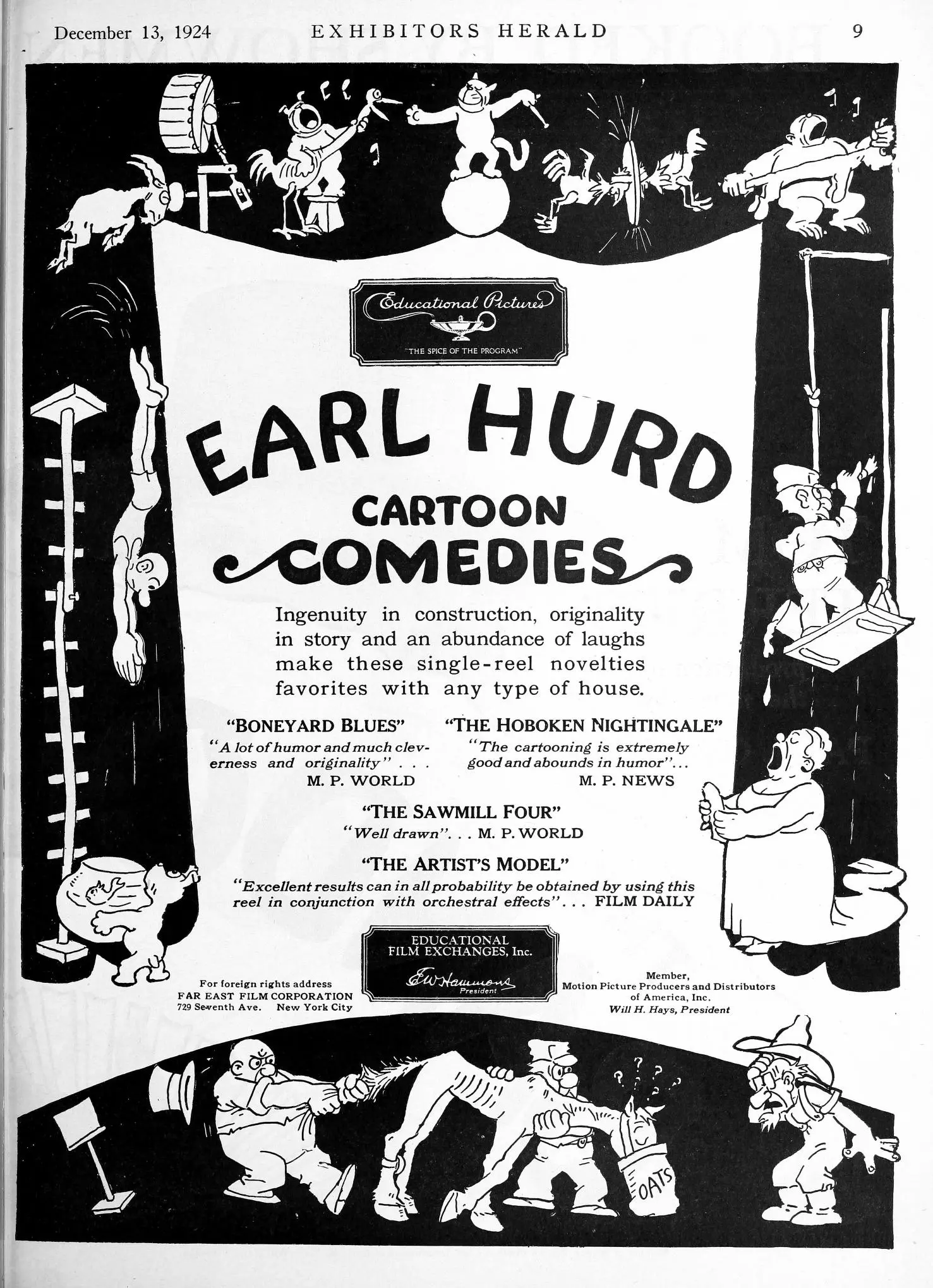
To approach the works of Earl Hurd is to step into the very crucible of modern visual storytelling. In his 1920 short, The Sawmill Four, we are not merely observing a relic of the silent era; we are witnessing the birth of a grammar that would eventually define the global animation industry. Hurd, the progenitor of the cel animation process, utilized this specific film to push the boundaries of background stability versus foreground kineticism. While contemporary live-action dramas like The Old Nest were exploring the domestic interiority of the American family, Hurd was busy deconstructing the physical world through the lens of pen and ink.
The sawmill trope is a cornerstone of early 20th-century melodrama, a recurring motif that signified the brutal intersection of nature and the machine age. However, in The Sawmill Four, the industrial setting is stripped of its Victorian gravity. Unlike the sweeping historical epics such as The Queen of Sheba, which sought to overwhelm the viewer with sheer scale and pageantry, Hurd’s work thrives on a claustrophobic intimacy. The buzzsaw is not just a threat; it is a character in its own right, possessing a rhythmic, almost hypnotic presence that dictates the pacing of the entire short.
The character of Bobby Bumps, Hurd’s most enduring creation, acts as the audience's surrogate in this whirlwind of mechanical chaos. His interactions with the environment suggest a sophisticated understanding of spatial dynamics that many of his peers lacked. Where a film like Mr. Opp might lean into the pathos of its protagonist's eccentricity, Hurd leans into the sheer physics of the gag. Every movement Bobby makes is a calculated response to the sawmill’s geometry, creating a visual dialogue between the organic form and the rigid lines of the machinery.
One cannot discuss The Sawmill Four without addressing the technical revolutionary at the helm. Earl Hurd’s patent for cel animation allowed for a level of detail in the static backgrounds that was previously impossible. This allowed the artist to render the textures of the timber and the metallic sheen of the tools with a fidelity that rivals the atmospheric cinematography found in The Sea Wolf (1920). By separating the moving elements from the environment, Hurd created a sense of depth that was profoundly immersive for audiences of the 1920s.
This depth is particularly evident during the high-tension sequences where the characters navigate the conveyor belts. The layering of these animations creates a parallax effect that was decades ahead of its time. It is a stark contrast to the more theatrical, flat staging seen in The Stimulating Mrs. Barton, which remained tethered to the proscenium arch. Hurd’s camera—or rather, his frame—is mobile, fluid, and relentlessly curious.
When we examine the tension inherent in The Sawmill Four, it is fascinating to compare it to the suspense thrillers of the same decade. Consider the espionage and intrigue of De røvede Kanontegninger or the mystery of Under Suspicion (1923). While those films rely on narrative twists and shadows, Hurd relies on the visceral fear of the blade. The animation medium allows for an exaggeration of danger that live-action simply could not replicate safely. The sawmill becomes a surrealist nightmare, where the laws of physics are momentarily suspended for the sake of a laugh, only to snap back into place when the peril becomes imminent.
Even the slapstick elements carry a weight of consequence. In The Skipper's Narrow Escape, the humor is derived from the absurdity of the situation. In Hurd’s sawmill, the humor is derived from the precision of the escape. There is a mathematical elegance to how Bobby Bumps evades disaster, a choreography that shares more in common with a ballet than a standard cartoon. This level of planning and execution speaks to Hurd’s dual role as writer and animator—a singular vision that ensured every frame served the overarching rhythm of the piece.
Beyond the technical achievements, The Sawmill Four serves as a fascinating cultural artifact. It reflects the post-war fascination with industrialization—a world being rebuilt by machines. While films like The Dawn of Freedom (1916) looked back at historical struggles for liberty, Hurd was looking at the contemporary struggle of man versus the machine. It is a theme that resonates through the ages, found in the gritty realism of Barnaby Rudge or the urban landscapes of Centocelle.
The "Four" in the title refers to a quartet of characters, each representing a different facet of the working-class struggle, albeit through a comedic lens. Their synergy is reminiscent of the ensemble dynamics in This Way Out (1924), where the humor is found in the collective failure and eventual triumph of the group. Hurd’s ability to imbue these ink-blot characters with distinct personalities is a testament to his prowess as a storyteller. They are not merely placeholders; they are living, breathing entities within their two-dimensional realm.
As we reflect on the impact of Earl Hurd, it is clear that The Sawmill Four was a vital stepping stone. It lacks the cynicism of later animation but possesses a sharp, observational wit that is often missing in modern CGI spectacles. The stakes feel real because the craftsmanship is so evident. Every line was hand-drawn, every cel hand-painted. This tactile quality gives the film a soul that transcends its short runtime. It doesn't need the melodrama of $5,000 Reward or the historical sweep of When Broadway Was a Trail to make its point. It simply exists as a pure expression of creative energy.
In the grand tapestry of silent cinema, where films like Dodging a Million focused on the social aspirations of the era, Hurd focused on the fundamental joy of movement. The Sawmill Four is a celebration of what the medium can do when unshackled from the limitations of reality. It is a masterclass in economy, pacing, and visual wit. For any serious student of film history, it remains an essential text—a vibrant, flickering reminder of the time when the world was new, the machines were loud, and a simple line of ink could conquer both.
Ultimately, Hurd’s contribution to the art form cannot be overstated. By providing a template for how to animate efficiently without sacrificing aesthetic integrity, he paved the way for every animator who followed. The Sawmill Four stands as a monument to that innovation, a frantic and delightful romp through a world of gears and saws that still manage to sparkle with life a century later. It is a work of profound simplicity and complex execution, a dichotomy that remains the hallmark of all great art.
The enduring brilliance of The Sawmill Four lies in its refusal to be dated. While the technology of its production has been surpassed, the clarity of its vision remains untarnished. Hurd understood that at the heart of all cinema—animated or otherwise—is the tension between the character and their environment. By placing Bobby Bumps in the heart of a sawmill, he created a microcosm of the human experience: the constant negotiation with forces larger than ourselves, handled with a wink and a perfectly timed leap. It is a quintessential piece of American animation that deserves its place in the pantheon of silent era masterpieces.
IMDb 6.9
1923
Community
Log in to comment.