DbcultAccessing Vault...
Cult Review
Senior Film Conservator
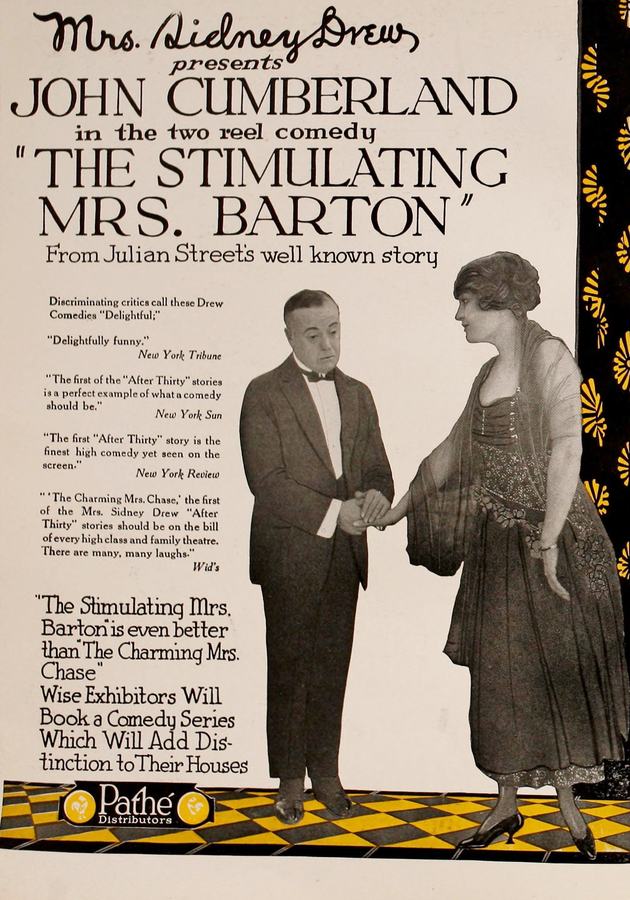
The Stimulating Mrs. Barton arrives like a pressed violet discovered between the pages of a forgotten etiquette manual: delicate, faintly perfumed, yet capable of drawing blood if you rub it the wrong way.
Shot in the autumn of 1919 and released the following spring, this brittle social comedy was shepherded by Mrs. Sidney Drew—silent-era matriarch who understood that the most subversive jokes are whispered, never shouted. She co-writes, co-directs, and cameos, gifting the project a matrilineal authority rare in a landscape dominated by male gag merchants. The result is a 55-minute celluloid essay on the economics of affection: what happens when two people who already own the deed to each other’s routines decide to window-shop elsewhere.
The Bartons’ townhouse is a museum of shared compromises: antimacassars crocheted during scarlet-fever convalescence, a pianola that only plays the waltz they first kissed to, a cat who has witnessed every quarrel and still deigns to purr. Into this ecosystem of gentle déjà vu arrives the idea of infidelity—less a tornado than a draft under the door. Jimmie, played by John Cumberland with the rueful handsomeness of a man who once rowed crew and now rows only responsibilities, drifts toward Margot Leighton’s bohemian watercolorist because she smells of risk. His wife—Elinor Curtis in a performance so lucid it feels like staring through leaded glass—accepts the attentions of Harold Foshay’s banker, a creature so upholstered in self-regard he practically creaks.
What follows is not the expected bedroom farce but a series of moral hiccups. Each time a liaison inches toward consummation, the film cuts to the couple’s shared history: a flash of the night their first child miscarried, the way Jimmie’s palm trembled on her abdomen; the memory of her darning his socks while he recited advertising slogans to make her laugh. These interludes, rendered in soft-toned double exposures, land like paper cuts—tiny, precise, disproportionately painful.
Cinematographer Tom Bret favors medium two-shots that treat the marriage itself as protagonist. When Mrs. Barton removes her gloves to touch the banker’s lapel, the camera hesitates at the wrist—lace cuff, pulse flickering, a whole Victorian novel in a square inch of flesh. The moment she withdraws, the film smash-cuts to her kitchen at dawn, where Jimmie wordlessly butters toast for her preference, crusts removed. No intertitle is needed; the juxtaposition is scalpel-sharp.
Compare this surgical minimalism to the volcanic eroticism of Yamata or the flapper exuberance of Untamed Ladies. Mrs. Barton courts neither tribal drums nor jazz cacophony; its score is the hush of a shared blanket. Even the tinting strategy whispers: amber for domesticity, cerulean for temptation, a faint rose blush for the moment the couple reconvene in mutual forgiveness.
Hollywood typically treats 40 as the invisible zipper in the dress of life—pull it and youth sloughs off in a comic heap. Here, middle age is quieter, more galling: it is the realization that your knees now provide weather forecasts, that flirtation requires an ergonomic strategy. When Jimmie attempts the rakish lean he perfected at 25, the film undercuts him with a subtitle: “Atmospheric conditions prevented high pressure.” The joke lands because it is tethered to flesh, not farce.
Elinor Curtis embodies the same predicament with eyes that register every micro-defeat. Watch her study her own reflection before the banker’s dinner: she adjusts a stray curl, hesitates, then removes the daring diamond clasp she intended. The gesture lasts maybe three seconds, yet it contains whole treatises on self-permission and the taxation of time. Silent cinema excels at this—turning stillness into narrative dynamite.
Critics seeking precedents might invoke A Modern Thelma for its gendered power seesaws, or Pique Dame for its fatalism. Yet Mrs. Barton refuses operatic stakes; its battlefield is a breakfast nook. Where The Walk-Offs treats separation as screwball prank and A Man’s Fight frames marriage as moral crucible, this film locates its tension in the microscopic negotiations of daily courtesy—who pours the coffee first, who pretends not to notice the new waistcoat bought to impress a stranger.
Julian Street’s magazine satires inform the dialogue cards, which read like whispered asides at a Manhattan cocktail hour. When Mrs. Barton’s confidante asks, “Is virtue a currency or a corset?” the line is so incisive it feels smuggled in from a future decade. Co-writer Tom Bret allegedly kept a notebook of overheard subway quarrels; the authenticity shows in the way the couple’s final rapprochement hinges not on flowers or theater tickets but on the husband quietly replacing her broken boot heel—an act so intimate it feels almost pornographic.
John Cumberland’s Jimmie is perpetually caught between a smile and a sigh, shoulders suggesting a man forever arriving at the wrong party. Elinor Curtis counterbalances with the stillness of a pond whose depths you suddenly realize are fathoms. In one devastating beat, she catches her husband’s scent on a handkerchief left by the watercolorist; her nostrils flare a millimeter—enough to convey entire ledgers of jealousy, relief, and resignation. Try finding that emotional granularity in the broad hijinks of It Happened in Honolulu or the Expressionist contortions of El eco del abismo.
The picture’s parsimony extends to set design. The Bartons’ parlor reappears throughout, but props migrate: a portrait angled toward the wall during quarrel, a chessboard left mid-game during reconciliation. These micro-shifts externalize the couple’s emotional tectonics more eloquently than any speech could. Note how the banker’s office is cluttered with hunting prints—visual shorthand for conquest—while the watercolorist’s studio blooms with unfinished canvases: invitations to incompletion. Production design, usually the silent era’s overlooked child, here becomes a stealth dramaturg.
Released months before the 19th Amendment’s ratification, the film sidesteps suffrage sloganeering yet radiates the unease of shifting power. Mrs. Barton’s flirtation is not mere escapism but market research—testing what currency her wit commands outside the domestic bourse. Contemporary viewers will detect pre-echoes of I my kak liudi’s communal self-interrogation, albeit filtered through lace-curtain gentility. The movie understands that liberation without self-knowledge simply swaps one set of manacles for another.
Modern marriage therapists could screen this as a 55-minute cautionary masterclass. The couple’s near-infidelities collapse not from external policing but from internal ledgers of cost-benefit analysis: Is the transient thrill worth the paperwork of deceit? The film anticipates current debates about consensual non-monogamy yet lands on a quietly radical note—choose the prison you already decorated together.
For decades the negative languished in a Rochester vault, mislabeled as A Nymph of the Foothills. A 2018 4K restoration by the Museum of Modern Art reveals textures previously smothered: the glint of a brass doorknob, the fray on Jimmie’s waistcoat elbow. The tinting schema has been recreated via photochemical analysis rather than digital guesswork; the amber glow now looks like honey held to candlelight, the cerulean like ocean seen through train window. The Library of Congress print screened last year at Il Cinema Ritrovato earned a five-minute ovation—testimony to how quietly seismic restraint can be.
Streaming rights remain fragmented, though occasional 35 mm revivals surface at venues like the American Cinematheque. For the vigilant cinephile, the hunt mirrors the film’s own ethos: the prize is sweeter for the conscience required to obtain it.
Great art often asks: can a story still throb if stripped to the bone? The Stimulating Mrs. Barton responds with a sly, compassionate affirmative. It is a comedy whose punchline is the survival of tenderness, a marital thriller whose most explosive device is memory. Long after the projector’s clatter fades, what lingers is the image of two people buttering toast in complementary silence, having weighed the world and found nothing worth the weight of shared history. In an age addicted to maximalism, such exquisite restraint feels—paradoxically—like the wildest stunt of all.
IMDb 5.2
1934
Community
Log in to comment.