DbcultAccessing Vault...
5.9/10
Senior Film Conservator
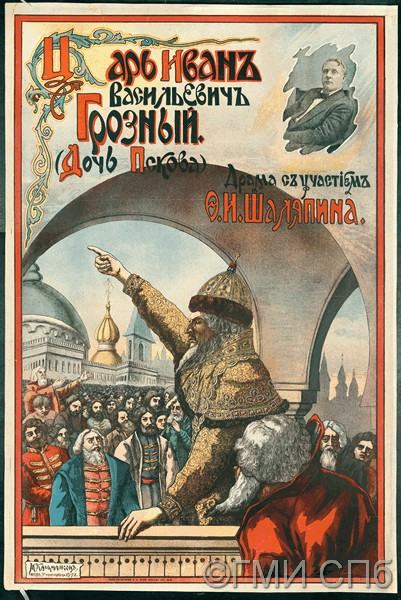
A definitive 5.9/10 rating for a film that redefined the boundaries of cult cinema. Tsar Ivan Vasilevich Groznyy remains a cornerstone of transgressive art.
To witness Tsar Ivan Vasilevich Groznyy (1915) is to observe the tectonic shift of performance art from the operatic stage to the flickering celluloid of early Russian cinema. While the era was saturated with short-form diversions and primitive narratives, this production sought a gravitas that few contemporaries dared to emulate. At the epicenter of this earthquake is Feodor Chaliapin Sr., a man whose very silhouette seems to swallow the frame. His portrayal of Ivan the Terrible is not merely acting; it is an exorcism of historical memory. Unlike the more delicate sensibilities found in Should a Woman Tell?, Chaliapin utilizes a physical vocabulary that is both gargantuan and surprisingly nuanced.
Every gesture of Chaliapin’s hand, every furrow of his brow, communicates a legacy of divine right and paranoid isolation. The film, also known as The Maid of Pskov, serves as a bridge between the 19th-century theatrical tradition and the emerging visual grammar of the 20th century. While Western audiences in 1915 were perhaps more accustomed to the urban realism or slapstick of their own burgeoning industries, the Russian school was already experimenting with the psychology of the 'Great Man.' This film does not just tell a story; it constructs a mythos.
The cinematography, though constrained by the technical limitations of its birth year, exhibits a remarkable sense of spatial awareness. One cannot help but compare its atmospheric density to The Isle of the Dead, which utilized shadow and light to evoke a sense of impending doom. In Tsar Ivan Vasilevich Groznyy, the darkness is not merely a lack of light; it is a manifestation of the Tsar's psyche. The interiors of the Pskov palaces and the Tsar’s own quarters are rendered with a claustrophobic richness that mirrors the suffocating weight of the crown.
In contrast to the adventurous, almost documentary-like spirit of Panama and the Canal from an Aeroplane, this film remains grounded in the soil of the Russian soul. It is a static, yet vibrating work of art. The use of depth in the frame—where the Tsar looms in the foreground while his subjects tremble in the distance—establishes a visual hierarchy that requires no dialogue to understand. This is a sophisticated use of the medium that predates many of the innovations we attribute to later masters.
The script, adapted from Lev Mey’s drama, avoids the pitfalls of a simple chronological biography. Instead, it focuses on the siege of Pskov as a crucible for character study. We see Ivan not as a cartoonish villain, but as a man burdened by the paradox of his own divinity. The discovery of his daughter, Olga, provides the emotional fulcrum of the film. It is a narrative device that humanizes the autocrat without forgiving his atrocities. This complexity is often missing in other 1915 releases like The Tide of Death, which relied more on externalized peril than internal conflict.
Richard Boleslawski and Mikhail Zharov provide sturdy support, but they are inevitably eclipsed by the solar flare of Chaliapin. Boleslawski, who would later influence the very fabric of American acting through the Laboratory Theatre, here displays the nascent sparks of a technique that prioritizes emotional truth over pantomime. The interactions between the characters are choreographed with a rhythmic precision that suggests a director who understands the power of the 'tableau vivant.'
"The film functions as a psychological architecture, where the Tsar's madness is the foundation and his fleeting moments of paternal grace are the fragile ornaments that eventually shatter."
To appreciate this film, one must place it within the context of the Russian Silver Age. The year 1915 was a period of immense turmoil, with the Great War raging and the seeds of revolution already germinating. Cinema was the new playground for the intelligentsia. While Sumerki zhenskoy dushi (Twilight of a Woman's Soul) explored the domestic tragedies of the bourgeoisie, Tsar Ivan Vasilevich Groznyy looked backward to look forward, using the past to interrogate the nature of Russian authority.
It shares a certain epic DNA with The Child of Paris, particularly in its ambition to tell a story that feels larger than the screen itself. Yet, where the French production leans into the Dickensian, the Russian production leans into the Dostoevskian. There is a spiritual heaviness here, a sense that the characters are wrestling with God as much as they are with each other. This is a far cry from the lightheartedness of Come Robinet sposò Robinette or the straightforward action of The Jockey of Death.
The lighting in the film deserves its own dissertation. In several sequences, the use of high-contrast lighting creates a proto-expressionist effect. The way the light catches the metallic threads of the Tsar’s robes while his face remains partially obscured in shadow is a masterclass in visual storytelling. It evokes the same haunting quality found in Through Dante's Flames. This isn't just a record of a play; it is a reimagining of the play for a medium that can manipulate the viewer's eye through the lens.
The production design is equally staggering. The recreation of Pskov and the Kremlin is done with a meticulous eye for historical verisimilitude. It lacks the escapist whimsy of Lion of Venice, opting instead for a gritty, tactile reality. You can almost smell the incense and the damp stone of the cathedrals. This commitment to atmosphere ensures that the film transcends its silent nature; the visuals are so evocative that they practically generate their own soundtrack of liturgical chants and clashing steel.
Analyzing the cast beyond Chaliapin reveals a fascinating cross-section of early 20th-century acting. Mikhail Zharov, who would go on to become a staple of Soviet cinema, shows a youthful energy that balances Chaliapin’s leaden intensity. Boris Sushkevich, another disciple of the Moscow Art Theatre, brings a level of psychological realism that was rare for 1915. When compared to the more archetypal performances in En hjemløs Fugl, the ensemble in Ivan feels like a modern unit, working in concert to build a world rather than just occupying space.
Even the crowd scenes, often a point of failure in early epics, are handled with a sense of organic chaos. There is a palpable sense of fear in the Pskov citizenry. This isn't the choreographed movement of a ballet, but the frantic scurrying of a people who know their lives hang by a thread. It mirrors the tension found in contemporary war films like With Serb and Austrian, bringing a touch of documentarian dread to the historical drama.
Tsar Ivan Vasilevich Groznyy stands as a towering achievement of pre-revolutionary Russian cinema. It is a film that demands much from its audience, requiring a surrender to its slow, deliberate pacing and its intense emotional outbursts. It lacks the populist appeal of The Call of the North, but it offers something far more enduring: a glimpse into the soul of a nation through the eyes of its most controversial figure.
In the final analysis, the film is a study of the 'Groznyy'—the Terrible—not as a title of cruelty, but as a title of awe. It asks whether a man can ever truly be separate from the office he holds, and whether the blood on a Tsar's hands can ever be washed away by the tears of a father. Like Das Recht aufs Dasein, it interrogates the right to exist within a system that demands total subservience. It is a haunting, beautiful, and profoundly disturbing work that remains as potent today as it was over a century ago. To watch it is to engage with the very foundations of cinematic storytelling, a reminder that before there were special effects, there was the human face, and few faces have ever been as expressive as Chaliapin’s Ivan.
Even when compared to the exoticism of The Capture of a Sea Elephant, the spectacle of Ivan the Terrible is more profound because it is an exploration of the internal wilderness. It is a landmark of the silent era that deserves its place in the pantheon of world cinema, a testament to the power of a single, monumental performance to define an entire era of film.

IMDb —
1933
Community
Log in to comment.