DbcultAccessing Vault...
Cult Review
Senior Film Conservator
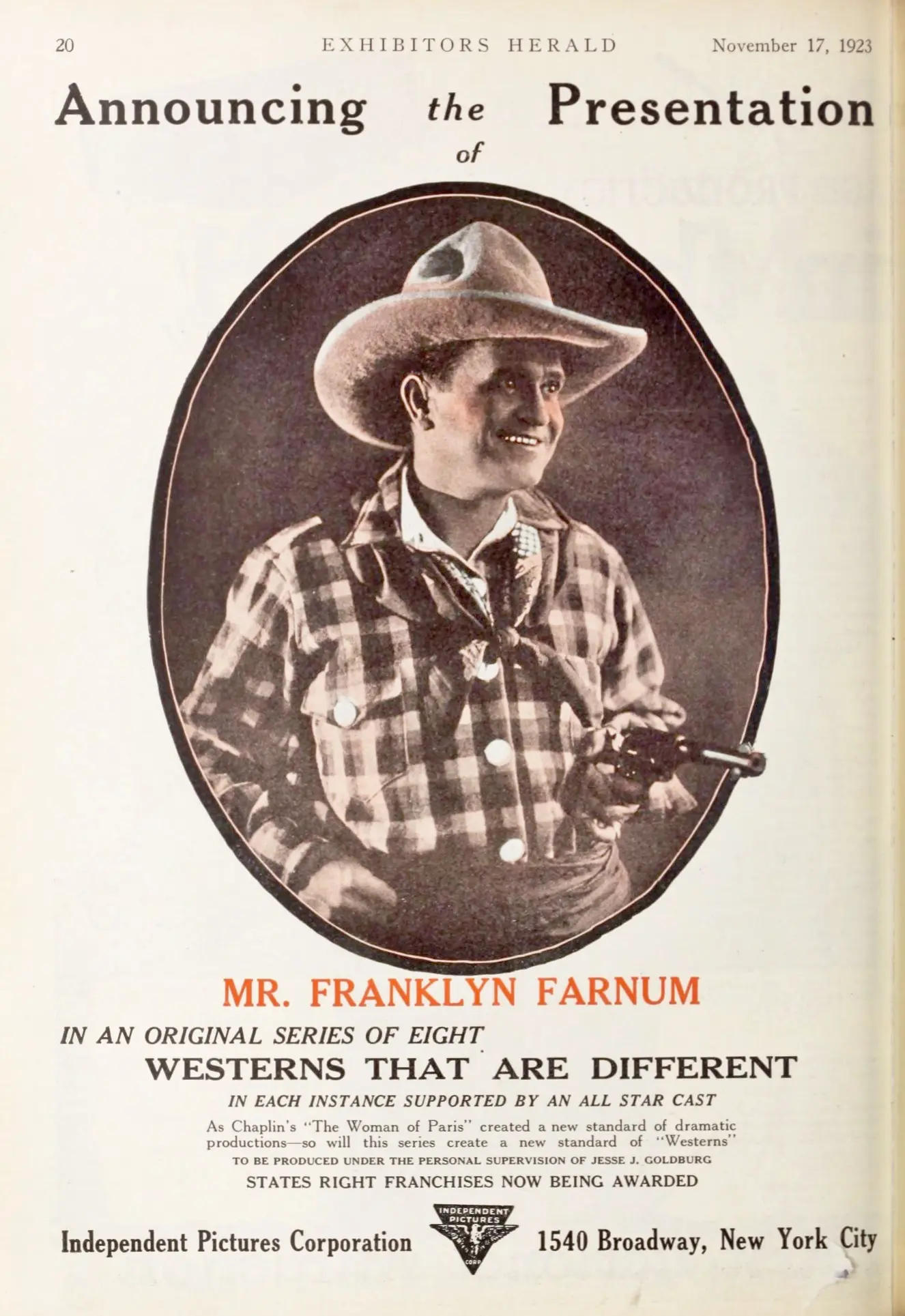
To witness the 1924 silent Western Two Fisted Tenderfoot is to observe a quintessential American myth in its most concentrated form. The trope of the 'tenderfoot'—the soft-palmed Easterner who ventures into the wild interior only to find his true mettle—was already a staple of the genre by the mid-twenties. However, under the shrewd direction of J.P. McGowan, this particular iteration transcends the usual slapstick pitfalls of its contemporaries like The Book Agent, opting instead for a narrative that balances the socioeconomic friction of the meatpacking industry with the raw kineticism of the cattle trail.
Franklyn Farnum, an actor whose screen presence often bridged the gap between the dapper leading man and the rugged action star, delivers a performance that is surprisingly nuanced for the era. As Tom Ransom, Farnum must navigate the difficult transition from a man defined by his father’s wealth to a man defined by his own calloused hands. Unlike the more whimsical transformations seen in Going! Going! Gone!, Farnum’s Ransom feels grounded in a specific kind of desperation—the need to escape the shadow of a tycoon father who views the West not as a landscape of beauty, but as a factory of raw materials.
The film’s central conflict is sparked by the machinations of Bennett, played with a delightful, sneering opportunism by Jack Richardson. Bennett represents the darker side of the frontier: the middleman who thrives on the exploitation of those caught between the old world and the new. When Ransom arrives to purchase a large herd, he isn't just fighting for cattle; he is fighting against a corporate sabotage that mirrors the cutthroat boardrooms of the East. This thematic depth elevates the film beyond the standard 'horse opera,' drawing parallels to the moral complexities explored in Life's Blind Alley.
The pacing of the film is a testament to McGowan’s efficiency. Known for his work in high-speed serials, McGowan brings a rhythmic urgency to the cattle-buying sequences. The tension builds not through mere gunplay, but through the logistical hurdles Bennett places in Ransom’s path. We see the 'tenderfoot' struggle with the environment, the language of the cowboys, and the sheer physical exhaustion of the trail. It is a grueling baptism that feels far more earned than the sudden heroics found in The Secret of the Pueblo.
Visually, Two Fisted Tenderfoot utilizes the wide-open spaces of the California locations to simulate the vastness of the cattle range. The cinematography captures the dust and the heat in a way that feels tactile. There is a specific shot—a long take of the herd moving across a dry wash—that rivals the pastoral beauty of The Faithful Heart, though with a much more aggressive, utilitarian edge. The camera doesn't just observe; it participates in the struggle to keep the herd moving, emphasizing the chaos that Bennett tries to exploit.
The supporting cast provides a sturdy framework for Farnum’s evolution. Lorraine Eason brings a quiet strength to her role, serving as a catalyst for Ransom’s maturation without falling into the trap of the helpless damsel. Her presence reminds us that the West was not just a playground for men’s egos, but a community in flux. Meanwhile, the veteran J.P. McGowan pulling double duty as both director and actor ensures that the ensemble remains tight and the narrative beats land with precision.
What sets this film apart from the typical action-heavy Western is the climax. While there is certainly enough physical confrontation to satisfy the genre’s demands, the ultimate victory is one of intellect. Ransom doesn't just outshoot Bennett; he outmaneuvers him. This focus on 'wit over brawn' is a refreshing departure from the more simplistic morality plays of the time, such as The Spirit of the Conqueror. It suggests that the modern world—represented by Ransom’s education and strategic thinking—can indeed survive and thrive in the primitive West, provided it adopts the requisite grit.
Comparing this to the surreal or avant-garde efforts of the period, like Literaturno-instruktorskiy agitparokhod vtsik 'Krasnaia Zvezda', might seem like a stretch, yet both films deal with the concept of 'instruction' and the molding of a new man for a new era. Ransom is a prototype of the modernized American hero: one who retains his civility but is capable of 'two-fisted' action when the veneer of civilization is stripped away.
In the broader context of silent cinema, Two Fisted Tenderfoot serves as a fascinating bridge. It lacks the melodrama of La dame masquée or the psychological darkness of Morphium, yet it possesses a sincerity that is often missing from contemporary blockbusters. There is a sequence involving a stampede—likely achieved with real livestock and terrifyingly close camera work—that puts modern CGI to shame. The stakes feel real because the danger was real.
The film also touches upon themes of legacy and inheritance that echo through works like Dombey and Son. Tom Ransom is not just fighting for his father’s approval; he is fighting to define what the Ransom name will mean in a landscape that doesn't care about bank accounts. It’s a struggle for a 'common level' of humanity, a theme explored in A Common Level, where social standing is stripped away in favor of character.
J.P. McGowan’s direction is characterized by a lack of pretension. He understands that the audience is there for the story, and he delivers it with a muscular clarity. The editing, particularly in the third act, creates a sense of escalating doom that is eventually shattered by Ransom’s clever intervention. This isn't the slow, theatrical pacing of Love Without Question; it is the lean, hungry storytelling of a director who grew up in the trenches of the film industry.
Even the lighter moments—the 'tenderfoot' struggling with his gear or misinterpreting the local customs—are handled with a dry wit that avoids the over-the-top mugging found in A Lyin' Hunt or Birthday Guests and Jungle Pests. There is a respect for the character of Tom Ransom; the film mocks his ignorance but never his spirit. This empathy is what allows the audience to fully invest in his eventual triumph.
While Two Fisted Tenderfoot may not be the most famous Western of the 1920s, it remains a vital piece of the genre’s DNA. It encapsulates the transition from the frontier to the modern age, using the cattle industry as a microcosm for a changing America. It lacks the broad caricature of Dead Eye Jeff, opting instead for a narrative that feels surprisingly sophisticated in its understanding of power dynamics and personal growth.
For those interested in the evolution of the Western hero, this film is essential viewing. It showcases Franklyn Farnum at the height of his powers and J.P. McGowan at his most disciplined. It is a film about the grit required to survive a world that wants to take everything you have, and the intelligence required to keep it. In the end, Tom Ransom isn't just a 'two-fisted' hero; he is a man who has found a balance between his refined past and his rugged future, a sentiment that resonates as much today as it did a century ago.
Reviewer Note: This analysis considers the cultural impact of the 1924 release and its standing among the silent era’s prolific Western output. The interplay between industry and adventure remains its most striking feature.
IMDb —
1920
Community
Log in to comment.