DbcultAccessing Vault...
Cult Review
Senior Film Conservator
There are films you watch with your eyes; then there is Uneasy Feet, a puckish contraption that demands you watch with your metatarsals.
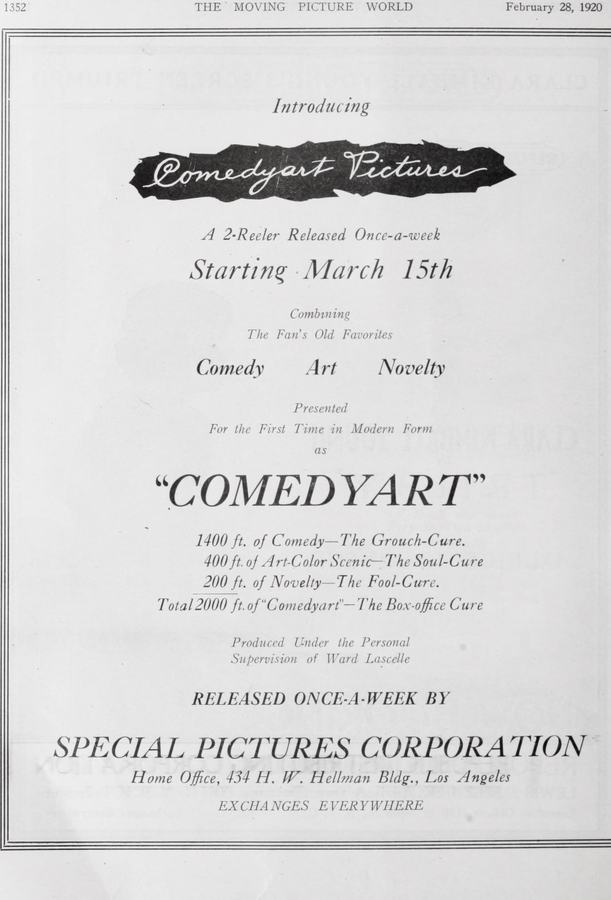
The year is 1922. While Flame of Youth was busy selling flappers as the new American religion, and The Woman Who Dared championed corseted rebellion, a Kansas-born vaudevillian named Ward Lascelle lopped off the human body at the shin and dared the remainder to emote. The result—five reels trimmed to a manic six-minute short—feels like Bunuel slicing Magritte’s ankles in a Dada cabaret.
Two leather-bound proletarians shuffle in, their cracked soles suggesting Great-War thrift. Enter bourgeois calves sheathed in Parisian silk—cream, licorice-stripe, impossibly pristine. A courtship of locomotion erupts: tap, slide, pirouette. Yet the moment desire nears consummation, riding boots—brown, brass-spurred—gallop into frame, imperial and patriarchal. Cue triangular tension, a tango of treads, and a finale that leaves the underdog footwear limp as discarded gloves.
But narrative is mere scaffolding. Lascelle’s coup is ontological: he evacuates the face—the cinema’s fetishized mirror—forcing us to project psyche onto phalanges. Every muscle twitch becomes a soliloquy; every scuff mark, a scar of lived experience. The camera, fixed at floor-level, turns the screen into a proscenium of political economy. You do not see poverty—you read it in the asymmetrical wear of a left heel.
Lascelle, himself a former hoofer in the Ziegfeld Follies, treats the frame like a Busby Berkeley hexagon inverted. Instead of overhead kaleidoscopes, we get underfoot geographies: the diagonal thrust of a silk-stockinged knee conjures Pikes Peak’s perilous escarpments, while the boots’ metronomic stomps echo the assembly-line montage of The Gum Riot. The film’s tempo accelerates in lockstep with industrial anxiety; seconds feel stitched by a sweatshop Singer.
Sound, though absent, haunts. The squeak of patent leather becomes a surrogate squeal for the silenced worker. Contemporary reviewers complained of phantom thwacks in the orchestra pit—audience synapses so rattled they hallucinated Foley. In 1978, Anthology Film Archives screened a 16 mm print with a live junk-percussion trio; the result reportedly drove two patrons to remove their shoes, convinced the noise emanated from their own arches.
Censors of the time, ever alert to the dangers of patella, missed the erotic landmine entirely. Yet Uneasy Feet is suffused with podiatric voyeurism. Note the moment silk droops an inch, revealing a violin-curve of calf—an ankle’s equivalent of the Lubitsch linger. Or the boots’ slow zip, a striptease of authority divesting itself. Lascelle weaponizes the off-screen torso: by denying us the face, he forces libido to migrate south, turning metatarsals into Grecian statues. The spectator’s gaze, thus displaced, becomes complicit in the commodification it mocks.
Compare this to Bubbles, where corporeal fragmentation titillates through cut-glass close-ups of soap spheres. Lascelle refuses such ocular ease; his fragmentation is radical, not decorative. The leg ends, the world ends—everything above is bourgeois mythology.
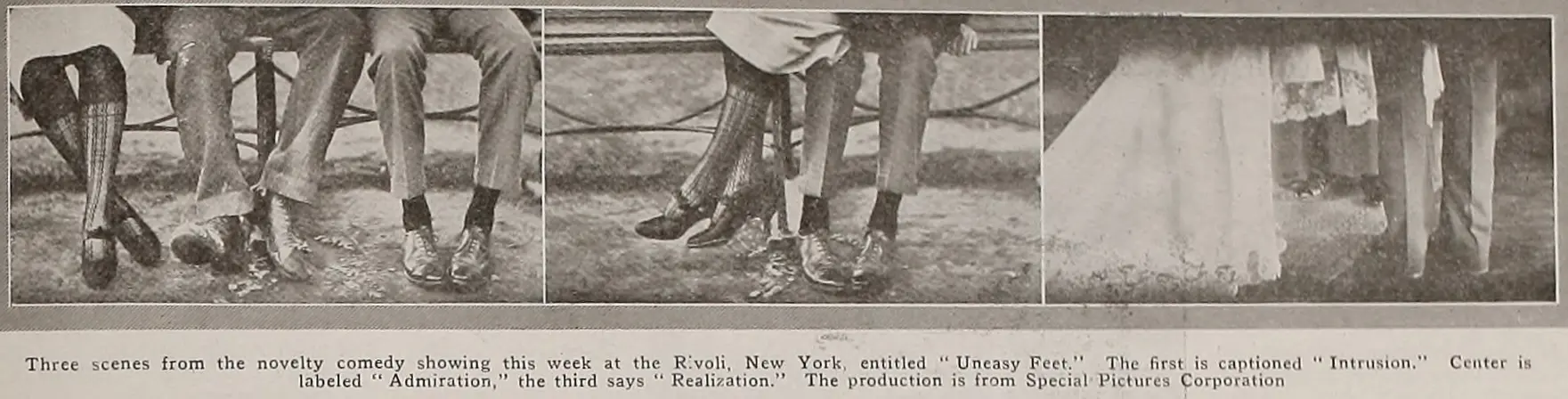
Read the riding boots as Manifest Destiny incarnate. Their brass buckles catch the studio lights like conquistador helmets; each heel strike is a gunshot across an unnamed border. When they pin the worker-oxfords supine, the image rhymes with Les chacals’ jackal-plutocrats gnawing Algerian soil. Yet Lascelle, Midwestern son of a railroad machinist, embeds ambivalence: the boots, after victory, perform a solitary shuffle—exhausted, lonely, perhaps aware that empire always ends with a single awkward dancer on a darkened stage.
Some scholars claim the silk stockings enact a proto-Butlerian gender performativity. Note how they reject both suitors, sashaying offstage in self-sufficient hauteur. The gesture lasts perhaps 72 frames, but it ruptures the patriarchal triangle: woman exits not as conquest but as flâneuse. Compare the tragic bridal capitulation in The Mail Order Wife; Lascelle grants his ankles anarchic autonomy.
How did this anarchic footnote survive? Most shorts of its ilk were melted for their silver halide during WWII. Uneasy Feet endured because Lascelle, ever the showman, spliced a single print inside a tin labeled “Outtakes—Barn Dance” and pawned it to a projectionist cousin in Topeka. Decades later, a MOMA intern discovered the reel misfiled between Some Boy and My First Jury, its title card scrawled in pencil: “Uneasy Ft—silent—legs only.” The acetate reeked of vinegar syndrome yet retained its ochre warmth, as though the feet inside kept strutting through history’s landfill.
Though photographed in monochrome, the print’s tinting—hand-applied by Lascelle’s girlfriend, a Kansas City dye-house worker—carries ideological weight. The oxfords glow sepia, hinting at agrarian toil; the stockings shimmer amber, evoking bootleg champagne; the boots are daubed in cold steel-blue, the palette of munitions. Thus the film anticipates the chromatic propaganda of The Firebrand yet achieves its polemic without a single intertitle.
Freud would chuckle: the foot, long a fetish object, here becomes slapstick subject. The laugh arrives not via pratfall but via ontological vertigo—our brains scramble to graft a human narrative onto ambulatory fragments. The guffaw is the moment cognitive dissonance resolves into absurdity. Contrast The Tale of a Wag, where facial mugging cues humor; Lascelle excises the cue, forcing the spectator to become both author and butt of the joke.
Trace its ghost through Shirley Clarke’s Bridges-Go-Round, in the shoe-mounted camera that waltzes across Brooklyn Bridge. Hear its echo in Maya Deren’s Ritual in Transfigured Time, where footfalls replace plot beats. Even Beavis and Butt-Head unknowingly parodied Lascelle in the couch-dance of disembodied legs. The YouTube POV roller-skate video? Merely Uneasy Feet digitized for the age of GoPro narcissism.
When the 4K scan premiered at Il Cinema Ritrovato, purists balked. The restorers had stabilized the image, erased gate wobble, and—heresy—digitally sharpened the scuffs. Lascelle’s intended blur, which once rendered class as a smear of motion, now looked like a high-fashion commercial. The lesson: sometimes decay is dialectic. The flicker of nitrate mimics the precarity of the labor it depicts. Over-pristine pixels betray the grime of historical struggle.
In an era of OnlyFans foot content and algorithmic commodification of every toe hair, Uneasy Feet feels prophetic yet innocent. Its eros is allegorical, its satire systemic. Watch it on your phone and you reduce revolutionary cinema to swipe-fodder; project it on a wall, turn off the lights, let the whirr of your 16 mm projector mimic the factory belts of 1922, and you will feel the ghosts of machinists, seamstresses, and chalk-skinned dreamers jitterbugging across your retinas.
Final stride: Uneasy Feet is not a curio for cine-archaeologists; it is a manifesto encoded in musculature. Strip humanity to its lowest extremity and you uncover the entire circus of ideology—class, gender, colonial thirst—tap-dancing on a six-minute loop. Watch it once, you smirk. Twice, you squirm. Three times, you unlace your own shoes and wonder whose story your soles are silently performing.
IMDb —
1926
Community
Log in to comment.