DbcultAccessing Vault...
Cult Review
Senior Film Conservator
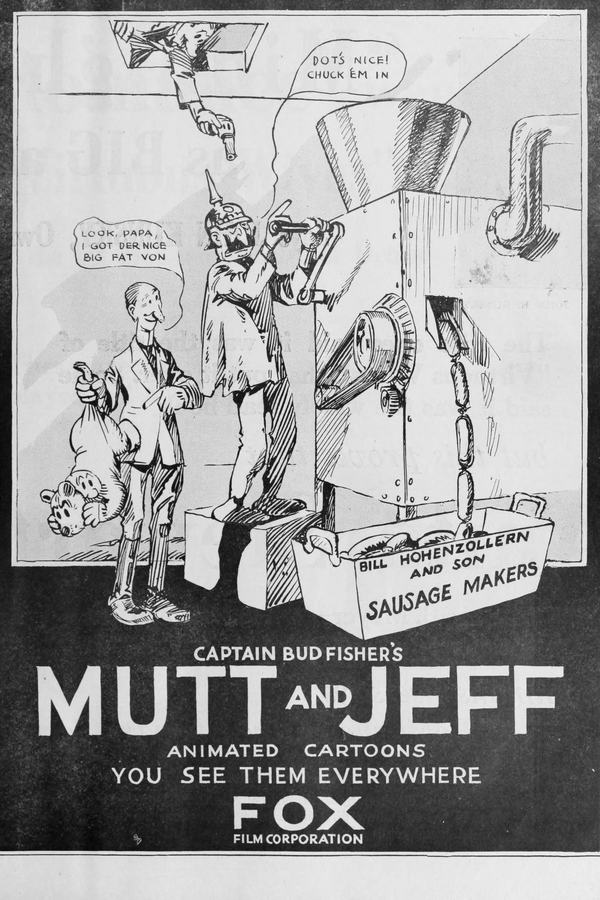
In the immediate wake of the Armistice, the global collective consciousness sought not merely peace, but a specific brand of retributive mockery. Bud Fisher, the titan of the comic strip medium, pivoted from the escapades of his iconic Mutt and Jeff to a more pointed, vituperative target in William Hohenzollern Sausage Maker. This 1919 short stands as a fascinating artifact of early cinematic propaganda, yet it transcends simple agitprop through its sheer, surrealist audacity. While contemporary features like Branding Broadway were busy exploring the burgeoning urban myths of the American dream, Fisher was occupied with the systematic dismantling of a fallen idol.
The premise is deceptively simple: the exiled Kaiser Wilhelm II, having traded his scepter for a meat grinder, attempts to navigate the indignities of the service industry. However, the subtext is thick with the irony of the era. To witness the man who once commanded the most formidable military force in Europe struggling with a stubborn sausage casing is to witness the ultimate democratizing power of the animated medium. Unlike the grounded, often melodramatic narratives found in Paid in Full, Fisher’s work operates in a realm of pure, unadulterated iconoclasm. The Kaiser is not merely a character; he is a vessel for the world's collective frustration, rendered in ink and subjected to the laws of cartoon physics.
Visually, the film is a masterclass in the economy of line. Fisher’s style, honed in the high-pressure environment of daily newspaper syndication, prioritizes clarity and exaggerated movement over the ornate backgrounds seen in films like Told in the Hills. The sausage shop is a sparse, almost Beckettian stage where the protagonist’s failure is inevitable. There is a specific, tactile quality to the animation—the way the sausages coil like serpents, or the way the Kaiser’s mustache bristles with impotent rage—that anticipates the more fluid, surrealist ventures of the 1920s.
One cannot help but draw a parallel to the international cinematic landscape of the time. While the Russian avant-garde was beginning to experiment with montage, and the Brazilian industry was producing works like Alma Sertaneja to capture a sense of national identity, Fisher was using the American cartoon as a weapon of psychological warfare. The "sausage maker" motif is particularly inspired; it suggests that the machinery of war, which once processed human lives into statistics, has now been reduced to a literal meat-grinder, producing nothing but cheap food for the masses he once ruled. It is a charnel house humor that resonates with the cynical spirit of the post-war years.
To understand the impact of William Hohenzollern Sausage Maker, one must look at how other films of the era handled themes of duty and fallibility. In For Valour, the concept of military honor is treated with a certain degree of reverence or, at the very least, dramatic weight. Fisher, conversely, strips all dignity from the uniform. The Kaiser’s spiked helmet—the Pickelhaube—becomes a punchline, a relic of a discarded age. This rejection of traditional heroism is also palpable when compared to Flying Colors, where the thrill of the new and the adventurous still holds sway. Fisher’s world is one of consequences, where the bill for the last four years has finally come due, and it must be paid in sausages.
Furthermore, the film’s portrayal of the "fallen great man" provides a stark contrast to the domestic dramas of the time. While The Wife He Bought or The Girl Who Didn't Think dealt with the complexities of interpersonal relationships and social standing, Fisher’s satire is purely external and political. There is no interiority to this version of Wilhelm; he is a caricature in the truest sense—a collection of recognizable features designed to be mocked. This lack of empathy is the film’s greatest strength, allowing the audience to engage in a form of ritualistic humiliation that was likely necessary for the psychic healing of the era.
The sausage machine itself is a marvel of early animated design. It represents the industrialization of the mundane. As the Kaiser feeds various items into the hopper—perhaps his medals, his pride, or the very remnants of his empire—the machine churns with a relentless, mechanical rhythm. This reflects the era's fascination with and fear of the machine age, a theme explored in more grounded ways in films like The Sea Master. However, Fisher imbues the machinery with a mischievous life of its own, turning the Kaiser’s own tools against him.
There is also a subtle commentary on the shifting class dynamics of the early 20th century. The Kaiser, once at the apex of the social hierarchy, is now a laborer. This forced proletarianization is a theme that echoes through the more serious European dramas, such as Sein schwierigster Fall, which navigated the crumbling structures of the old world. Fisher, however, finds the comedy in the collapse. He doesn't ask us to pity the sausage maker; he asks us to laugh at the absurdity of his new station. It is a precursor to the slapstick of Chaplin, but with a much sharper, more specific political edge.
It is illuminating to place William Hohenzollern Sausage Maker alongside international contemporaries like Arshin mal-alan from Azerbaijan or Don Juan Manuel from Argentina. These films were often preoccupied with establishing a unique cultural voice or adapting local folklore. Fisher’s work, by contrast, is aggressively global in its scope, targeting a figure who was, for a time, the most hated man on the planet. The film speaks a universal language of ridicule, needing no intertitles to convey the depth of the Kaiser’s disgrace.
Even when compared to lighter American fare like From Two to Six or the whimsical The Wanderer and the Whoozitt, Fisher’s short feels remarkably modern in its cynicism. It possesses a bite that many live-action comedies of the period lacked, perhaps because the medium of animation allowed for a level of cruelty that would have felt unseemly if enacted by human actors. The "rubber hose" limbs and bulging eyes of the animated Kaiser allow for a physical degradation that is both hilarious and total.
In the final analysis, William Hohenzollern Sausage Maker is more than just a footnote in the history of animation. It is a vital document of a world in transition. It captures the moment when the grand narratives of the 19th century—of kings, empires, and divine right—were finally ground into the dust of the 20th. While films like The Island of Desire offered audiences a chance to escape into exotic fantasies, Bud Fisher forced them to look directly at the wreckage of the old world, albeit through a lens of extreme distortion.
The film’s brevity is its strength. It does not overstay its welcome or attempt to offer a nuanced psychological portrait. It is a cinematic drive-by, a quick and efficient strike against a defeated foe. In the century since its release, the specific political heat of the film has cooled, but its artistic vitality remains. We see its DNA in every political cartoon and satirical sketch that followed. Fisher understood that the best way to kill a monster is not with a sword, but with a laugh. By turning the Kaiser into a sausage maker, he ensured that the terrifying figure of the Great War would forever be remembered as a bumbling butcher, lost in a sea of frankfurters. It is a triumph of the pen over the sword, and a testament to the enduring power of the animated image to reshape reality in the service of a higher, more hilarious truth.
As we look back from our vantage point in the 21st century, the film serves as a reminder of the raw, unpolished power of early cinema. It was a time of experimentation, where the boundaries of what could be shown—and what could be mocked—were being pushed daily. Bud Fisher was at the forefront of this movement, and William Hohenzollern Sausage Maker remains one of his most audacious contributions. It is a chaotic, colorful (in spirit, if not in tint), and utterly essential piece of silent film history that deserves to be studied not just for its technique, but for its profound understanding of the human need to see the powerful brought low.
IMDb 2.5
1920
Community
Log in to comment.