DbcultAccessing Vault...
Cult Review
Senior Film Conservator
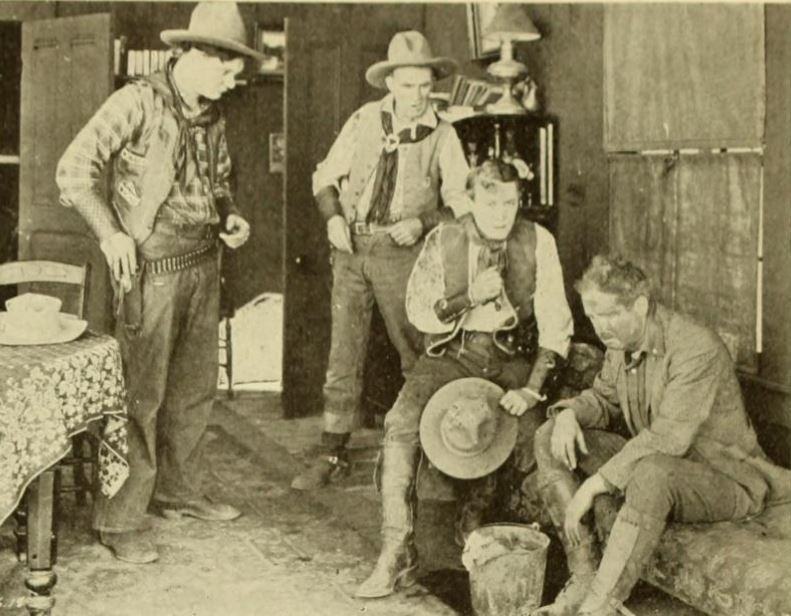
The first time I watched With Hoops of Steel I expected another saddle-sore morality tale: good hombre framed, bad cattle baron twirls moustache, last-minute rescue, curtain. Instead, what unfurled was a chiaroscuro poem where loyalty is currency more volatile than gold and love is both bullet and balm. Director Paul Hurst—better known for twitchy henchmen in other oaters—here steps behind the lens with the appetite of a man who’s memorised every ridge of Monument Valley and every tremor of the human pulse.
Strip the narrative to studs and you still feel the ghosts of older myths: The Law That Failed also toyed with judicial lynch mobs, while A Friend of the People flirted with the sacrificial hostage trope. Yet Kelly and Geraghty’s screenplay inks something rawer: Emerson’s flight is less escape than pilgrimage, his return not surrender but defiant blaze. The moment he trades freedom for the possibility of Marguerite’s smile, the film vaults from programmer to parable.
Henry B. Walthall—forever etched as the little colonel in The Birth of a Nation—imbues Emerson with spindly grace, a man whose joints seem hinged on invisible wire. Watch the way his shoulders sink when the jail door clangs: not defeat, but recognition that destiny has finally cornered him. Opposite him, Anna Mae Walthall (no relation, though their chemistry suggests cosmic sibling conspiracy) lets Marguerite’s porcelain composure fracture by micrometres; the quiver at the corner of her mouth when she hears Emerson volunteered to find Paul is silent-era thunder.
Mary Charleson’s Amanda Garcia flickers through only three intertitles, yet her eyes—shot in lingering close-up—carry the weight of frontier womanhood: the knowledge that marriage can be both sanctuary and shackle. Meanwhile Clifford Alexander’s Tommy speaks volumes by refusing to speak; when he offers himself as hostage, the gesture is so wordless it feels biblical.
Cinematographer William De Vaull treats celluloid like wet plate: skies balloon with sulphuric grandeur, while nighttime interiors are lit by kerosene halos that threaten to scorch the frame. The trial sequence cross-cuts between Emerson’s gaunt profile and the pendulum shadows of a courtroom clock—time itself swinging toward doom. Later, when our hero rides out to locate Paul, Hurst tilts the horizon until the world seems balanced on the horse’s withers, a visual daredevilry that anticipates John Ford’s apocalyptic stagecoaches.
Note the colour symbolism that squeaks past orthochromatic stock: Marguerite’s cream-coloured shawl appears ghost-grey, foreshadowing the quasi-burial of her betrothal to Albert; Amanda’s dark rebozo drinks light, becoming void. These are grad-school readings, sure, but the subconscious registers them anyway.
Seen without accompaniment, the film still vibrates with imagined hooves; seen with a live score (as I did at the 2019 Boise silent-fest) it mutates. The fiddler scraped out a modal reel that morphed into a funeral dirge the instant little Paul vanished—audience gasped as if someone had slammed a church organ lid. Silence, here, is never absence but pregnant space where viewers pour their own dread.
Where The Romance of Tarzan leapt into exotic fever dreams and I Accuse dissected post-war malaise, With Hoops of Steel stays rooted in prairie pragmatism yet achieves operatic crescendo. Its DNA also snakes through Under Four Flags’ camaraderie-under-fire, though that picture substituted trenches for canyons.
Modern viewers might squint at Marguerite’s seeming passivity, yet the script sneaks subversion: her whispered “Go” when Emerson volunteers is command, not consent. She weaponizes gratitude, weaponizes gaze; by finale she’s rewritten the social contract without firing a shot. Amanda, too, reclaims agency by choosing clandestine marriage over paternal cattle auction. These women pivot the plot more than six-guns ever could.
Rumour claims the production shot for eleven days on back-lots the size of a Woolworth’s parking lot. You feel it in repeated canyon shots flipped horizontally to feign new geography. Yet necessity mothers poetry: the same rock arch looms like a moral gate, first behind Emerson’s flight, later behind his vindication—a visual reprise that shouts redemption without intertitle assistance.
Missing-child trope doubles as Nativity inversion: Paul’s crib is the wilderness, the magi are flawed cowboys, and the star is the promise of communal absolution. When Emerson hoists the found boy onto his saddle, backlit by a sunburst, you half expect cherubs to trumpet. Hurst, canny showman, lets the image linger only long enough for myth to germinate, then cuts to a hog rooting in dust—grace and grit in one breath.
Tommy and Nick’s self-immolation on the altar of friendship is the film’s ethical keystone. No legal logic props it up; the judge nods because folklore, not statute, governs this micro-republic. It’s a pre-Code flourish that would be outlawed once Hays clamped the leash, a reminder that early cinema believed in the liquidity of honour.
Joseph J. Dowling’s Col. Whittaker is mustache-twiddle boilerplate; the script never gifts him the Shakespearean complexity that might have elevated conflict from feud to tragedy. Intertitle verbosity occasionally lands like cream pies: “The heart hath its reasons which the range knows not”—yes, we gleaned that from Walthall’s quivering nostrils, thanks. And the comic-relief bartender seems teleported from a Mack Sennett two-reeler, all pratfalls and eye-pokes that puncture the film’s otherwise taut membrane.
Only two 35mm prints survive: one at MoMA (missing reel four) and a French tinted version held at Cinémathèque de Toulouse. Rumours swirl of a 4K crowdfunding campaign led by the same archivists who resurrected The Passing of the Third Floor Back. Until then, gray-market rips circulate online, watermarked like cattle brands. Even battered, the film’s emotional heft leaks through the scratches.
I’ve screened With Hoops of Steel four times, each occasion revealing fresh hieroglyphs: a wedding ring glinting in a pistol barrel, a buzzard circling exactly where Will Whittaker will emerge, the way the word “steel” in the title card vibrates as if hammered on an anvil. It’s not a pristine masterwork; it’s something knottier—a testament to how frontier mythmaking, when filtered through human frailty, can feel truer than documentary. If you crave the philosophical grandeur of The Man Who Couldn’t Beat God but need the locomotive pace of a Saturday matinée, hitch your pony to this one. Just bring a bandanna—for dust, for tears, for the metallic taste of justice finally served under a sky too vast for gallows.
IMDb 4
1927
Community
Log in to comment.