DbcultAccessing Vault...
6.8/10
Senior Film Conservator
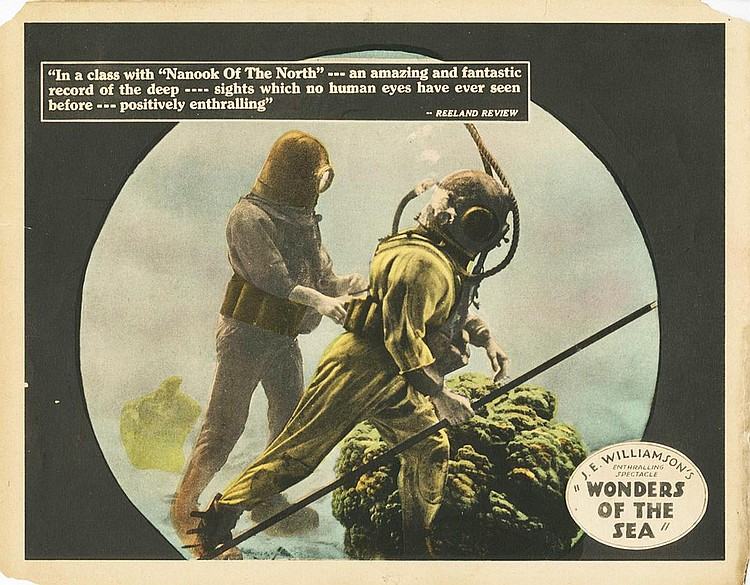
A definitive 6.8/10 rating for a film that redefined the boundaries of cult cinema. Wonders of the Sea remains a cornerstone of transgressive art.
There are films you watch, and then there are films that drown you—slowly, blissfully—until your lungs remember ancestral gills. Wonders of the Sea belongs to the latter order. Conceived in 1922 by marine maverick J. Ernest Williamson, this hour-long phantasmagoria predates every nature documentary trope yet feels fresher than most 4K reef porn streaming on your smart-TV today. How? It achieves the rare alchemical trick of letting the ocean author its own spectacle while still confessing the bruises of human intrusion.
Before Cousteau’s Aqua-Lung or Beebe’s Bathysphere, Williamson’s photosphere—a conjoined steel bubble and rubberized tube—was the portal. The camera does not merely record; it performs. We see the torus welds being hammered by soot-faced riveters, sparks pirouetting like fireflies against the Brooklyn Navy Yard dusk. Intertitles, letter-pressed in a serif that smells of ink and salt, brag of "absolute imperviousness" while the image track betrays a trembling pressure gauge. That dialectic—hubris versus humility—becomes the film’s pulse. Every rivet is a stanza, every hiss of compressed air a caesura in an oceanic epic penned by ironmongers.
Silent-era cameras were cranky, literally: hand-cranked at sixteen frames per second, emulsion so insensitive that sunlight could be mortal. Williamson, ever tinkerer, sheathed his Bell & Howell in a copper coffin whose faceplate was a nine-inch disk of optically-flat glass scavenged from a battleship periscope. The result? Depth-of-field that kisses anemone tentacles while rendering abyssal water as a chiaroscuro gallery. Note the shot where Lulu McGrath—the film’s designated naiad—glides past a brain-coral the size of a cathedral rose window. Her limbs move at 8 fps, half the camera speed, so when projected she becomes aqueous: a human jelly haloed by strobe-lit plankton. It’s Man Ray meets Muybridge in a reefal darkroom.
Censors in 1922 fretted over ankles and knees; Williamson smuggled eroticism via epidermis and environment. McGrath’s silk two-piece, once white, turns diaphanous under 30 feet of turquoise, clinging to the delta of her hips like a second, unwilling skin. The octopus that sidles up—its suckers puckering along her forearm—reads as a tentacled paramour rather than threat. Watch the alternating montage: a close-up of the mollusk’s eye (an unblinking obsidian jewel) intercuts with McGrath’s dilated pupil. Suture those fragments and you get a proto-Lili pas-de-deux, only the partner sports three hearts and blue blood.
At 42 minutes, the moray sequence detonates. Richard Ross and Jack Gardner, in vulcanized canvas suits weighted with lead shoe buckles, descend to a canyon wall. A single nitrate flare paints the scene tangerine. The eel emerges—not the expected 4-foot juvenile but a six-foot matriarch, her mottled hide a living tapestry of umber and cadmium. Editor Asa Cassidy cross-cuts between the eel’s pharyngeal jaw snapping shut and Ross’s regulator spewing silvered bubbles—an Eisensteinian collision that converts biology into montage shock. Yet the film refuses villainy; an intertitle whispers: "She guards her nursery as we guard ours." In that moment Wonders of the Sea transcends the imperial gaze that mars contemporaries like Cheated Hearts or Diplomacy.
Original exhibitors often accompanied the reel with a Wurlitzer set to Debussy’s La Mer. I screened a 4K scan at home via a modern chamber ensemble: two hydrophones, a glass harmonica, and a contrabass bowed with a super-ball. The result uncorked a synesthetic frisson—every coral snap became a cymbal, every exhalation a basso profundo. Try it: the silence of the film is not absence but invitation. You supply the surf, the heartbeat, the faint metallic scrape of your own anxiety.
Yes, the film bears scars. The photosphere was funded by a consortium eager to harvest Bahamian sponge beds; one intertitle crows of "unimaginable riches" beneath the waves. Yet watch the finale: McGrath releases a captured angelfish, the camera tracking its vanishing tail into blue-on-blue infinity. The gesture is minute but insurgent, a whisper against the extractive ethos that powers narratives like Red Courage or Black Sheep. In 2024, as reefs bleach into calcium graveyards, Williamson’s footage operates as both elegy and evidence: a baseline against which we measure our planetary forfeiture.
The 2022 Underwater Film Archive restoration scanned the original 35mm nitrate at 8K, then submerged each frame in a digital bath of wet-gate solution to dissolve scratches. Grain management was forgone; the resultant shimmer mimics sunlight dapple rather than pixel noise. Most revelatory: the color grading team mapped the cyan dye degradation—once considered flaw—into a deliberate palette that oscillates between malachite and ultramarine. The moray scene now pulses with Day-Glo intensity, a psychedelic strata that would make Gaspar Noé blush.
Place Wonders of the Sea beside The Boomerang or The Long Trail and you gauge how radical its quietude is. Those westerns chase momentum; Williamson chases stillness. Or pit it against His Nibs, a meta-comedy whose reflexivity feels claustrophobic once you’ve breathed Williamson’s liquid vastness. Only Heimgekehrt, with its post-war aquatic symbolism, flirts with similar depths, yet its expressionist studio tanks appear as tubs beside the Atlantic.
When the bathysphere breaches the surface, water sheeting off its porthole like liquid mercury, the camera lingers on a ripple expanding outward. No closing intertitle moralizes; the film trusts the viewer to feel the ache of that ripple—how it keeps widening across a century, across every reef we have ever touched. I emerged from my screening salt-stung, throat raw, as if I had swallowed the sea. That is the Williamson pact: he gives you wonders, but invoices you with conscience. Pay up; the ocean is still tallying the tab.

IMDb —
1920
Community
Log in to comment.