DbcultAccessing Vault...
Cult Review
Senior Film Conservator
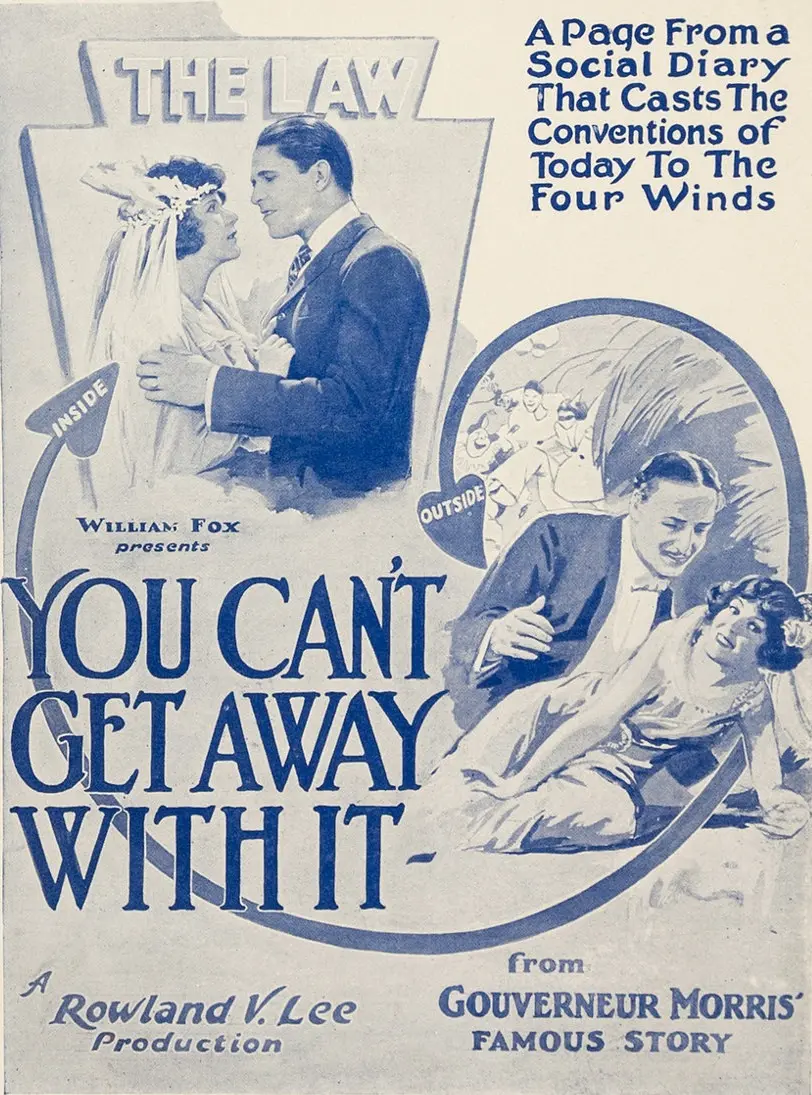
The 1923 silent era was a landscape defined by sharp contrasts, where the glitz of the burgeoning Jazz Age collided with the lingering Victorian moralities of the previous century. In the midst of this cultural friction, You Can't Get Away with It emerges not merely as a melodrama, but as a searing indictment of the economic structures that commodify female virtue. Directed with a steady, if somewhat somber, hand, the film navigates the treacherous waters of class stratification and the illusory nature of social mobility. It is a work that feels remarkably contemporary in its understanding of how the 'past' is never truly past, but rather a shadow that elongates as one attempts to run toward the light.
The narrative opens in the claustrophobic confines of a department store, a setting that functions as a microcosm for the capitalist machine. Jill Mackie, portrayed with a haunting vulnerability by Jewel Carmen, is the quintessential 'shopgirl'—a figure often romanticized in the literature of the time, but here presented with the grit of survival. Unlike the more whimsical urban escapades found in Torchy a la Carte, Jill’s reality is one of diminishing returns. Her labor is a transaction that barely secures her basic existence, making the eventual advances of the store’s owner, Charles Hemingway (Percy Marmont), less an act of seduction and more an inevitable gravitational shift.
Marmont’s Hemingway is a fascinating study in the 'gentlemanly' transgressor. He is not a villain in the traditional sense; he does not seek to ruin Jill, but rather to find a respite from the frigid domesticity of his own making. This dynamic is handled with more nuance than the typical moral plays of the era, such as The Eternal Law, where the lines between righteousness and sin are often drawn with a much thicker brush. In Hemingway’s world, the obstacle is not his conscience, but the legal and social machinery embodied by his wife, played with a terrifyingly stiff-necked resolve by Clarissa Selwynne.
When Mrs. Hemingway refuses the divorce, the film transitions into a subterranean exploration of the 'kept woman' status. The 'illicit alliance' formed between Jill and Charles is painted in shades of gray. There is a genuine tenderness here, a shared intimacy that stands in stark contrast to the performative morality of the public sphere. Yet, the film never allows the viewer to forget the fragility of Jill’s position. While Hemingway provides her with a sum of money and a comfortable life, he cannot provide her with the one thing that would ensure her safety: legitimacy. This theme of social entrapment echoes the narrative tensions found in Wedlock, though here the focus is less on the legalities of the union and more on the psychological toll of its absence.
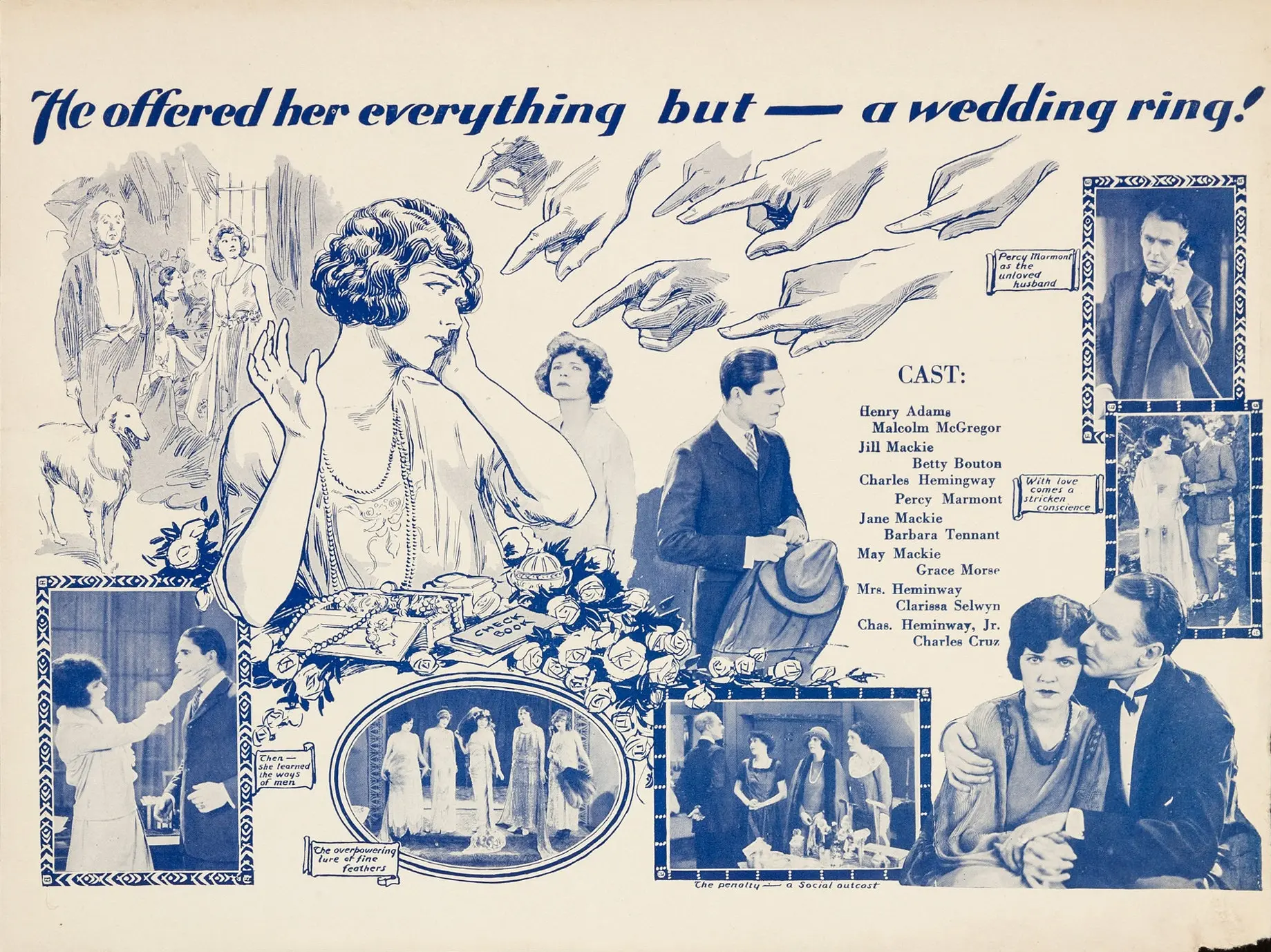
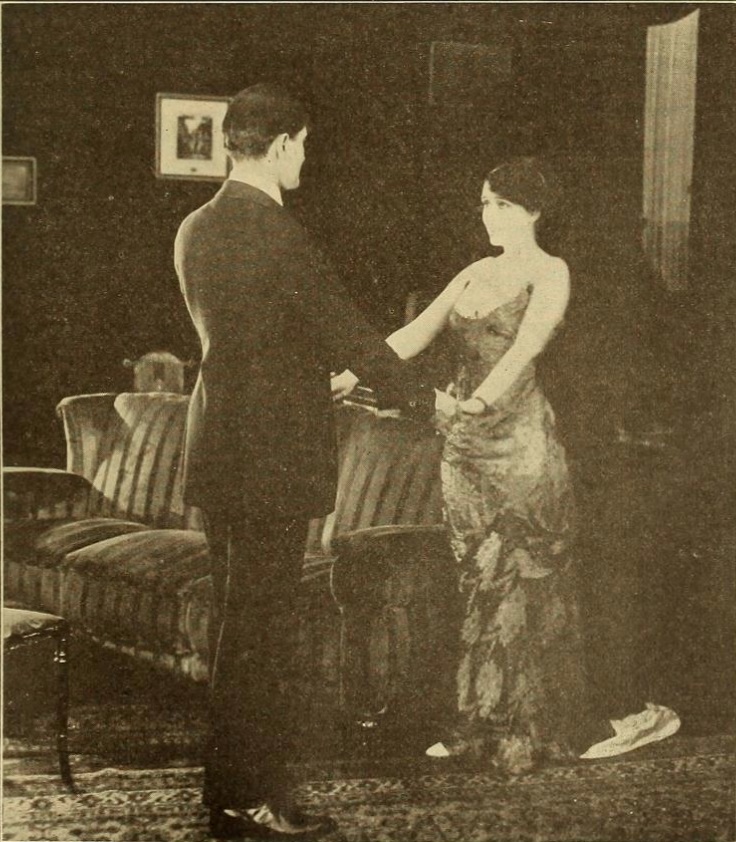
The cinematography during these middle acts is particularly noteworthy. The use of shadow and interior lighting creates a sense of a world shrinking. As Hemingway’s health begins to fail, the opulent rooms they share become a gilded cage. The death of Hemingway is not just a personal tragedy for Jill; it is a catastrophic economic event. In the silent era, the death of a benefactor was the ultimate plot device to reset a female character’s social standing, forcing her back into the wild.
Jill’s departure from the country marks a tonal shift in the film. She moves from the gritty realism of the American department store to a more ethereal, European setting. This is where Malcolm McGregor enters the fray as the young suitor. The romance that blossoms between them is initially presented as a chance for Jill to wash away her past, a trope frequently explored in films like Love's Pilgrimage to America. However, the writers—Robert N. Lee and Gouverneur Morris—subvert the expected happy ending with a cynical twist that feels ahead of its time.
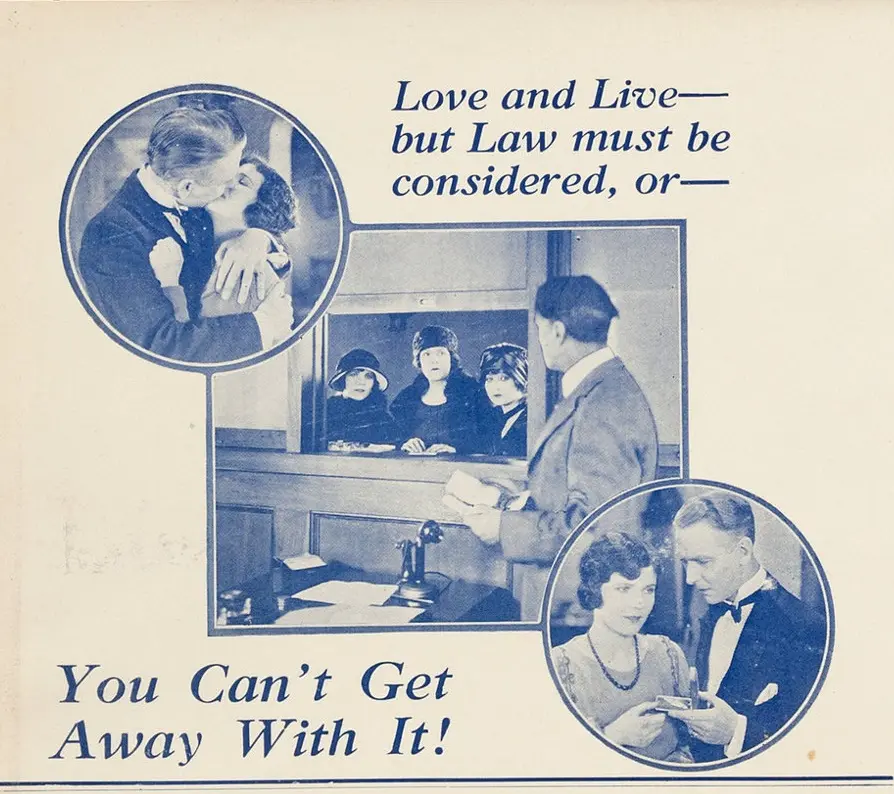
The moment of confession is the film's emotional zenith. Jill, believing in the transformative power of honesty, reveals her history to the young man. His reaction is a masterclass in the hypocrisy of the era. He does not reject her out of moral outrage; rather, he views her past as a precedent. If she was willing to be Hemingway’s mistress, why not his? This 'arrangement' proposal is the ultimate insult, as it suggests that once a woman has stepped outside the bounds of traditional morality, she is forever categorized as a commodity. This cynical view of human nature is far more biting than the pulpier elements of Kiss or Kill.
Visually, the film benefits from the sophisticated set designs that characterize high-budget 1920s dramas. The department store floor is a marvel of production design, capturing the scale and the impersonality of industrial commerce. When compared to the more experimental or localized visuals of Mariano Moreno y la revolución de Mayo, You Can't Get Away with It feels like a polished product of a studio system finding its footing in long-form narrative. The editing, particularly in the transition between Jill’s life of luxury and her eventual isolation, uses pacing to mirror her internal state—frantic and then suddenly, chillingly still.
The supporting cast, including Betty Bouton and Barbara Tennant, provide the necessary social texture. They represent the world that Jill has left behind and the world she can never truly rejoin. Their performances, while smaller in scope, contribute to the feeling of a society that is constantly watching, judging, and waiting for a slip. This sense of surveillance is something it shares with Cornered, though the stakes here are social rather than strictly criminal.
What makes this film stand out from other melodramas like My First Jury or the more lighthearted Hoot Mon! is its refusal to offer an easy out. The title itself is a grim promise. In the moral universe of 1923, a woman could not 'get away' with the transgression of her status, regardless of the purity of her heart or the desperation of her circumstances. The film operates as a tragic loop, where Jill’s attempt to find a new life only leads her back to the same proposition she thought she had escaped.
Consider the contrast with L'homme et la poupée, which deals with themes of control and artifice. In You Can't Get Away with It, Jill is not a doll being manipulated; she is a sentient being making impossible choices in a system designed to fail her. Even the title suggests a cosmic or social inevitability that is as inescapable as the plot of The Seven Pearls, though without the serial adventure’s sense of hope.
Jewel Carmen’s performance deserves a modern reappraisal. She avoids the histrionics common to the era, opting instead for a weary intelligence that makes Jill Mackie a deeply sympathetic protagonist. Her eyes convey the weight of every dollar earned and every secret kept. While the film may lack the whimsical charm of Balgaran e galant or the fantastical elements of The Magic Note, it possesses a gravity that anchors it in the canon of significant silent dramas. It is a film about the gravity of the past, the weight of the present, and the impossibility of a future that isn't built on the ruins of both.
Even when compared to international curiosities like Eine weisse unter Kannibalen, which uses exoticism to drive its narrative, You Can't Get Away with It finds its 'horror' in the familiar—the department store, the marriage bed, and the polite drawing room. It is a haunting reminder that the most dangerous traps are often the ones we walk into willingly, driven by the simple, human need to survive.
IMDb —
1918
Community
Log in to comment.