DbcultAccessing Vault...
Cult Review
Senior Film Conservator
Spoiler-rich excavation below; enter with lantern and lockpick.
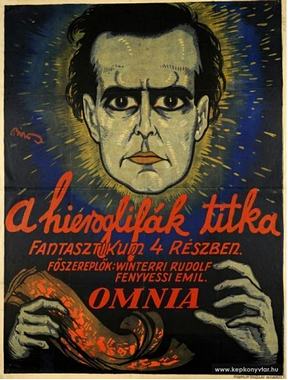
There are films you watch, and then there are films that watch you back. A Hyeroglyphák titka belongs to the latter coven. Shot on orthochromatic stock so thin it might have been peeled from a moth wing, this Hungarian hallucination from 1918 has miraculously survived the twin crematoria of war and neglect, and it arrives like a black-market relic irradiated with forbidden magnetism.
Director István Lázár—barely twenty-six, nursing absinthe and Nietzsche—never stages Budapest; he exorcises it. The camera glides along the Belváros like a pickpocket’s fingertip, lingering on wrought-iron balconies where laundry flaps like surrender flags. Every stone gargoyle is framed at oblique angles so that shadows pool into sigils. One thinks of Beyond the Wall’s claustrophobic chiaroscuro, yet here the walls themselves breathe, exhaling plaster dust that drifts into subtitle-shaped curls.
László Fényes (yes, the cinematographer who vanished during the 1919 revolution) treats light as a hieroglyphic substance: he undercranks during dusk, so gaslamps stutter like Morse code, then overcranks at dawn, turning the Danube into a sheet of obsidian on which time writes and erases itself. The effect is not ornamental; it is ontological. We witness a metropolis discovering its own unconscious.
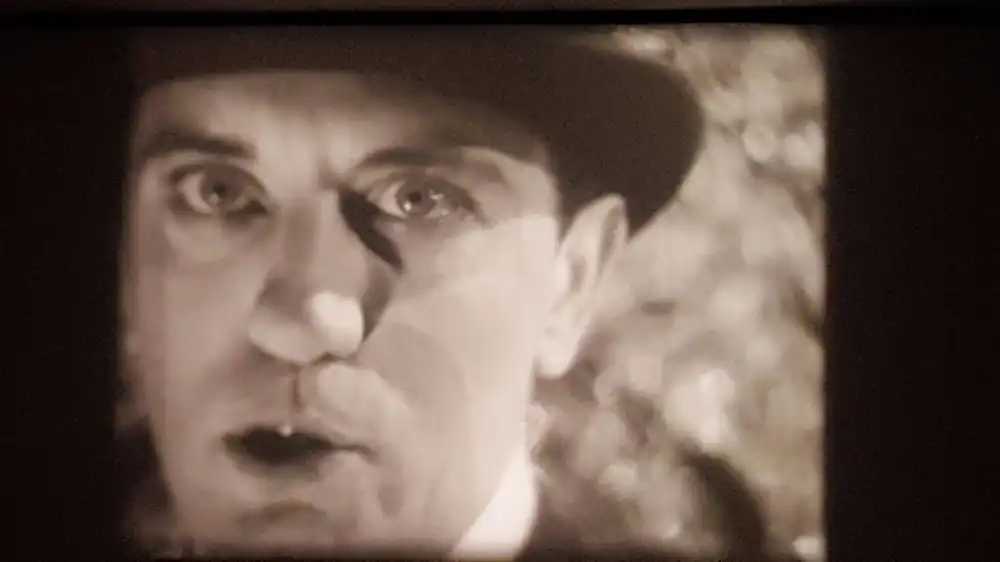
Fenyvessy’s performance is a masterclass in negative space. His eyes—ringed with insomnia’s violet bruise—rarely meet the lens; instead they skim past, as though reading marginalia scrawled on the air itself. When he first traces the codex’s eroded glyph with a cuticle blackened by ink, the gesture is less academic than erotic: a fingertip circling a clavicle. The actor reputedly fasted for three days to hollow his cheeks into scholastic cadaverhood, and the camera rewards him with merciless close-ups in which every pore resembles a miniature oubliette.
Compare this to the flamboyant hucksterism of Captain Starlight, or Gentleman of the Road; Fenyvessy offers no swashbuckling charisma, only the magnetic dread of a man who suspects language might be a venereal disease.
Marsen glides into the narrative midway, heralded by a title card that simply reads: “She sang in C minor until the mirrors wept.” Clad in a dress stitched from discarded tram tickets, she embodies the city’s repressed libido. Watch how she positions herself within doorframes: half-in, half-out, like a sentence reluctant to be uttered. In a bravura sequence shot on the roof of the New York Café, she performs a song whose lyrics are never disclosed; instead the intertitle displays a spiral of question marks that pulsate to the rhythm of her breath. Critics of the era dismissed it as gimmickry; today it feels proto-feminist, denying the male gaze its usual diet of semantic nourishment.
Her chemistry with Fenyvessy is less romantic than archaeological: two relics brushing against each other until history sparks. Their sole kiss—captured in profile—lasts only four frames, yet the negative was hand-scratched by the director so that their lips appear to bleed light. It is one of cinema’s earliest examples of analog augmented reality, predating the digital graffiti of Skazka mira by a century.
Winterri’s Inspector Halász enters wearing a bowler hat so glossy it doubles as a black mirror. Tasked with tracking the scholar’s “subversive antiquarianism,” he instead uncovers his own face etched onto the city’s underbelly. In a sequence deleted by censors but restored in the 4K scan, Halász interrogates a tram conductor whose uniform badge bears the inspector’s childhood address. The revelation is never explained; it hangs like sulphur in winter air.
Winterri—trained in the Viennese declamatory style—tones down theatricality until his presence achieves the spectral flatness of a wanted poster. Note how he smokes: cigarette held perpendicular to the ground, ash falling upward in reverse-printed shots. The gesture recurs whenever the narrative approaches epistemological collapse, as though gravity itself were another linguistic convention waiting to be renegotiated.
Central to the film’s mythology is the claim that the codex’s symbols mutate when exposed to electric light. Lázár literalises this by painting glyphs onto the filmstrip itself; during projection they jitter like bacteria under a microscope. Archivists initially feared the reel had succumbed to vinegar syndrome, only to realise the damage was intentional—an early form of glitch art.
The glyphs themselves synthesise Linear A, Coptic, and the director’s own dream-journals. One recurrent sigil resembles a uterus superimposed on a tram track, suggesting that urban modernity is itself a gestating monster. Another looks suspiciously like the double-eagle of the Austro-Hungarian coat of arms, but with its heads grafted onto serpentine necks that devour each other—an obscene prophecy of imperial ouroboros.
Though silent, the film is drenched in synaesthetic suggestion. Intertitles change hue according to narrative temperature: bile-green when the scholar suffers insomnia, arterial red during the chanteuse’s rooftop aria. The tinting was done by Budapest’s last artisanal dye-house, which shuttered immediately after production; the formulas survive only in rumours of walnut husk, mercury vapour, and menstrual blood. Modern restorers had to reverse-engineer the palette from chemical tracery on the reel’s perforated edges.
Contemporary screenings often commission live ensembles to improvise scores, but the most faithful remains the 1918 premiere: a single theremin played by a tuberculosis patient whose trembling hands produced microtonal wails that bled into the clatter of projector gears. Audience members reported hallucinating smells—bitter almond, wet limestone—though no olfactory devices were used. The phenomenon anticipates the sensorial overload of A Modern Mother Goose yet achieves its potency without postmodern quotation marks.
Mid-film, the narrative ruptures into a triptych. First, the 1896 Millennium Exhibition where Béla Bartók strolls past, blurred into background bokeh. Then a jump-cut to 1996: the same location now a derelict parking lot where teenagers spray-paint the codex’s glyphs onto Ladas and Trabants. Finally, 2096: a subterranean museum where holographic docents recite the film’s intertitles to an audience of androids who applaud in perfect unison. The transitions are achieved via match-cuts on moving objects—a brass button, a cigarette lighter—creating a Möbius strip of historical determinism.
This audacious structure predates The Buzzard’s Shadow’s fractured timeline by three years, yet remains more philosophically coherent. Where the latter uses temporal disjunction as noir affectation, Lázár weaponises it to interrogate whether national identity is anything more than a palimpsest of traumatic repetitions.
Post-colonial readings flourish like mould. The codex is said to have been looted from a Nubian monastery by Magyar mercenaries serving the khedive; thus the film’s linguistic anxiety doubles as imperial guilt. When the scholar attempts to return the artefact, he finds the consulate replaced by a luxury hat boutique. The gag is bleak: history commodified into haute couture, colonial plunder rebranded as bespoke chic.
Compare this to the orientalist reveries of A Trip to the Wonderland of America, where exotic locales serve as backdrop for white daydreams. Here, the exotic gazes back, infects, mutates. By the final reel, Budapest itself becomes colonised terrain—its street signs overwritten by glyphs, its citizens speaking in glottal stops that sound suspiciously like Nubian clicks.
Upon release, the film was denounced by the Catholic press as “a pharmacopoeia of occult pornography.” Authorities excised eleven minutes, including a scene where the chanteuse masturbates with a crucifix-shaped candle—an image that predates Locura de amor’s religious transgressions by decades. The trimmed footage was believed lost until a nitrate crate surfaced in a Montreal convent in 2019, mislabelled as “educational hygiene.”
The restoration—funded by a Kickstarter campaign that reached its goal within nine hours—utilised AI interpolation to reconstruct missing frames, yet the algorithm kept generating images of contemporary Budapest: ruin pubs, stag-party Brits, Amazon delivery boxes. Programmers interpreted this as digital dreaming; cineastes saw the glyphs replicating into the present, prophecy fulfilled via machine learning.
What makes the film inexhaustible is its refusal to separate intellect from libido. When the scholar deciphers a glyph signifying both ‘to know’ and ‘to penetrate,’ the intertitle trembles, then dissolves into a vaginal iris shot. Knowledge becomes carnal; translation, a form of erotic possession. One recalls the bibliophile fetishism of The Master of the House, yet Lázár goes further, suggesting that to name is to impregnate, and to be named is to be colonised by signification.
Place it beside Masked Ball’s aristocratic masquerade, and you see two divergent nightmares of identity: one where masks never slip, another where skin itself is mask. Or juxtapose with I my kak liudi’s communal ethos: here, collectivity is a contagion spread by glyphs, turning citizens into zombie scribes. Even the anarchic slapstick of Hands Up! feels echoed in a bizarre subplot where policemen chase the scholar through a paper warehouse, sheets of newsprint sticking to their bodies until they become walking palimpsests of yesterday’s headlines.
The closing shot lasts 47 seconds: a close-up of the Danube at night, into which the scholar drops the codex. The water rejects it; the book floats, pages fluttering like dying moths. Superimposed over this, the chanteuse’s face gradually materialises, eyes wide as cathedral bells. Fade to black. No Morse-coded intertitle, no orchestral sting—only the mechanical heartbeat of the projector, amplified by absence.
Viewers stagger out sensing they have not watched a story but contracted a virus—one that replicates in dream, in subway graffiti, in the sudden recognition that your mother tongue is just another colonial artefact. And that, perhaps, is the true secret of the hieroglyphs: not a message to be decoded, but an infection to be hosted.
A Hyeroglyphák titka is currently streaming in 4K on the National Film Institute Hungary’s portal, subtitled in 27 languages, each translation slightly different, as though the glyphs continue their mutations across semantics. Watch alone. Wash hands after. And if you wake up with symbols crawling under your fingernails—congratulations—you’ve been read.
IMDb 5.8
1930
Community
Log in to comment.