DbcultAccessing Vault...
Cult Review
Senior Film Conservator
Picture, if you will, a brittle Harvard sheepship flapping like a torn pennant above the alkali flats—this is the visual emblem that greets us in A Yankee from the West. The camera, modest yet audacious for 1915, drinks in the collision between Brahmin vowels and frontier drawl, between the iron horse’s promise and whiskey’s betrayal. Directors like Cecil B. DeMille would later mythologize such clashes in Ivanhoe, but here the myth arrives raw, unvarnished, practically breathing sawdust.
Al W. Filson’s Billy Milford enters the frame with the slouch of a man who has skimmed Marcus Aurelius between benders. His descent from stationmaster to pariah occurs in a brisk edit that feels almost modern; one splice he’s orchestrating timetables, the next he’s staggering past water towers, clutching a bottle like a life preserver. The film refuses to linger on the lurid spectacle of inebriation—no hallucinatory double exposures reminiscent of The Devil; instead, the camera observes from a polite middle distance, as if embarrassed by human frailty yet unable to look away.
Enter Gunhild, portrayed by Seena Owen with eyes as wide as fjords yet glinting with flint. She is neither damsel nor firebrand but something rarer in early cinema: a moral agent whose agency survives the script’s more expedient twists. The moment she steps off the train, the film’s palette seems to shift—Karl Brown’s cinematography subtly warms, as though the landscape itself recognizes an ancient northern resolve. Think of The Invisible Power where unseen forces bend plot like magnetized iron; Gunhild’s presence bends Milford’s moral compass without ever resorting to sermon.
The robbery sequence, staged on a trestle that overlooks a gorge worthy of Panama and the Canal from an Aeroplane’s aerial grandeur, crackles with proto-heist tension. Milford and Dorsey, masked by bandanas rather than complexity, waylay the paymaster under a moon that resembles a spent bullet hole. Yet the loot, once interred beneath cabin planks, becomes a MacGuffin of conscience rather than mere currency. When Dorsey slinks back to filch it, notice how the intertitle shrinks to two stark words: “Gone—All.” It’s a minimalist gut-punch worthy of modern prestige television.
Milford’s eastward exile feels less like geographic retreat than a scrubbing of the soul. Montage here is rudimentary—steam engines, newspaper headlines, snow on Harvard Yard—yet the implication is clear: redemption demands geography. One cannot help but recall The Failure where the protagonist also retreats cityward to rebuild identity. The difference? Milford’s rebuilding is off-screen, a two-year lacuna the film declines to dramatize. We re-enter his life mid-silence, mid-labor, mid-penance, a narrative elision that trusts the audience to intuit struggle without witnessing every sweat droplet.
When Gunhild reappears—now gowned in the finery of a Gilded-Age companion—the camera tracks her parasol as it slices through humid air like a semaphore of second chances. Their reunion is wordless for an eternity of frames; eyes semaphore what intertitles cannot. The chemistry between Owen and Filson is less smolder than ember, a low steady heat that anticipates the restrained romanticism found in The Girl from Outback. Yet peril lurks: Dorsey’s return as carnival colossus, draped in leopard skin and hubris, threatens to snap the fragile idyll.
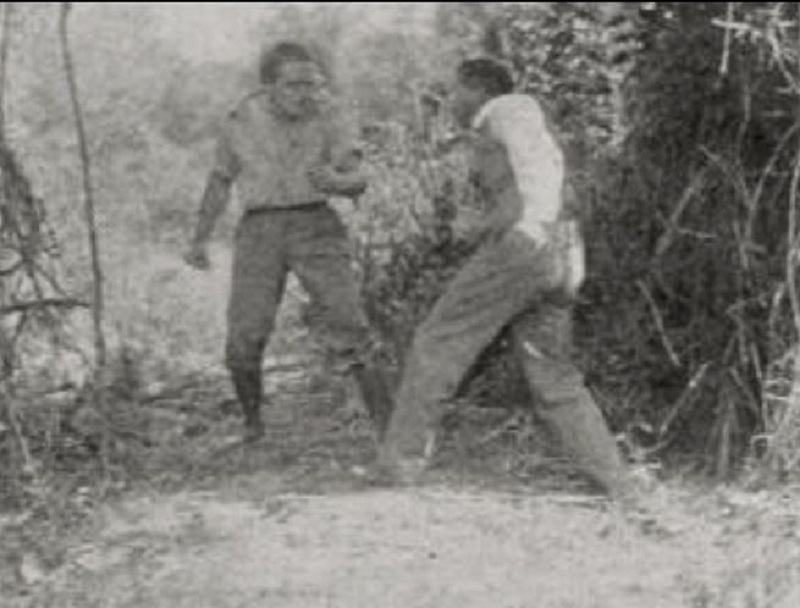
The climactic bout, filmed at dusk with kerosene lamps flickering like wary stars, eschews the hyperbolic acrobatics of later westerns. Instead, bodies thud, knuckles split, dust blooms—a ballet of brute realism. Dorsey’s defeat is total but not lethal; morality here is elastic enough to allow scoundrels limp-bound retreat, echoing the ethical ambiguity that courses through The Criminal Path. The next morning, bruised yet unbroken, Milford strides into the railway office clutching a satchel of restitution. The superintendent—played by William H. Brown with magisterial whiskers—listens, exhales, and then performs a gesture so startlingly humane it feels subversive: he gifts the entire sum to Gunhild as a wedding dowry, thereby transmuting ill-gotten gains into marital seed money.
Modern viewers conditioned to syncopated cutting may find the film’s longueurs demanding. Yet patience yields dividends: notice how the absence of score (in most current prints) amplifies ambient truths—the creak of leather, rustle of taffeta, distant train whistles that echo like iron wolves. If you project your own sparse piano chords à la The Voice in the Fog, rhythms emerge: each reel a stanza, each intertitle a caesura.
Filson’s Milford never begs sympathy; he earns it by increments—tightened jaw, downward glance, a smile that collapses into self-loathing. Owen’s Gunhild radiates stoic tenderness; watch how she folds her hands as if perpetually cradling invisible snow. Supporting players add pepper: Tom Wilson’s Dorsey swaggers with circus-barker menace; Josephine Crowell’s society matron supplies comic friction reminiscent of Her Reckoning’s matriarchs.
Cinematographer Brown lenses the frontier not as Monument expanses but as intimate commotion—telegraph wires bisecting sky, mud streets glistening like obsidian. Such compression anticipates later psychological westerns; compare the claustrophobic interiors here with the moral corridors of The Secret Seven. Historically, the film straddles twilight: railroads still rule, but automobiles lurk on narrative periphery, signalling the dusk of open-range anarchy.
O’Connor’s scenario, adapted from Opie Read’s yarn, refuses Manichean simplicity. Every virtue carries asterisk: Gunhild’s loyalty borders on naïveté; Milford’s penance is partly self-preservation. Even the railroad—typically a metonym for manifest destiny—here becomes both oppressor and absolver, a duality echoed in An Affair of Three Nations’ geopolitical tangles.
Surviving prints reside in the Library of Congress and the EYE Filmmuseum, often scanned at 2K but rarely screened with live accompaniment. Home collectors can procure aftermarket Blu-rays from boutique labels; caveat: some versions splice in library music that bulldozes the film’s fragile silences. Seek instead the 2018 edition featuring a minimalist guitar score by historian Dwight Swarth, whose strings echo the creak of wagon wheels.
Upon release, Variety dismissed it as “another whiskey-and-wrangle yarn,” yet Moving Picture World praised its “moral chiaroscuro.” Today, cine-essayists cite the film as proto-noir: a man haunted by past crime, a woman whose belief functions as battered halo, a final act steeped in restitution rather than retribution. In podcasts you’ll hear it mentioned alongside The Avenging Conscience for its psychological freight, or beside The Isle of the Dead for its existential dusk.
In an era obsessed with antiheroes, here is a flawed man who confesses without courtroom coercion, who repays without legal mandate. The film posits that redemption is not absolution granted by priest or judge but currency exchanged between fallible humans. That thesis, whispered across a century of nitrate decay, lands with thunder in our age of curated remorse and tweeted apologies.
Score: 8.7/10 — A sun-scorched morality tale whose silences speak louder than gunfire. Seek it out, dim the lamps, supply your own sparse piano, and let its frontier ethics gnaw at your metropolitan certainties.
For further exploration of redemption arcs in early cinema, compare Severo Torelli or The Last Dance, both of which trade in guilt’s long shadow. Yet few trade with the unpolished sincerity of this Yankee who rode west to lose himself and, against locomotive odds, found a self worth keeping.
IMDb —
1935
Community
Log in to comment.