DbcultAccessing Vault...
Cult Review
Senior Film Conservator
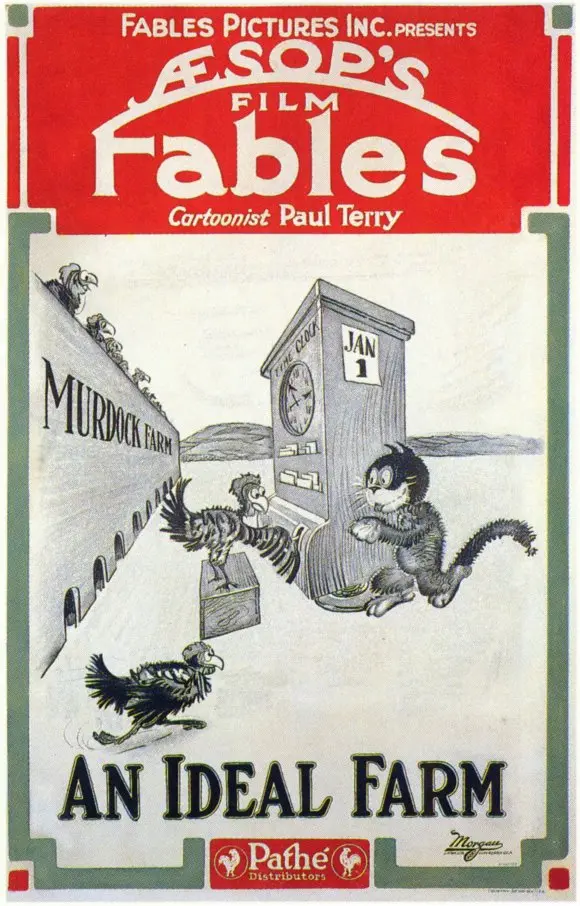
In the pantheon of early American animation, few names evoke the same sense of tireless productivity and foundational craft as Paul Terry. With An Ideal Farm, Terry didn't merely sketch a series of gags; he engineered a miniature universe where the laws of physics were secondary to the requirements of a punchline. To view this piece today is to witness the primordial soup of what would eventually become the global animation industry. It is a work that breathes with the curiosity of an era untethered from the rigid expectations of photorealism, opting instead for a fluid, expressive geometry that feels remarkably modern in its minimalism.
The aesthetic of the film is defined by its stark, high-contrast ink work—a necessity of the time, but also a stylistic choice that emphasizes the silhouette and the gesture. Unlike the heavy moralizing found in The Morals of Hilda, Terry’s work here is light, almost ephemeral, though it carries a distinct structural integrity. The 'ideal' nature of the farm in the title is not just a descriptor of the setting, but a manifesto for the medium itself. Animation, Terry suggests, is the ideal farm for the imagination, a place where ideas can be planted and harvested with a speed and absurdity that live-action cinema of 1920 could never hope to emulate.
Analyzing the visual language of An Ideal Farm requires an appreciation for the economy of motion. Every frame is a testament to Terry’s burgeoning 'Terrytoons' philosophy: keep it moving, keep it rhythmic, and keep it funny. The animals are not mere caricatures; they are cogs in a delightful machine. This mechanical harmony stands in stark contrast to the gritty realism or social drama found in contemporary works like A Factory Magdalen. Where the latter seeks to expose the harshness of labor, Terry seeks to celebrate the kinetic energy of it, turning the chores of the farm into a choreographed spectacle.
There is a certain 'rubber-hose' elasticity beginning to manifest here, a precursor to the style that would dominate the 1930s. The way the characters react to gravity—or lack thereof—suggests a filmmaker who understood that the true power of animation lies in its ability to defy the mundane. In this sense, the film shares a spiritual kinship with the grandiosity of Christus, though on a much more intimate and comedic scale. Both films, in their respective genres, strive to present a world that is 'more than'—more holy, more funny, more vivid than the one the audience occupies.
While An Ideal Farm lacks the dialogue-heavy exposition of a film like The Hidden Law, its narrative clarity is profound. The silent era demanded a mastery of visual storytelling, and Paul Terry was a virtuoso of the sight gag. The 'plot' is a series of escalating vignettes, each building upon the last to create a sense of frantic momentum. It avoids the melodramatic pitfalls of Tainted Money, opting instead for a purity of purpose. The stakes are low, but the engagement is high, driven by the sheer inventiveness of the gags.
Consider the way Terry handles the interaction between species. There is a democratic sense of chaos that mirrors the social upheavals of the post-war era, yet it is sanitized and repackaged as entertainment. This is not the heavy-handed patriotism of The Birth of Patriotism; it is a more subtle, perhaps more enduring, form of cultural reflection. It reflects the American obsession with efficiency and the burgeoning industrialization of the heartland, all through the lens of a dancing cow or a mischievous pig.
Technically, An Ideal Farm is a fascinating artifact. The registration of the cels, the consistency of the line weight, and the timing of the cycles show a studio that was rapidly refining its process. One can see the seeds of the 'Aesop’s Fables' series here, which would later become a staple of the movie-going experience. Unlike the theatrical grandiloquence of David Garrick, Terry’s work is unpretentious. It doesn't ask the audience to marvel at the actor's range; it asks them to marvel at the animator's audacity.
The film also serves as a counterpoint to the more somber 'wilderness' films of the era, such as Code of the Yukon. While those films focused on the brutal struggle against nature, Terry presents nature as a willing participant in the comedy. The farm is not a place of struggle but a playground. Even when things go wrong—as they inevitably do in a slapstick short—the consequences are as fleeting as a smudge on a celluloid sheet. This resilience is the core of the film's charm.
In the broader context of 1920s cinema, An Ideal Farm occupies a unique niche. It bridges the gap between the static illustrations of the late 19th century and the character-driven animation of the 1930s. It lacks the cynicism of A World of Folly, maintaining a naive optimism that is infectious. The 'ideal' farm is a world where everyone has a role, and even the errors are delightful. It is a vision of harmony that must have been incredibly appealing to an audience navigating the complexities of a rapidly changing world.
Furthermore, the film’s use of negative space is masterly. Terry understands that what is *not* drawn is often as important as what is. The white background serves as an infinite stage, a void that the characters populate with their frantic energy. This is a far cry from the dense, atmospheric sets of Sacred Silence or the alpine isolation of Der Rächer von Davos. In Terry’s world, there is no room for shadows; everything is illuminated by the bright, harsh light of the animator's desk.
Ultimately, An Ideal Farm is a celebration of the 'new.' It celebrates new technology, new ways of seeing, and new ways of laughing. It shares the redemptive spirit of The Reclamation, but instead of reclaiming land or character, it reclaims the joy of pure movement. It is a film that reminds us that before there were blockbusters, before there were complex narrative arcs, there was the simple, profound pleasure of seeing a drawing come to life.
Even its minor flaws—the occasional jitter in the background or a gag that feels slightly derivative of 'Twas Henry's Fault—only add to its historical charm. These are the marks of a medium finding its feet, the 'growing pains' of an art form that would eventually conquer the world. It is far more honest than the polished but empty spectacle of Fair But False, offering a raw, unfiltered look at the creative process of one of animation's true pioneers.
As we look back through the lens of a century, An Ideal Farm stands as a beacon of early 20th-century creativity. It is a reminder that even in the most restricted formats, genius can flourish. Paul Terry took a bottle of ink and a stack of paper and created a world that still vibrates with life today. It is a crucible of creativity, much like the thematic core of The Crucible of Life, where the heat of innovation forges something enduring. For anyone interested in the history of film, the evolution of humor, or the sheer joy of the moving image, this 'ideal farm' is a destination well worth visiting.
IMDb 6.8
1920
Community
Log in to comment.