DbcultAccessing Vault...
7.6/10
Senior Film Conservator
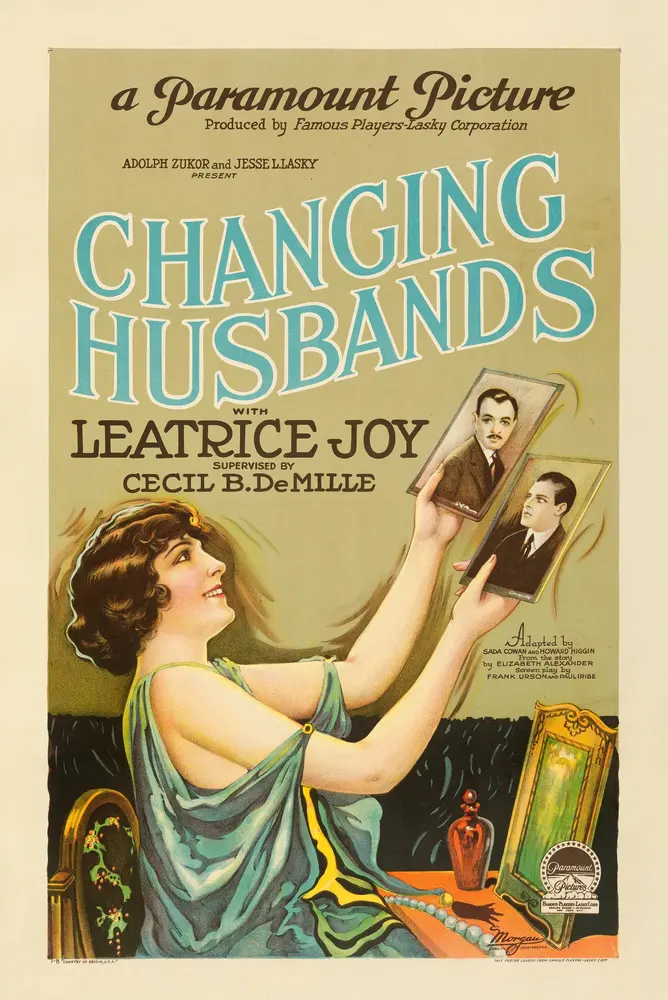
A definitive 7.6/10 rating for a film that redefined the boundaries of cult cinema. Changing Husbands remains a cornerstone of transgressive art.
The year 1924 stood as a threshold for American cinema, a moment where the crude mechanics of early film matured into a sophisticated language of visual metaphor and social critique. Changing Husbands emerges from this era not merely as a lighthearted farce, but as a trenchant examination of the 'New Woman' and the suffocating structures of post-Victorian marriage. Directed with a deft hand by Howard Higgin and Paul Iribe, and featuring a script by the formidable Elizabeth Alexander and Sada Cowan, the film captures a zeitgeist of restlessness. It eschews the heavy-handed moralizing often found in contemporary works like The Greatest Question, opting instead for a champagne-dry wit that feels surprisingly modern.
At the heart of this cinematic endeavor is the luminous Leatrice Joy, an actress whose range is tested and proven through the dual roles of Gwynne Evans and Ava Shore. Joy possesses a singular ability to alter her internal frequency; as Gwynne, she radiates a muted, simmering frustration, her eyes reflecting the dimming light of a woman whose aspirations are being systematically extinguished by the hearth. Conversely, as Ava, she exudes a kinetic, almost predatory vitality, the hallmark of a woman who has conquered the stage but finds herself weary of the spotlight's glare. This duality is not merely a gimmick of the plot but a profound commentary on the fragmented nature of female identity in the early 20th century.
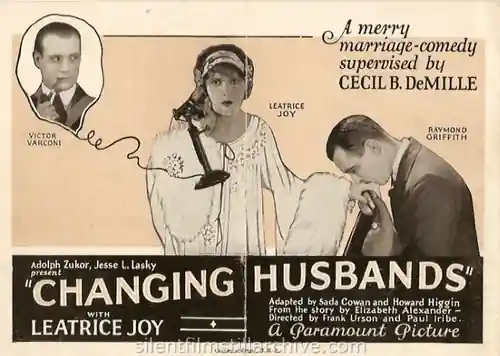
The premise of the doppelgänger has long haunted the corridors of literature and art, yet in Changing Husbands, it is utilized to dismantle the myth of the 'ideal' domestic life. When Gwynne and Ava decide to trade places, the film shifts from a study of ennui to a sophisticated comedy of errors. The transition is handled with a technical finesse that belies the era's limitations. The double-exposure shots, while primitive by today's standards, carry an ethereal quality that heightens the film's dreamlike subtext. We see the two women together, a visual manifestation of the road not taken, a theme also explored with varying degrees of success in films like Follow Me.
The male counterparts in this equation, played by Victor Varconi and Raymond Griffith, serve as the anchors for the film’s satirical edge. Varconi’s portrayal of the husband is a masterclass in oblivious patriarchal comfort. He does not see Gwynne as a person, but as a function of his own status. This stands in stark contrast to the more adventurous, albeit confused, romantic interests found in escapist fare like The Tents of Allah. Raymond Griffith, meanwhile, injects the proceedings with a dapper, almost surrealist humor. His presence ensures that the film never descends into the saccharine, maintaining a rhythmic levity that keeps the audience engaged in the absurdity of the swap.
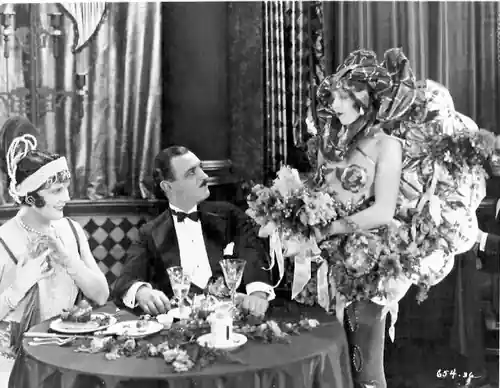
One cannot discuss Changing Husbands without acknowledging the visual opulence that was the hallmark of a Cecil B. DeMille production (through his associates). The set design is a character in its own right—the Evans' home is a labyrinth of shadows and expensive clutter, a stark contrast to the chaotic, brightly lit backstage of the theater. This visual dichotomy reinforces the film’s central conflict: the safety of the known versus the peril of the desired. Unlike the gritty realism of Britain's Bulwarks, No. 1: Women Munitioners of England, which focuses on the physical labor of women, this film focuses on their psychological labor—the effort required to maintain a persona that satisfies everyone but themselves.
The narrative rhythm is punctuated by intertitles that are sharp, economical, and occasionally devastating. H.M. Walker’s contribution to the titles cannot be overstated; they bridge the gap between the silent image and the spoken word with a literary flair. This linguistic precision helps elevate the film above the standard slapstick of the era, such as Beaches and Peaches or Casey at the Bat. There is a maturity here, an understanding that the most profound changes in life often happen in the quietest moments of realization.
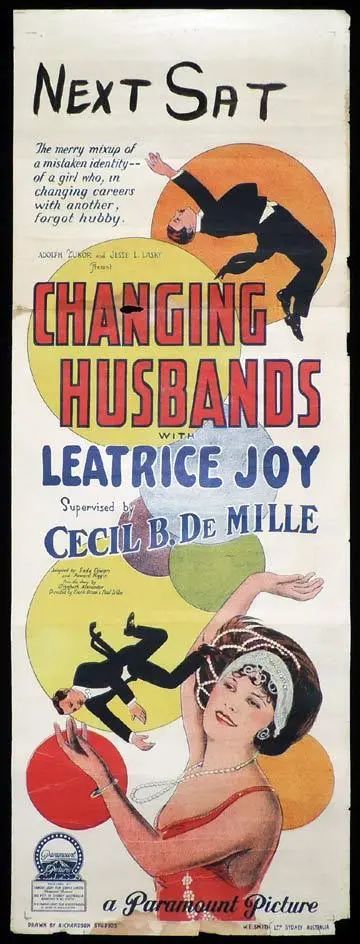
The film also navigates the treacherous waters of 1920s morality with a surprising amount of subversion. While the 'switch' is eventually resolved, the resolution is not a simple return to the status quo. Instead, the characters are fundamentally altered by their experiences. The film suggests that once the veil of domesticity is lifted, it can never be fully restored. This thematic boldness is reminiscent of the social critiques found in Gimme, where the financial and social independence of women is brought to the forefront. Changing Husbands argues that emotional independence is just as vital, and perhaps even more dangerous to the established order.
In the broader context of international cinema, the film’s focus on the upper-class domestic sphere can be compared to the stately dramas of Os Fidalgos da Casa Mourisca, though it lacks the latter's gothic weight. It is more aligned with the breezy, identity-focused comedies that would eventually evolve into the screwball genre of the 1930s. The pacing is brisk, avoiding the languid stretches that sometimes plague silent epics like Marc'Antonio e Cleopatra. Every scene serves the central thesis: that identity is a fluid construct, easily manipulated by a change of clothes or a shift in scenery.
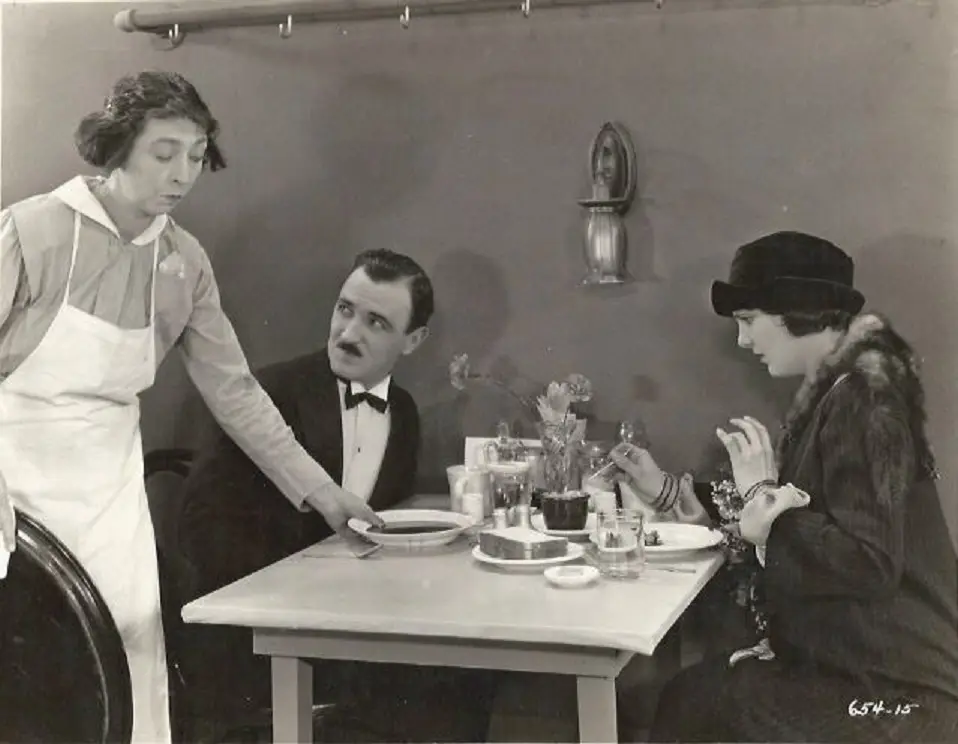
The supporting cast, including the inimitable Zasu Pitts and the rugged William Boyd, provide a rich tapestry of human eccentricity. Pitts, in particular, offers a performance that is both pathetic and hilarious, a precursor to the specialized comedic roles she would perfect in the sound era. Her presence adds a layer of vulnerability to the film, reminding the audience that while the main characters are playing a game of high-stakes role-reversal, there are real human emotions at risk. This grounding effect is essential, preventing the film from becoming a mere intellectual exercise in plot mechanics, a trap that even films like The Fourth Musketeer occasionally fall into.
Technically, the film is a testament to the artistry of the mid-20s. The lighting, often overlooked in comedies, is used here to delineate the two worlds. The theater scenes are bathed in a harsh, artificial glow that highlights the artifice of Ava’s life, while the Evans' home is often shot in deep chiaroscuro, suggesting the hidden depths and secrets of a seemingly perfect marriage. This visual storytelling is far more sophisticated than the flat, functional cinematography of Smiling Jim or the utilitarian framing of a low-budget thriller like 1,000 Reward.
The legacy of Changing Husbands lies in its refusal to offer easy answers. It presents a world where the 'happily ever after' is not a return to tradition, but a leap into the unknown. It mirrors the adventurous spirit of Johanna Enlists, where a woman takes control of her destiny in the face of societal upheaval. However, here the battlefield is the parlor and the stage, and the weapons are wit and wardrobe. It is a film that demands to be seen not just as a relic of a bygone era, but as a vibrant, breathing piece of art that continues to speak to the complexities of human desire.
As we analyze the contributions of Monte Collins, Guy Oliver, and Helen Dunbar, we see a cast that is perfectly attuned to the film’s specific frequency. They inhabit their roles with a naturalism that was becoming the new standard in Hollywood, moving away from the exaggerated gestures of the early silent period. This shift towards a more subtle, internal acting style allowed for the exploration of more complex themes, such as the existential dread of the housewife or the hollow triumph of the celebrity. It is this psychological depth that separates Changing Husbands from the more superficial 'flapper' films of the time.
In the final analysis, the film is a triumph of collaboration. The writers, directors, and performers worked in a rare harmony to create a piece that is as intellectually stimulating as it is aesthetically pleasing. It lacks the exoticism of Gypsy Love or the historical grandeur of Ashoka, but it possesses something far more rare: a genuine insight into the human condition. It reminds us that we are all, in some way, changing husbands—or changing lives—constantly seeking a version of ourselves that feels more authentic than the one we currently inhabit.
To watch Changing Husbands in the 21st century is to witness the birth of the modern romantic comedy. It is a film that understands the inherent theatricality of life, the way we perform our identities for an audience of one or a theater of thousands. It is a sparkling, sophisticated, and ultimately profound work that deserves its place in the pantheon of silent cinema, a mirror held up to the restless soul of the Jazz Age.
IMDb —
1926
Community
Log in to comment.