DbcultAccessing Vault...
7.4/10
Senior Film Conservator
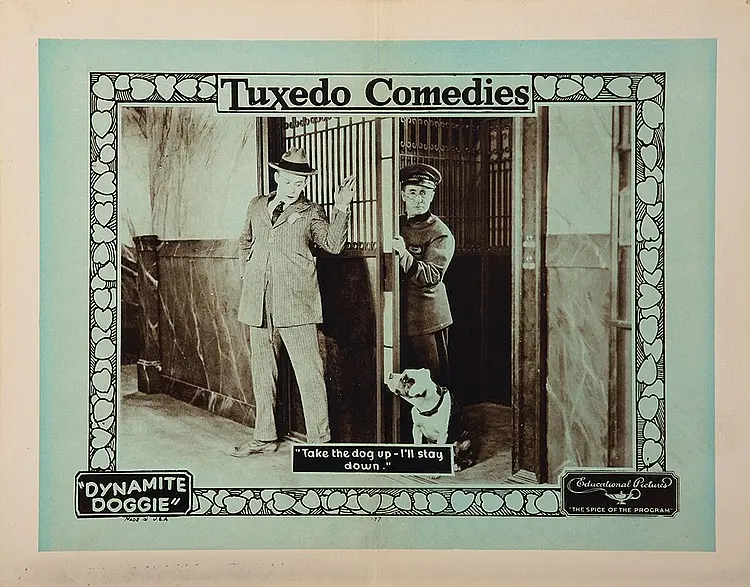
A definitive 7.4/10 rating for a film that redefined the boundaries of cult cinema. Dynamite Doggie remains a cornerstone of transgressive art.
Silent cinema, with its expressive pantomime and kinetic energy, often found its purest comedic form in the simplest of premises. "Dynamite Doggie," a delightful romp from 1924, is a sterling example of this principle, elevating a straightforward romantic dilemma into a symphony of escalating chaos. At its heart lies a universal human desire: the yearning for clandestine love, specifically an elopement, thwarted by an unexpected, four-legged antagonist. This isn't merely a film about a dog; it's a profound exploration of how the best-laid plans of mice and men—and eager lovers—can be utterly undone by a creature driven by instinctual, yet profoundly disruptive, loyalty. The film, penned by the seasoned comedic minds of Grover Jones and Roscoe 'Fatty' Arbuckle, demonstrates an impeccable understanding of visual storytelling and the mechanics of slapstick, cementing its place as a minor, yet significant, gem in the annals of silent film comedy.
The narrative, while slender, is robust enough to support a cascade of meticulously timed gags. Our protagonist, Al (portrayed with an endearing mix of exasperation and determination by Al St. John), is consumed by the passionate desire to whisk his girlfriend, played by the charming Doris Deane, away from the watchful eyes of her family and, more pertinently, her fiercely protective pet. This isn't just any pet; Pete, the titular 'Dynamite Doggie,' is less a docile companion and more a furry, four-legged sentinel of domesticity. His devotion to his mistress borders on the obsessive, and any perceived threat to her well-being or, indeed, her undivided attention, is met with an immediate, often destructive, response. The comedic tension arises from Al's increasingly desperate attempts to outmaneuver Pete, only for the dog's seemingly innocuous actions to trigger an avalanche of unintended consequences.
The comedic scaffolding of "Dynamite Doggie" owes much to the inventive minds of its writers, Grover Jones and Roscoe 'Fatty' Arbuckle. Arbuckle, a titan of early cinema whose personal travails tragically overshadowed his undeniable creative genius, possessed an unparalleled knack for crafting physical comedy that felt both spontaneous and intricately designed. Here, his influence is palpable in the escalating absurdity and the almost balletic precision of the pratfalls and chases. Jones, a prolific writer of the era, undoubtedly contributed to the narrative's structure, ensuring that each thwarted attempt by Al built upon the previous one, leading to a crescendo of comedic frustration. Their collaboration results in a screenplay that, despite its lack of spoken dialogue, speaks volumes through action, reaction, and the universal language of exasperation. The pacing is relentless, a hallmark of silent comedies, ensuring that the audience is swept along on a wave of laughter from one mishap to the next. This is storytelling through pure motion, a testament to the power of visual gags that transcends time and cultural barriers.
The brilliance lies in the writers' ability to turn the simplest premise into a complex comedic mechanism. Unlike the more introspective narratives of films like A Soul for Sale or the grander ambitions of The Great Gamble, "Dynamite Doggie" finds its profundity in the mundane made extraordinary. A dropped item, a misplaced object, a seemingly innocent wag of a tail – each becomes a catalyst for an elaborate chain reaction of comedic disaster. It's a masterclass in cause and effect, where the cause is invariably Pete's well-meaning interference and the effect is Al's mounting despair. The writers understood that the audience's investment in Al's romantic plight would amplify the humor derived from his repeated failures, making his eventual, inevitable defeat all the more satisfyingly hilarious.
Al St. John, a veteran of countless silent comedies, delivers a performance that is both physically demanding and emotionally resonant. He perfectly embodies the hapless suitor, his facial expressions shifting from hopeful anticipation to utter bewilderment, then to profound frustration, often within a single rapid-fire sequence of events. St. John's physical dexterity is on full display as he navigates obstacles, performs tumbles, and endures the indignities inflicted upon him by Pete. His contorted leaps and desperate dashes are not just gags; they are the physical manifestation of a man battling against an unseen, yet very tangible, force of nature. He is the ideal foil for Pete, his human vulnerability contrasting sharply with the dog's relentless, unthinking efficacy. In many ways, his performance here mirrors the escalating desperation seen in other silent film characters facing insurmountable odds, though perhaps with less existential dread than a film like Snowblind might evoke, and more akin to the spirited, albeit fruitless, endeavors of characters in early chase films.
St. John's comedic timing, honed over years of stage and screen work, is impeccable. He understands precisely when to pause for audience anticipation, when to accelerate into a full-blown chase, and when to simply react with a look of utter disbelief. This is not subtle comedy; it is broad, physical, and utterly captivating. His character, Al, is a relatable figure, an everyman whose romantic aspirations are repeatedly crushed by circumstances beyond his control. The audience empathizes with his plight, even as they delight in his misfortunes. This delicate balance of empathy and schadenfreude is crucial to the success of any great slapstick comedy, and St. John masters it with aplomb. His portrayal elevates Al from a mere caricature to a genuinely sympathetic, if perpetually unlucky, romantic lead.
While Al St. John and Pete dominate the screen, the supporting cast provides essential texture and reactions that amplify the comedic impact. Doris Deane, as Al's girlfriend, is charming and often oblivious to the true source of the chaos unfolding around her. Her innocent beauty provides the central motivation for Al's endeavors, making his struggles all the more poignant. John Sinclair, George Davis, and Walter C. Reed, along with Glen Cavender and Christine Francis, fill out the world of the film, often appearing as unwitting participants or bewildered observers of the escalating mayhem. Their reactions, ranging from mild surprise to outright panic, serve as a mirror for the audience's own amusement. In silent film, where dialogue is absent, the expressiveness of every actor, no matter how minor their role, is paramount. Each glance, each gesture, each hurried movement contributes to the overall narrative, painting a vivid picture of a world turned upside down by a very determined dog. The collective performances create a vibrant backdrop against which Al and Pete's comedic duel plays out, much like the bustling ensemble work found in other period pieces such as The Girl from Bohemia or East of Broadway, where the environment itself becomes a character.
And then there is Pete. The true star, the eponymous "Dynamite Doggie," is a marvel of animal acting and ingenious filmmaking. Directing animals in early cinema was a formidable challenge, requiring immense patience and often innovative techniques. Pete, however, seems to possess an almost preternatural understanding of his role, delivering performances that are at once spontaneous and perfectly integrated into the comedic flow. His actions are never malicious; they are simply the unwavering expression of canine loyalty, albeit taken to hilariously disruptive extremes. Whether he's chewing through a rope, barking at the most inopportune moment, or inadvertently tripping Al, Pete's contributions are the engine of the film's humor. He is the ultimate saboteur, a furry force of nature whose very presence guarantees the utter collapse of any well-meaning human endeavor. His comedic impact is perhaps even greater than the titular character in Alice and the Three Bears, as Pete's actions are central to the entire plot's progression, not just isolated gags.
The film cleverly exploits the unpredictability inherent in working with animals, turning potential obstacles into comedic gold. Pete's reactions feel genuine, adding a layer of authenticity to the fantastical premise. He is not merely a prop; he is an active participant, a character with agency, however instinctual. His relentless pursuit of Al, his determined guarding of his mistress, and his uncanny ability to be in precisely the wrong place at the wrong time are all masterfully orchestrated. The success of "Dynamite Doggie" hinges almost entirely on Pete's performance, and he delivers a memorable, scene-stealing turn that cements his place as one of silent cinema's most effective animal actors. The film celebrates the chaotic charm of pets, reminding us that sometimes, our most loyal companions can also be our greatest, albeit unintentional, tormentors.
"Dynamite Doggie" is a masterclass in the mechanics of silent film comedy. The film relies heavily on physical humor, chase sequences, and visual gags that require no dialogue to convey their intent. The escalating series of mishaps, from a simple trip to a full-blown demolition, is orchestrated with a precision that belies the apparent spontaneity. The use of exaggerated expressions, rapid cuts, and carefully choreographed movements creates a kinetic energy that is both exhilarating and hilarious. The beauty of this form of comedy lies in its universality; laughter is evoked not by witty repartee but by shared human experiences of frustration, surprise, and the sheer absurdity of life. The film's gags are timeless, resonating with audiences today just as they did a century ago, a testament to the enduring power of well-executed slapstick.
The film also subtly explores themes of love, loyalty, and the inherent chaos that can disrupt even the most carefully laid plans. Al's determination to elope is a classic romantic trope, but it is Pete's unwavering, if misguided, loyalty to his mistress that provides the dramatic and comedic friction. The film suggests that even the purest intentions can lead to pandemonium, and that sometimes, the most significant obstacles come in the most unexpected, and adorable, packages. It's a comedic exploration of the adage that love finds a way, but not without a significant amount of canine-induced tribulation. This narrative of thwarted plans and unforeseen complications resonates with the spirit of other films dealing with unexpected turns, such as Miscarried Plans, where the very title suggests a similar comedic vein of human endeavor meeting unforeseen resistance.
Released in the mid-1920s, "Dynamite Doggie" sits firmly within the golden age of silent comedy, a period characterized by remarkable innovation in filmmaking techniques and a burgeoning understanding of cinematic storytelling. Directors and performers of this era were constantly experimenting with how to convey emotion, action, and humor without the benefit of synchronized sound. The film's use of intertitles is sparse, relying instead on the visual performances and the kinetic energy of the chase sequences to drive the narrative forward. This reliance on visual cues demanded a higher degree of physical expressiveness from its actors and a more dynamic approach to camera work and editing. The result is a film that feels vibrant and alive, a testament to the creative ingenuity of its time. It stands in stark contrast to the more documentary-style approaches of films like Kino-Pravda No. 18, highlighting the diverse forms of cinematic expression flourishing concurrently.
The film's comedic style, while distinct, can be seen as part of a broader lineage of physical comedy that includes luminaries like Buster Keaton and Charlie Chaplin, though perhaps with a more pronounced emphasis on animal-induced chaos than their typical works. It also shares thematic ground with other films that explore domestic disruption, such as In the Night, where unforeseen events turn ordinary situations into comical fiascos. The simplicity of its premise allowed for maximum comedic mileage, proving that sometimes, less is indeed more when it comes to crafting enduring laughter. The film's ability to elicit genuine amusement through purely visual means is a powerful reminder of the fundamental strengths of cinema before the advent of sound transformed the medium forever.
"Dynamite Doggie" might not possess the grand narrative scope of a historical epic like The Kelly Gang or the dramatic weight of a social commentary piece such as The Reckless Sex. Yet, its charm is undeniable, and its comedic efficacy remains potent even a century later. It's a film that reminds us of the sheer joy that can be found in simple, well-executed slapstick. The interplay between Al St. John's exasperated suitor and Pete's relentlessly loyal, utterly chaotic canine is a comedic pairing for the ages. It's a testament to the power of a well-crafted gag, the brilliance of physical comedy, and the universal appeal of a story where human plans are hilariously undone by a creature driven by pure, unthinking instinct. For anyone seeking a dose of pure, unadulterated silent film fun, "Dynamite Doggie" is a delightful discovery, a barking good time that proves some comedic formulas are truly timeless.
The film serves as a vibrant historical document, preserving a style of humor that was foundational to the development of cinema. It showcases the talents of its cast and crew, particularly the underrated genius of Arbuckle's writing and the tireless efforts required to bring such kinetic energy to the screen. To watch "Dynamite Doggie" today is to be transported back to an era where laughter was a shared, communal experience, amplified by the absence of sound, relying solely on the power of visual storytelling. It's a reminder that sometimes, the most explosive entertainment comes in the smallest, furriest packages, leaving a trail of laughter and delightful destruction in its wake. It’s a film that, much like a tenacious terrier, refuses to be forgotten, continuing to charm and amuse with its indefatigable spirit and its wonderfully chaotic heart.

IMDb 6.3
1927
Community
Log in to comment.