DbcultAccessing Vault...
Cult Review
Senior Film Conservator
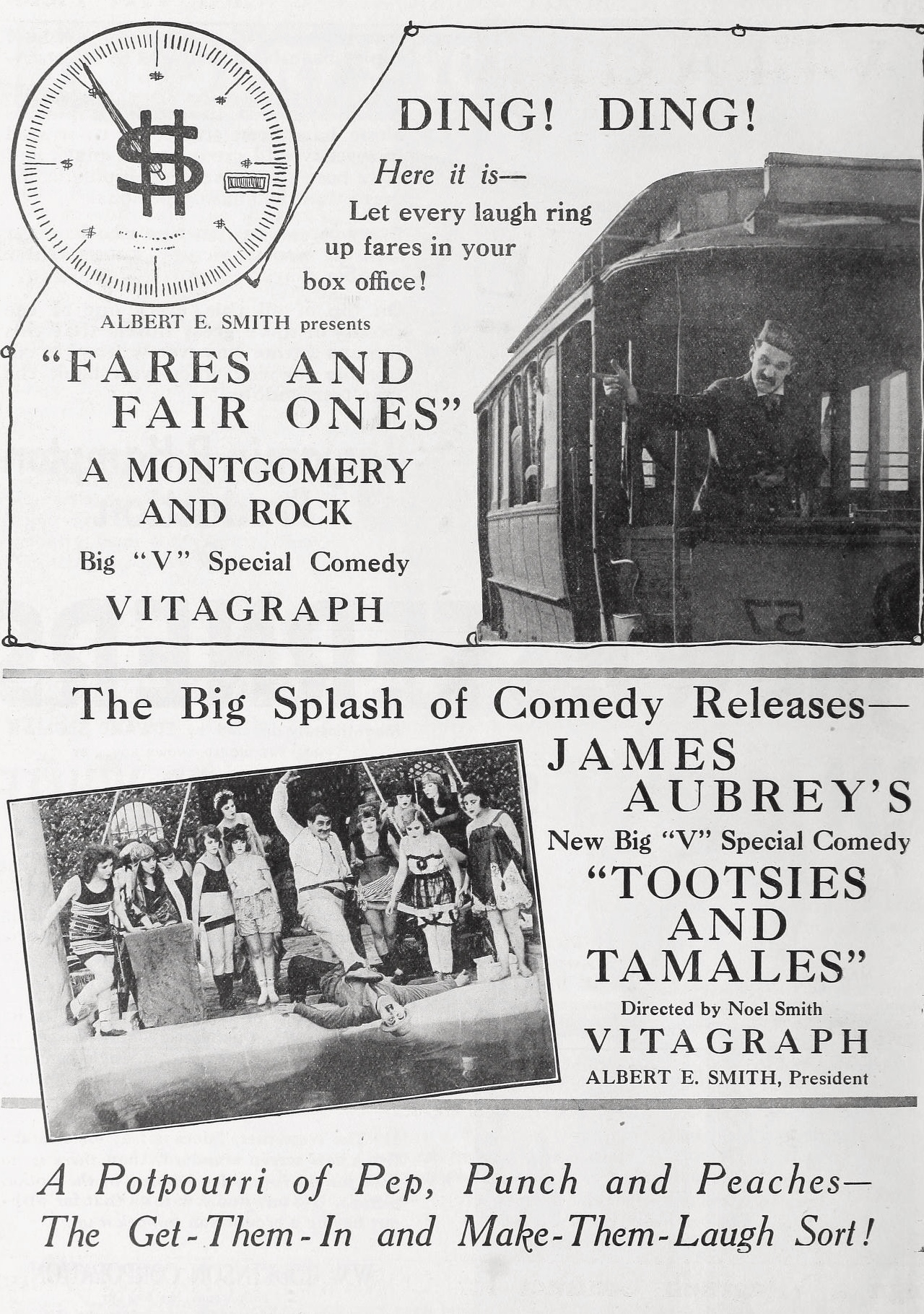
To gaze upon Fares and Fair Ones is to witness the frantic heartbeat of 1919 captured on celluloid. While the year was dominated by somber reflections like The Poppy Girl's Husband or the moral weight of The Miracle Man, Joe Rock and Earl Montgomery were busy engineering a different kind of miracle: the miracle of kinetic survival. This isn't merely a film; it is a historical artifact of pure, unadulterated velocity.
The narrative scaffolding of this Vitagraph short is deceptively simple, yet it supports a complex machinery of physical comedy. Rock and Montgomery, portraying a pair of taxi drivers whose professional ethics are as flexible as their joints, inhabit a world where the internal combustion engine is a temperamental beast. Unlike the brooding atmosphere found in Et Syndens Barn, the stakes here are measured in nickels and heartbeats. The 'Fair Ones' of the title represent the quintessential silent era ingenue—objects of desire who drive the plot forward by remaining perpetually out of reach, forcing our heroes into increasingly absurd feats of bravado.
What strikes the modern viewer most is the sheer density of action. In an era where A Falu rossza explored the pastoral and the tragic, Rock and Montgomery were obsessed with the urban and the frantic. The taxicab becomes more than a prop; it is a character, a rattling metallic extension of their own clumsiness. The way the camera captures the precariousness of 1919 traffic suggests a documentary-like urgency, even amidst the heightened reality of the slapstick genre.
Joe Rock, who would later become a prolific producer, showcases a gymnastic grace that is often overshadowed by the giants like Keaton or Lloyd. His timing is impeccable, a rhythmic counterpoint to Earl Montgomery’s more stoic, yet equally beleaguered, persona. Their chemistry is a precursor to the great comedy duos of the talkie era, but here, stripped of dialogue, their rapport is purely visual. They communicate through a shared language of shrugs, double-takes, and frantic escapes.
Comparing this to the heavy social commentary of Slave of Sin, one realizes that comedy in 1919 was a necessary release valve. While films like Nurse Cavell dealt with the harrowing echoes of the Great War, Fares and Fair Ones offered a vision of a world that could be conquered through resilience and a well-timed tumble. It is the optimism of the underdog, played out on the running boards of a Ford Model T.
Technically, the film is a testament to the ingenuity of the Vitagraph Company. The editing is surprisingly sharp for the period, maintaining a breathless pace that leaves little room for the languid introspection found in How Could You, Jean?. There is a specific texture to the cinematography—a high-contrast, sun-drenched clarity that makes the dust of the road feel tangible. The framing often utilizes deep space, allowing us to see the chaos unfolding in the background while the primary action dominates the foreground.
One must also consider the screenplay, co-written by the stars themselves. While it lacks the epic scale of Gance’s Napoleon (a later masterpiece, but relevant for its boundary-pushing nature), it masters the 'short-form' narrative. Every scene is a distillation of a single idea: the pursuit. Whether they are pursuing a wealthy passenger or a fleeting glance from a lady, the momentum never wavers. This singular focus is what makes the film so enduringly watchable; it doesn't get bogged down in the melodrama that sometimes plagued contemporaries like Lea or The Awakening of Bess Morton.
Underneath the laughter, there is a fascinating glimpse into post-war social dynamics. The taxicab drivers are the new proletarian heroes, navigating the shift from horse-drawn carriages to the mechanized future. We see the friction between classes—the 'Fair Ones' often belong to a world of leisure that the drivers can only glimpse through their rearview mirrors. This subtle class commentary is far less overt than in Bondwomen, yet it provides a necessary grounding for the absurdity.
In many ways, the film shares a spiritual DNA with Mountain Law or The White Scar—not in setting, but in the theme of the individual against a harsh, unforgiving environment. For Rock and Montgomery, the 'wilderness' is the city, and the 'law' is the demand of the meter. The ingenuity they display in overcoming obstacles—be they flat tires or rival drivers—is a comedic take on the rugged individualism that defined the era's dramas.
Why does Fares and Fair Ones matter today? In a digital age where comedy is often over-engineered and reliant on dialogue, there is something profoundly refreshing about the purity of this film. It reminds us that cinema, at its core, is the art of moving pictures. The film doesn't need a complex legal procedural like The Caillaux Case to hold our attention; it only needs a man, a car, and a precarious situation.
The 'Big Boy' comedies, as they were often known, represented a pinnacle of physical storytelling. When we look at the work of Joe Rock and Earl Montgomery, we see the blueprints for everything from Laurel and Hardy to the high-octane action comedies of the modern era. They understood that a fall is only funny if the character has dignity to lose, and in Fares and Fair Ones, our protagonists cling to their dignity with hilarious desperation, even as they are tossed from their vehicles or rebuffed by the objects of their affection.
Even when compared to the patriotic fervor of The Little Patriot, this film stands out for its universal appeal. Patriotism and tragedy are often tied to their specific historical moments, but the frustration of a stalled engine or the nervous butterflies of a first date are timeless. Rock and Montgomery tap into these universal anxieties and transform them into a source of communal joy.
In the grand tapestry of 1919 cinema, Fares and Fair Ones is a vibrant, neon-orange thread. It lacks the pretension of the 'Art Film' but possesses all the craft and soul of a masterpiece. It is a film that demands to be seen not as a relic, but as a living, breathing example of how to capture lightning in a bottle—or rather, how to capture a riot in a taxicab.
As the credits roll (or would have, in their original presentation), one is left with a sense of exhilaration. The film is a sprint, not a marathon. It respects the viewer's time by packing every frame with movement, expression, and wit. In the silent struggle between man and machine, between desire and reality, Joe Rock and Earl Montgomery emerge not as victors, but as survivors—and in the world of 1919, that was the greatest comedy of all.
This review is part of our 'Silent Giants' series, exploring the unsung heroes of the pre-talkie era. Stay tuned for more deep dives into the archives of Vitagraph and beyond.

IMDb —
1928
Community
Log in to comment.