DbcultAccessing Vault...
Cult Review
Senior Film Conservator
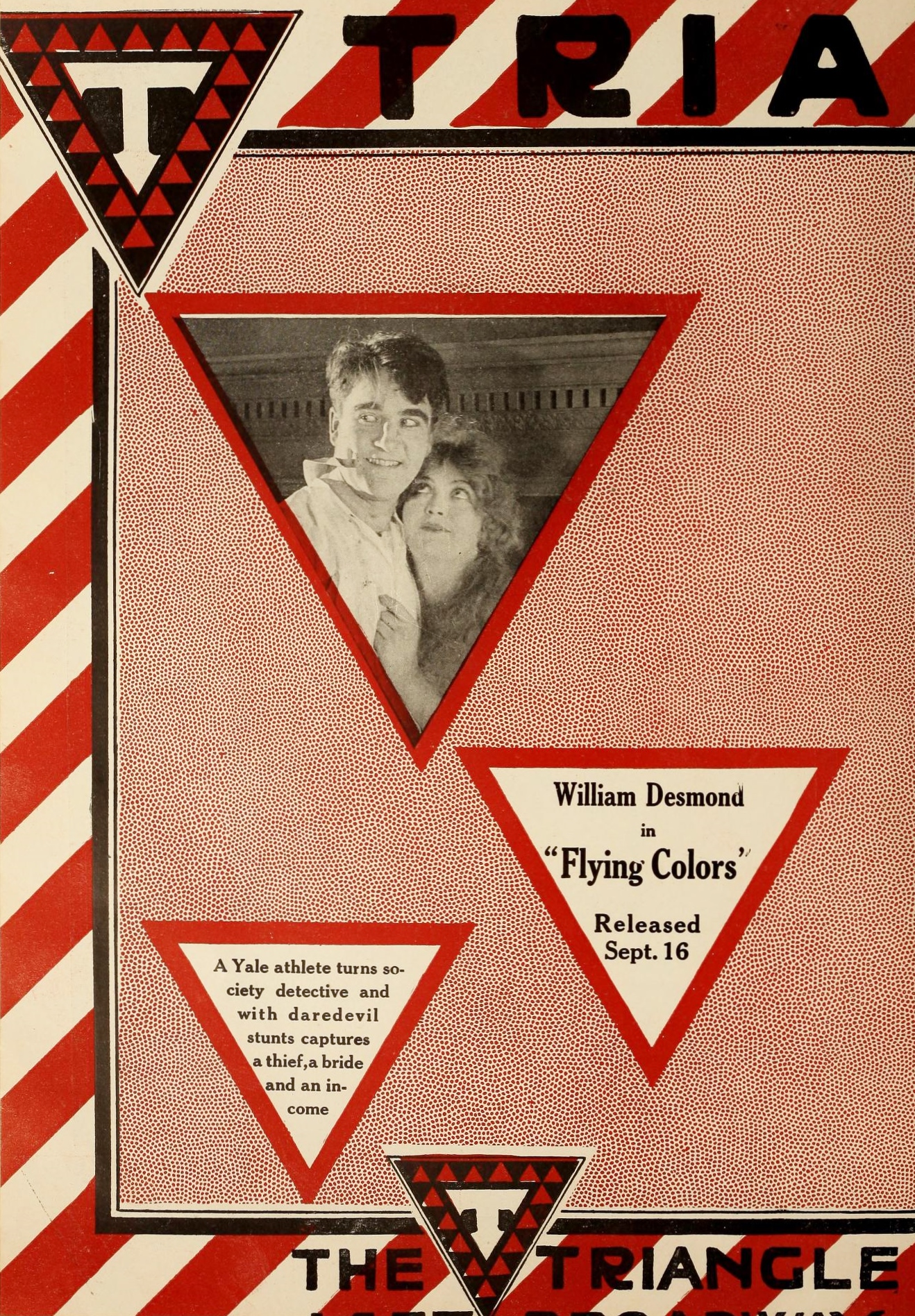
In the nascent years of American cinema, the synthesis of physical dynamism and moral rectitude found a peculiar avatar in the form of the "gentleman detective." Flying Colors (1917) stands as a quintessential artifact of this era, a film that leverages the visceral thrill of collegiate athleticism to navigate the treacherous waters of high-society scandal and grand larceny. Directed with a burgeoning sense of narrative economy, the film serves as a fascinating precursor to the more sophisticated noir sensibilities that would emerge decades later, yet it remains firmly rooted in the Edwardian ideals of honor and class mobility.
William Desmond portrays Brent Brewster not merely as a hero, but as a man out of time. His Yale pedigree, specifically his mastery of the pole vault, serves as a poignant metaphor for his social trajectory: he is capable of great heights, yet inevitably returns to the earth. The film’s opening act meticulously establishes Brewster’s inability to translate his physical grace into the vernacular of business. This disconnect between the meritocracy of the stadium and the ruthlessness of the boardroom is a theme echoed in The Key to Yesterday, where the protagonist must similarly navigate a world that no longer respects his previous identity.
When Brewster is cast out by his wealthy relatives, the film shifts gears from a social comedy into a proto-procedural. His entry into the detective agency is not framed as a descent into the gutter, but as an opportunity for reinvention. It is here that Flying Colors distinguishes itself from its contemporaries like The Narrow Path. While the latter often deals with the moral binary of right and wrong, Flying Colors suggests that the skills of the leisure class—athleticism, social grace, and an eye for quality—are the very tools required to police the excesses of that same class.
The middle act of the film is a masterclass in silent-era tension. The Lansing household in Poughkeepsie becomes a microcosm of early 20th-century anxieties. The jewel thefts are not merely crimes against property; they are violations of the sanctity of the domestic sphere. Brewster’s undercover operation allows the audience to witness the performative nature of the upper class. He recognizes Captain Drake (a deliciously sinister turn by the uncredited antagonist) not through forensic evidence, but through a shared social dialect. Drake is the dark reflection of Brewster: a man who uses his breeding to deceive rather than to protect.
This theme of the "gentleman thief" is a recurring motif in the period, often explored with more gothic undertones in films like A London Flat Mystery. However, in Flying Colors, the conflict is rendered with a brighter, more kinetic energy. The presence of Frank Borzage in the cast is particularly noteworthy. Before he became the visionary director of transcendental romances, Borzage was a formidable screen presence, and his contribution here adds a layer of dramatic weight to the ensemble.
Perhaps the most jarring element for a modern viewer is the transactional nature of the romance between Brewster and Ann (Mary McIvor). Ann’s declaration that she requires $40,000 a year to sustain her lifestyle is presented not as villainy, but as a pragmatic reality of her station. This financial hurdle provides the narrative with its secondary engine. Brewster isn't just solving a crime to catch a crook; he is solving it to secure a dowry. This blunt intersection of love and capital is a hallmark of the era, seen also in The Love Tyrant, where emotional bonds are frequently tested by fiscal constraints.
The character of Ruth Lansing provides the film's emotional pivot. Her flirtation with Drake, born of loneliness and the absence of her husband, threatens to shatter the family's reputation. Brewster’s decision to take the blame for her indiscretion is the ultimate act of self-sacrifice. It elevates him from a mere employee of a detective agency to a guardian of the social order. This sacrificial trope is a staple of silent melodrama, often used to bridge the gap between a character's flawed past and their heroic present, a technique utilized to great effect in The Manxman.
Everything in Flying Colors builds toward the climactic vault. It is a moment of pure cinematic joy and technical ingenuity. When Brewster seizes a clothes pole to launch himself through a window, the film transcends its melodramatic trappings and becomes a work of pure action. This sequence is not just a stunt; it is the resolution of Brewster’s character arc. The very skill that made him a failure in the eyes of his business-minded relatives becomes the instrument of his triumph. The use of practical athleticism over gadgetry or gunplay gives the film a visceral quality that remains impressive over a century later.
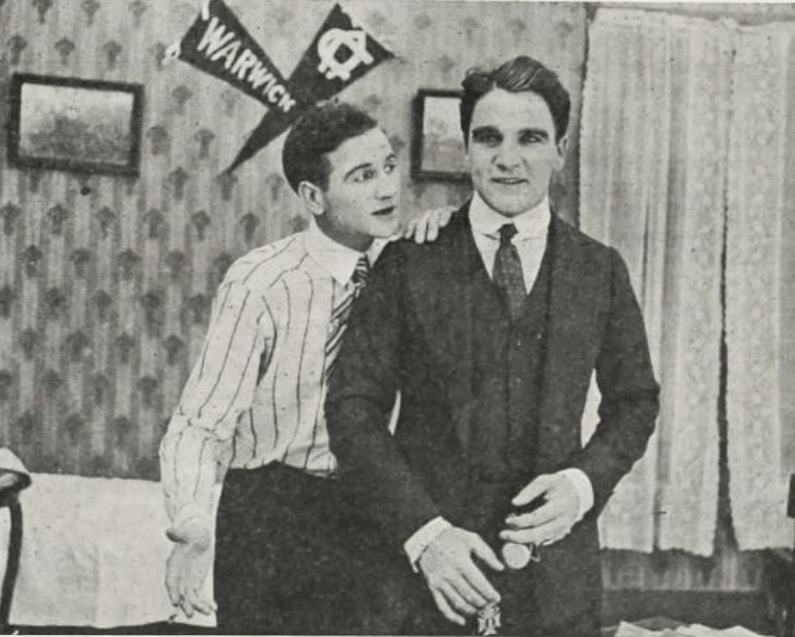
Comparing this climax to the more static resolutions of The Dragon or the stagey theatrics of The Lady of Lyons; or, Love and Pride, one can see the evolution of the film medium. Flying Colors understands that the camera loves movement. The vault is a rhythmic explosion that justifies the preceding sixty minutes of exposition.
While the cinematography of 1917 was often limited by the technology of the time, the framing in Flying Colors is surprisingly sophisticated. The use of deep focus during the party scenes allows the audience to track Brewster’s watchful eye even as the foreground is occupied by the frivolity of the guests. This creates a sense of voyeuristic tension similar to The Masked Motive, where the truth is often hidden in plain sight.
The lighting, particularly in the night scenes where Drake attempts his escape, utilizes stark contrasts that hint at the coming German Expressionist influence. The shadows in the Lansing estate aren't just lack of light; they are the hiding places for moral rot. The director’s ability to balance these darker visual elements with the bright, sun-drenched outdoor sequences of Brewster’s athletic past creates a compelling visual shorthand for the character's internal struggle.
To view Flying Colors today is to witness the birth of the American action hero. Before the swashbuckling of Douglas Fairbanks became the industry standard, William Desmond was providing a more grounded, yet equally impressive, version of physical heroism. The film also reflects the shifting social tides of pre-WWI America. The obsession with Yale, the rigid class structures, and the bluntness regarding wealth all speak to a society on the cusp of radical change. It lacks the political fervor of Revolución orozquista or the biographical gravitas of Florence Nightingale, but it captures the zeitgeist of the American upper class with uncanny accuracy.
The film's resolution—the inheritance—is often criticized as a lazy narrative device. However, within the context of 1917, it serves as a validation of Brewster’s character. In the logic of the silent melodrama, the inheritance is not a stroke of luck, but a divine reward for his integrity and his physical prowess. He has proven his worth through trial by fire (and by pole), and the universe responds in kind. This thematic resolution is far more satisfying than the tragic conclusions of films like The Eye of Envy or the ambiguous endings found in Ultus, the Man from the Dead.
Flying Colors is a testament to the durability of a well-told story. Despite its age, the film’s core conflict—the struggle to find one’s place in a world that values profit over personhood—remains strikingly relevant. William Desmond’s performance is a highlight, bringing a sense of earnestness to a role that could have easily devolved into caricature. The supporting cast, including the talented Mary McIvor, provides a solid foundation for the film's more extravagant moments.
For scholars of silent cinema, the film offers a rare look at the early work of writers R. Cecil Smith and John Lynch, whose ability to weave complex social dynamics into a brisk detective story is commendable. It may not have the haunting beauty of Doch isterzannoy Pol'shi or the intricate plotting of The Twin Triangle, but Flying Colors possesses a unique charm and a kinetic energy that is all its own. It is a film that reminds us that sometimes, to save the day, you have to reach back into your past and find the strength to jump.
Ultimately, Brewster’s journey from the Yale track field to the Lansing estate is a journey toward self-actualization. He enters the film as a man defined by what he cannot do, and leaves it as a man defined by the extraordinary things he can. In the world of Flying Colors, honor is the currency that matters most, even if it takes a forty-thousand-dollar inheritance to finally cash it in.
IMDb 5.3
1936
Community
Log in to comment.