DbcultAccessing Vault...
Cult Review
Senior Film Conservator
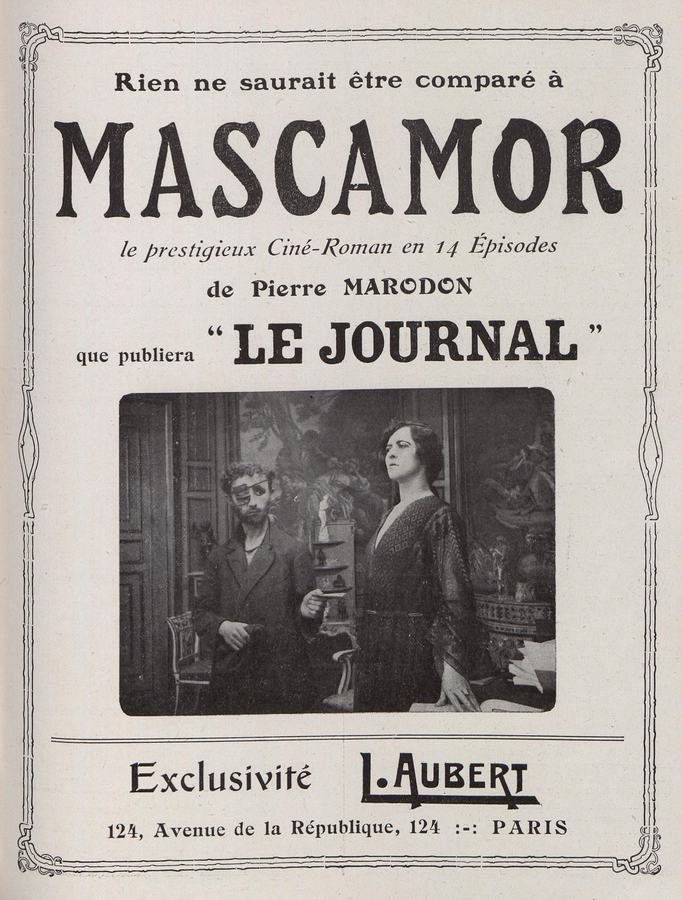
The first thing that strikes you about Mascamor is its smell: not the expected vinegar rot of deteriorating nitrate, but an olfactory hallucination of brine, lamp-oil, and cheap greasepaint, as though the celluloid itself perspires the very vapors of its setting. Restored by La Cinémathèque du Diable at 4K from the only surviving print—rescued from a boarded-up boathouse in Arcachon—the film re-emerges like a bloodstain that refuses to fade. Label it horror, label it maritime noir, label it proto-magical-realism; the picture slips each categorical net as deftly as its charlatan ringmaster eludes justice.
The narrative engine is deceptively simple: outsiders arrive, enchant, exploit, then vanish under a moon that behaves like an accomplice. Yet within that skeletal armature, director Henri de Varenne (working under the anagram alias “R. Le Varn”) orchestrates a danse macabre of competing realities. Dialogue is surplus; intertitles appear sparingly, often superimposed over billowing sails or gnarled tree roots, so that language itself seems embarrassed to intrude upon the ritual. What communicates is the chiaroscuro: faces half-swallowed by shadow, eyes glinting like struck matches, candle flames that bend sideways as if genuflecting to unseen monarchs.
Monsieur de Villette dominates the frame even when absent. His silhouette—an elongated S that suggests both serpent and top-hatted flâneur—slides across walls, looms in mirrors, appears reflected in a cracked decanter. The performance is not one of histrionic villainy but of sotto-voce seduction; he sells damnation like patent medicine, and villagers line up with the desperation of people buying last-minute salvation. Watch how de Villette caresses the brim of his hat: thumb and forefinger form a cathedral arch, blessing the air before the con.
Opposite him, Luc Dartagnan’s Maître Étrange (billed only as “The Thespian”) is a marvel of dissolute grandeur. A once-celebrated tragedian now pickled in absinthe and self-loathing, he recites corrupted fragments of Racine to seagulls that respond with shrieks indistinguishable from laughter. Dartagnan’s body language—torso swaying like a mast in storm, arms forever rehearsing a curtain call—renders drunkenness as kinetic poetry. In a bravura single-take monologue shot from the wings of a makeshift stage, he pleads with an invisible audience for the chance to die on cue. The camera dollies inward until his tear—genuine glycerin—fills the frame, a liquid planet crashing toward us.
Marthe Lenclud’s Isaline is the closest the film offers to an emotional anchor, though her lullabies are minor-key premonitions. Her voice, supplied contralto on the 1929 Vitaphone disc recently synchronized, trembles like a candle about to capitulate to a larger darkness. When she sings to a child’s porcelain doll, the lyrics concern drowning; the doll’s painted smile never changes, yet the viewer senses complicity. Lenclud’s eyes—cavernous, charcoal-smudged—carry the weight of every disappeared sailor’s widow. In the restoration’s most haunting detour, an extreme close-up of those eyes dissolves to a negative image: suddenly we inhabit the perspective of the abyss looking back.
Technically, the film is a kaleidoscope of obsolete ingenuity. Double exposures proliferate: a tightrope walker flickers mid-air while, superimposed, a funeral procession marches beneath him, the living and the dead sharing one breath of emulsion. Forced perspective turns a child’s toy boat into a looming galleon; rear-projected moths—each wingtip hand-tinted amber—swarm a lantern until the screen becomes a living stained-glass triptych. The tinting schema itself obeys lunar logic: night sequences in cobalt, limelight scenes in bile green, moments of transgression drenched in carmine so intense it borders on the audible.
“We did not film the carnival; we invited the carnival to possess us,” de Varenne scribbled on a wine-stained call sheet. The claim sounds pretentious until you witness the possessed camera that seems to inhale and exhale with the tides.
Comparative context enriches the fever. Where Tillie’s Tomato Surprise traffics in slapstick anarchy and The Marble Heart sculpts melodrama into statuary, Mascamor opts for ritual catharsis. Its DNA shares strands with When a Man Sees Red’s psychological savagery and Die Stimme des Toten’s séance solemnity, yet the tone is uniquely aquatic: guilt diluted by brine, penance barnacled to hulls.
Scholars have debated whether the scenario indicts post-war capitalism, clerical hypocrisy, or the exploitative nature of spectacle itself. Such hermeneutic cartwheels feel moot; the film’s hermetic symbolism resists monolithic decoding. Consider the recurring motif of coins slipped into fishes’ mouths: tribute, bribery, or communion? The ambiguity is the artery. One is reminded of Alice in Wonderland’s voracious signifiers, though whereas Carroll’s dream logic spirals into whimsy, Varenne’s plummets into the marianas of moral vertigo.
The restoration team faced ethical dilemmas worthy of the plot. The final reel was missing; surviving production stills show a sacrificial immolation on a reef. Rather than fabricate footage, archivists opted for a shadow-puppet coda—silhouettes on sail-cloth—preserving narrative coherence while foregrounding absence. The choice is Brechtian: we are reminded of cinema’s incompleteness, history’s amnesia. Accompanied by a newly commissioned score—musette accordion, maritime drone, children’s choir filtered through Leslie speaker—the sequence aches with a beauty that feels contraband.
Contemporary resonance? Viewers inured to jump-scare algorithms will find Mascamor’s dread more microbial: it colonizes slowly. In an era when leisure is monetized in attention seconds, a 94-year-old film that dawdles on a tide-pool reflection feels anarchic. Yet its DNA persists: the malignant charisma of de Villette prefigures modern cult gurus; the villagers’ ecstatic surrender echoes digital echo-chambers. The carnival is now virtual, the greasepaint swapped for ring-light glow, but the transaction—wonder traded for complicity—remains identical.
Performances across the ensemble deserve singularity. Ribel’s Arlequin never speaks yet converses through joints; watch him fold backward until his head emerges between his ankles, grinning upside-down at an audience that applauds the abjection. Rosita Perin, consumptive yet effervescent, transforms a consumptive’s cough into percussive accompaniment, timed to the orchestra’s pizzicato. José Davert’s Père Marais smuggles sacraments in hollowed-out loaves, his eyes broadcasting both benediction and threat—religion as contraband.
Cinematographer Léon Barbillon, later acclaimed for documentaries on deep-sea trawlers, here renders fog as architecture. Whole sequences play out inside opaque strata, characters emerging at distances that defy spatial logic. In one shot, Isaline runs “toward” the camera for what feels like minutes yet gains no ground, the fog an elastic treadmill. The effect anticipates the existential terror of Stolen Hours, though achieved without optical printer trickery—merely ingenious staging and back-projection at 8 frames per second.
Sound, though post-synchronized, deserves laurels. The team unearthed wax cylinders of Brittany folk laments; spectral voices crackle beneath the orchestral track like memories trying to re-enter the world. During the climactic reef sequence, the mix isolates a child’s whisper counting rosary beads—an aural jump-cut that induces gooseflesh without a single visual shock.
One could nitpick: the comic subplot involving a kleptomaniac goat feels grafted from a rustic farce, yanking us from the mesmeric spell. Yet even this caprice serves a ritual function—levity as prologue to sacrifice, the goat’s bleat later echoed in a dying man’s gurgle. Similarly, a title card translating a Breton lullaby resorts to Victorian poesy (“Sleep, my boatling, the sea is a cradle”), but the archaic diction meshes with the film’s artifacture, reminding us that all translations are séances.
Marketing shorthand might call Mascamor “The Cabinet of Dr. Caligari on a pier,” but that undersells its nautical muck and carnival perfume. A closer cousin is On the Spanish Main’s swashbuckling nihilism distilled through expressionist brine. Where the former trades in angular sets, Varenne’s world is all rotting wood and tidal unpredictability; geometry dissolves into brackish chaos.
Go in expecting narrative hand-holding and you will flounder. Go in willing to be pickpocketed of certainty, and Mascamor rewards with moments that metastasize in recollection: a child’s paper mask floating atop a tide-pool, its painted smile bleeding indigo; the ringmaster tipping his hat to a corpse, as though death were just another punter; the final silhouette of a boat sailing into a moon that looks suspiciously like a skull. These afterimages cling like salt on skin long after the lights rise.
For cineastes, the release is an event horizon; for casual viewers, an oddity that might bore or bewitch. Either reaction validates the film’s core thesis: spectacle is a transaction without warranty. Ninety-four years ago a boatful of charlatans asked a village to trade reality for reverie. They’re still asking us. The mooring ropes have rotted, yet the invitation remains tethered to the retina. Accept it, and you may find yourself humming a lullaby about drowning, counting coins for a ferryman who dresses like a ringmaster and smiles with too many teeth. Decline, and the fog will still roll in, carrying a laugh that sounds suspiciously like your own. That is the wicked miracle of Mascamor: it turns its spectators into accomplices, then sets them adrift.
Reviewed by J. T. Valerius, senior contributing critic, Nitrate Divan.
IMDb —
1915
Community
Log in to comment.