DbcultAccessing Vault...
Cult Review
Senior Film Conservator
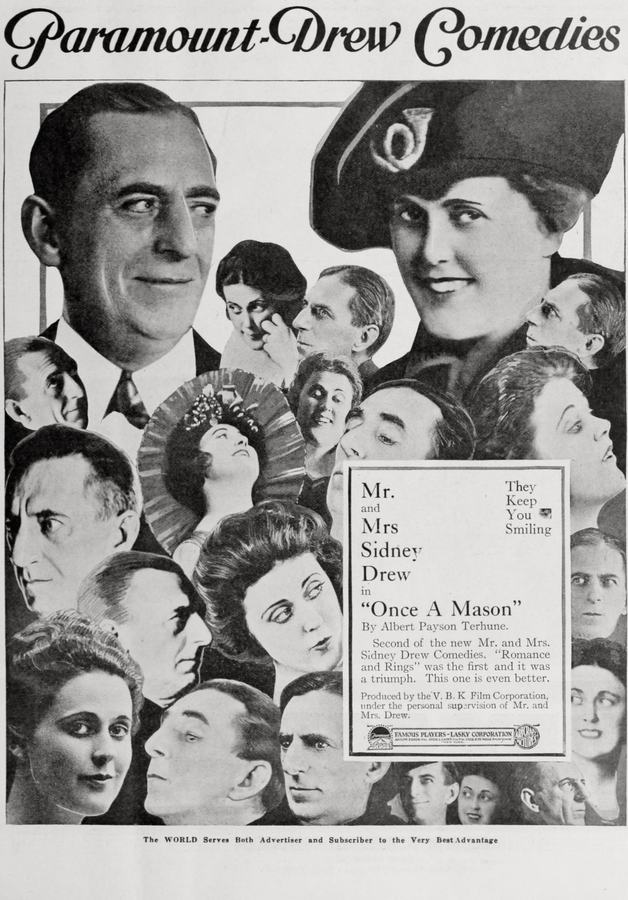
Step into the flickering glow of a bygone era, where the silver screen, still nascent and finding its voice, often served as a mirror to societal quirks and domestic foibles. In 1915, the comedic duo of Sidney and Mrs. Sidney Drew delivered a delightful slice of life, or rather, a slice of marital discord wrapped in fraternal mystery, with their short film, Once a Mason. This cinematic gem, a product of the early silent film industry, isn't merely a quaint relic; it’s a shrewd observation on trust, the porous nature of secrets, and the enduring battle of wills within the sanctum of matrimony. The Drews, celebrated for their nuanced portrayals of everyday predicaments, often infused their work with a gentle satire that resonated deeply with audiences of the time, and their touch here is no less deft, navigating the delicate balance between genuine affection and comedic exasperation.
Sidney Drew, a veteran of both stage and screen, alongside his wife, Mrs. Sidney Drew (Lucille McVey), carved a distinctive niche in early cinema. Their films, often characterized by their focus on the trivial yet profound dramas of married life, stood apart from the slapstick exuberance of contemporaries. Instead, the Drews specialized in a more understated, character-driven humor, drawing laughs from the relatable absurdities of human interaction. In Once a Mason, this signature style is perfectly encapsulated. Sidney Drew's Henry is a man caught between two worlds: the solemn camaraderie of his newly joined Masonic Lodge and the relentless, charmingly manipulative demands of his wife, Polly, brought to vivid life by Mrs. Sidney Drew. Their chemistry is palpable, a finely tuned dance of affection, exasperation, and compromise that feels remarkably authentic even a century later. This authenticity is what elevates their work beyond mere farce, imbuing it with a warmth that makes their characters enduringly sympathetic, even when they're at their most comically flawed.
The narrative thrust of Once a Mason begins with Henry’s recent initiation into a Masonic Lodge, an event that, in his eyes, confers upon him a newfound gravitas and membership in a venerable, secretive brotherhood. However, this solemn transition quickly collides with the domestic reality of his marriage to Polly. Her curiosity, far from benign, is a force of nature. She views his Masonic secrets not as sacred oaths but as personal affronts to their marital transparency, a breach of the unspoken covenant that no secrets should exist between husband and wife. Henry's initial resistance is admirable; he attempts to uphold the sanctity of his vow, explaining that he is simply not at liberty to reveal the Lodge’s mysteries. Yet, Polly’s insistence, framed within the emotional leverage of their shared life and his prior promises, proves irresistible. This dynamic, a classic battle of wills, is expertly played for both tension and comedic effect, laying the groundwork for the inevitable unraveling.
The pivotal moment arrives when Henry, worn down by Polly's unwavering demands, finally capitulates. In a scene brimming with both dramatic irony and tender absurdity, he confides in her the sacred word of his Lodge. But Polly’s thirst for knowledge extends beyond mere nomenclature; she desires a full, sensory experience of the initiation rites. Thus, Henry, under the strictures of a hastily extracted promise of absolute secrecy, proceeds to reenact the entire arcane ceremony for her benefit. We witness, through Polly’s eyes, Henry’s earnest, if slightly comical, re-enactment of the 'riding of the mythical goat,' the solemn gestures, and the mystic signs that define his new brotherhood. This sequence is a stroke of genius, transforming the hallowed and the arcane into something intimately domestic and inherently humorous. The humor derives not from mocking the Masons directly, but from the sheer incongruity of a sacred ritual being performed in a living room for an audience of one’s spouse. It speaks volumes about the early film industry's ability to create vivid imagery and narrative through performance and intertitles alone, much like the evocative storytelling found in The Prince Chap, which also relied on strong character portrayals to convey its emotional depth.
Polly's promise of secrecy, however, proves to be as fragile as spun sugar. The moment Henry has concluded his performance and extracted her renewed oath, her resolve crumbles. The temptation to share such juicy, forbidden knowledge is simply too great. She promptly confides in her neighbor, recounting Henry’s earnest re-enactment with perhaps a touch of embellishment. From there, like wildfire, the story spreads. The intimate details of Henry’s initiation, once shrouded in solemnity, become the stuff of public ridicule. The entire town, it seems, is soon privy to the 'secrets' of the Masons, guffawing at Henry’s 'holy revelations' and the supposed mystique of the Lodge. This rapid dissemination of gossip and its devastating impact on Henry’s reputation forms the core of the film’s comedic climax. The humor, here, is rooted in the universal experience of social embarrassment and the often-unintended consequences of our actions. It’s a poignant commentary on the power of the spoken word, especially when wielded by an unwitting or overzealous tongue, a theme subtly echoed in the social dynamics explored in films like A Girl Named Mary, where community perception often dictates personal fate.
The fallout for Henry is immediate and profound. On his return from a subsequent Lodge meeting, he is a man deflated, his pride wounded, his fraternal standing jeopardized. The Lodge, naturally, is not amused by the widespread mockery. Yet, in a testament to either their understanding or their pragmatic desire to maintain their own mystique, they offer Henry a lifeline. He is permitted to remain within the esteemed organization, but on one crucial, rather humiliating condition: Polly must publicly declare that the 'secrets' Henry had revealed were, in fact, nothing more than an elaborate joke. This resolution, while restoring Henry’s membership, shifts the burden of deception onto Polly, forcing her to participate in a public fabrication to mend the damage she inadvertently caused. It's a clever twist, highlighting the complexities of maintaining social decorum and the lengths to which individuals and institutions will go to preserve their perceived integrity. The film doesn't offer a clean, moralistic ending but rather a practical, if slightly cynical, solution to a very human problem, showcasing the nuanced character writing that sets the Drews apart from more one-dimensional comedic portrayals of the era, reminiscent of how Jane tackles the delicate dance of social appearances.
The direction in Once a Mason, while typical of its era, demonstrates a keen understanding of visual storytelling. Without the aid of spoken dialogue, the narrative relies heavily on expressive performances, clear staging, and well-placed intertitles. Sidney Drew, who also shared writing credits with Tom Bret, Albert Payson Terhune, and Mrs. Sidney Drew, likely had a significant hand in shaping the film's comedic rhythm. His portrayal of Henry is a masterclass in understated exasperation; his facial expressions and body language convey a man torn between duty and domestic peace, gradually succumbing to the inevitable. Mrs. Sidney Drew's Polly is equally compelling, her insistent curiosity evolving into a charming, if reckless, indiscretion. Her ability to convey both genuine affection and mischievous intent without uttering a single word is a testament to her skill as a silent film actress. The staging of the 're-enactment' scene, in particular, is a triumph of comedic timing, with Henry’s solemnity contrasting humorously with the domestic setting and Polly’s wide-eyed absorption. This meticulous attention to visual detail and character expression is a hallmark of effective silent cinema, allowing the audience to fully grasp the emotional beats and comedic nuances, much like the precise staging and visual gags that defined early comedies such as Jumbles and Jokers.
The film’s pacing is brisk, a common characteristic of early one-reelers, ensuring that the comedic premise is established, developed, and resolved efficiently. The use of close-ups, though sparse by modern standards, effectively draws attention to key emotional reactions, particularly Henry’s growing dismay and Polly’s mischievous delight. The intertitles are succinct and serve to advance the plot and highlight crucial dialogue, rather than merely narrating the action. This judicious use of text ensures that the visual storytelling remains paramount. The cinematography, while straightforward, is clear and allows the performances to shine, capturing the intimate scale of the domestic drama. The overall effect is a cohesive and engaging comedic experience that requires no translation across the decades. It’s a testament to the fact that compelling storytelling and nuanced performances transcend technological limitations, proving that the heart of cinema lies in its ability to connect with universal human experiences. One can draw parallels to the crisp storytelling found in mysteries like A Study in Scarlet, where every visual clue and textual hint contributes to the overarching narrative without superfluous detail.
Once a Mason, beneath its humorous veneer, delves into several perennial themes that continue to resonate today. At its core, it’s a film about trust – both within a marriage and within a fraternal organization. Henry’s trust in Polly is ultimately betrayed, leading to a public humiliation that threatens his standing in a community he clearly values. Polly’s initial insistence on transparency, while understandable from a certain marital perspective, ultimately undermines the very trust she claims to uphold. The film cleverly explores the tension between individual privacy and marital intimacy, questioning whether absolute transparency is always beneficial or even desirable. It suggests that some secrets, even those seemingly innocuous, might be better left unshared, particularly when they involve external allegiances and oaths.
Furthermore, the film offers a subtle commentary on gender roles in the early 20th century. Polly’s relentless curiosity and her subsequent inability to keep a secret could be interpreted as a playful, yet pointed, critique of prevailing stereotypes about women’s garrulousness. However, it can also be seen as a woman asserting her right to knowledge and challenging male-dominated secret societies, even if her methods are a touch chaotic. Henry, on the other hand, embodies the male figure caught between his public and private lives, striving to maintain decorum and uphold his word in both spheres, a delicate balancing act that often leads to comedic friction. This exploration of domestic power dynamics and societal expectations is a recurring motif in the Drews’ work, distinguishing them from more purely escapist fare and providing a social mirror that remains surprisingly clear even after all these years. One might even draw a parallel to the struggles for personal agency and societal acceptance depicted in films like Bobbie of the Ballet, where characters navigate their roles within a specific social structure.
The film also touches upon the concept of reputation and the fragility of social standing. Henry’s humiliation is not just personal; it’s a public affront that requires a public retraction. The Lodge’s condition for his continued membership underscores the importance of maintaining appearances and the mystique of their organization. The 'joke' resolution, while pragmatic, highlights the performative aspect of social life, where truth can be bent or reinterpreted to preserve face and order. This interplay between private reality and public perception is a rich vein for comedy and social commentary, and the Drews mine it with considerable skill. The enduring popularity of their films suggests that these themes of marital trust, the allure of secrets, and the absurdity of social conventions are timeless, transcending the specific historical context of the Masonic Lodge to speak to universal human experiences. In an era when communication was rapidly evolving, the film subtly hints at the speed with which information, or misinformation, could travel through a community, much like the intricate social networks implicitly explored in dramas such as The Defeat of the City.
Over a century after its release, Once a Mason retains its gentle charm and comedic punch. It’s a testament to the enduring power of well-crafted characters and a relatable premise. The film doesn't rely on grand spectacle or intricate plots; instead, it finds its strength in the everyday, in the small battles and compromises that define married life. Sidney and Mrs. Sidney Drew’s performances are a masterclass in silent comedy, conveying a wealth of emotion and intent with subtle gestures and expressive faces. Their ability to make their characters both flawed and lovable is what truly makes this film, and indeed much of their oeuvre, stand the test of time. It offers a fascinating glimpse into the social mores of the early 20th century, particularly regarding gender roles and the perceived sanctity of fraternal organizations, while simultaneously delivering universal truths about human nature.
For enthusiasts of early cinema, Once a Mason is an essential watch, not just for its historical significance but for its sheer entertainment value. It reminds us that humor, at its best, often springs from the most human of dilemmas: the desire for connection clashing with the need for individual space, the allure of the forbidden versus the comfort of the familiar. The film’s quiet brilliance lies in its ability to elicit genuine laughter while also prompting a thoughtful reflection on the intricate dance of trust and transparency in our most intimate relationships. It’s a delightful journey back to a time when cinema was discovering its voice, proving that even without sound, a story well told can resonate across generations, much like the timeless human spirit captured in films such as Sunshine Dad or the dramatic tension of Body and Soul, which similarly explore fundamental aspects of the human condition.
IMDb 6.6
1928
Community
Log in to comment.