DbcultAccessing Vault...
5.8/10
Senior Film Conservator
A definitive 5.8/10 rating for a film that redefined the boundaries of cult cinema. Outwitting the Hun remains a cornerstone of transgressive art.
Cinema in 1918 was not merely an entertainment medium; it was a psychological crucible where the anxieties of a world at war were melted and recast into narrative forms. Outwitting the Hun stands as a peculiar artifact of this era, a film that navigates the liminal space between domestic tranquility and the visceral horrors of the front line. By utilizing the framework of a child’s dream, the production bypasses the logistical constraints of depicting actual trench warfare, instead opting for a symbolic miniaturization that resonates with a haunting, uncanny energy. The presence of Giovanni Pastrone, a titan of early Italian epic cinema, lends the project a stylistic gravitas that elevates it beyond mere propaganda.
The film begins with a scene of quiet indoctrination. The father, a figure of patriarchal authority and a conduit for the state's martial ethos, regales his son with tales of the 'clash of arms.' This is not merely storytelling; it is the transmission of a cultural legacy. Unlike the overt melodrama found in Sin, which deals with moral decay on a more intimate, adult scale, this film focuses on the malleability of the youth. The boy's eventual descent into slumber acts as a cinematic bridge, a dissolve that transports the viewer from the tactile reality of the parlor to the fluid logic of the subconscious.
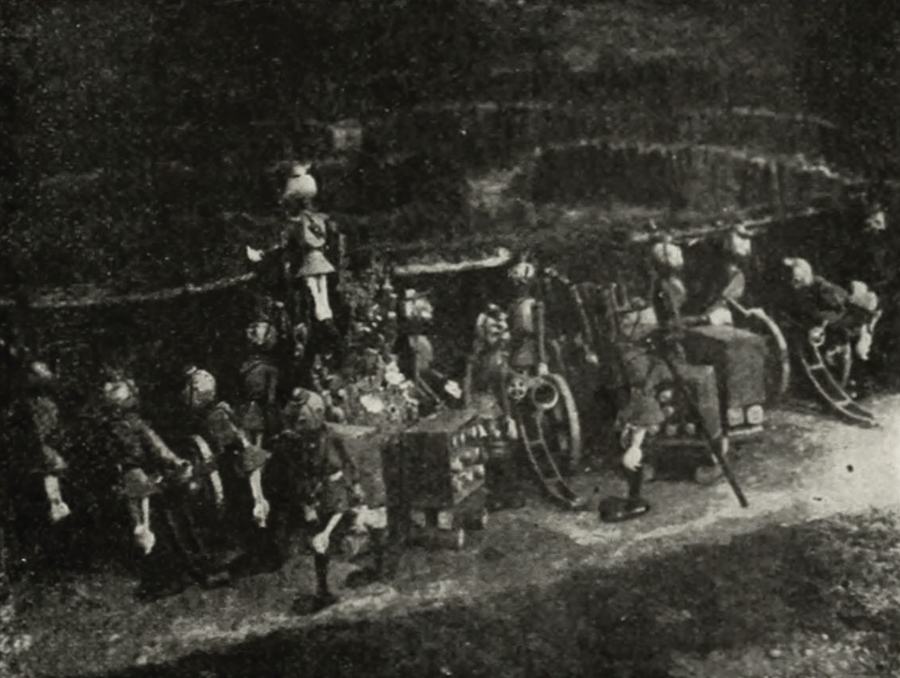
Once the dream sequence commences, the film sheds its terrestrial shackles. The toy soldiers, meticulously arranged, become the protagonists of a grand, silent opera. The technical execution here is fascinating, especially when contrasted with the more traditional narrative structures of contemporary works like The Straight Road. There is a rhythmic precision to the movement of the toy armies, a stop-motion-adjacent quality that imbues the plastic and wooden figures with a terrifying sense of agency. The 'Hun,' depicted through the lens of early 20th-century caricature, becomes an elemental force of chaos that must be systematically dismantled by the boy's disciplined playthings.
The visual composition utilizes deep shadows and sharp highlights, a chiaroscuro effect that mirrors the moral binaries of the time. While A Man There Was used the vastness of the sea to represent isolation and struggle, Outwitting the Hun uses the claustrophobic confines of the nursery to suggest that the war is everywhere—even in the sanctuaries of childhood. The battle sequences are not merely chaotic; they are choreographed with a geometric rigor that suggests the influence of Pastrone’s earlier obsession with grand-scale staging, albeit compressed into a microcosm.
To understand the unique positioning of this film, one must look at the cinematic landscape of the late 1910s. While films like Sylvia of the Secret Service leaned into the intrigue of espionage and the burgeoning 'New Woman' trope, Outwitting the Hun remains firmly rooted in the masculine tradition of the combat narrative. However, it subverts this by making the protagonist a child. This isn't the lighthearted escapism of Mister 44 or the theatrical whimsy of Stage Struck; it is a serious, almost somber reflection on the inevitability of conflict.
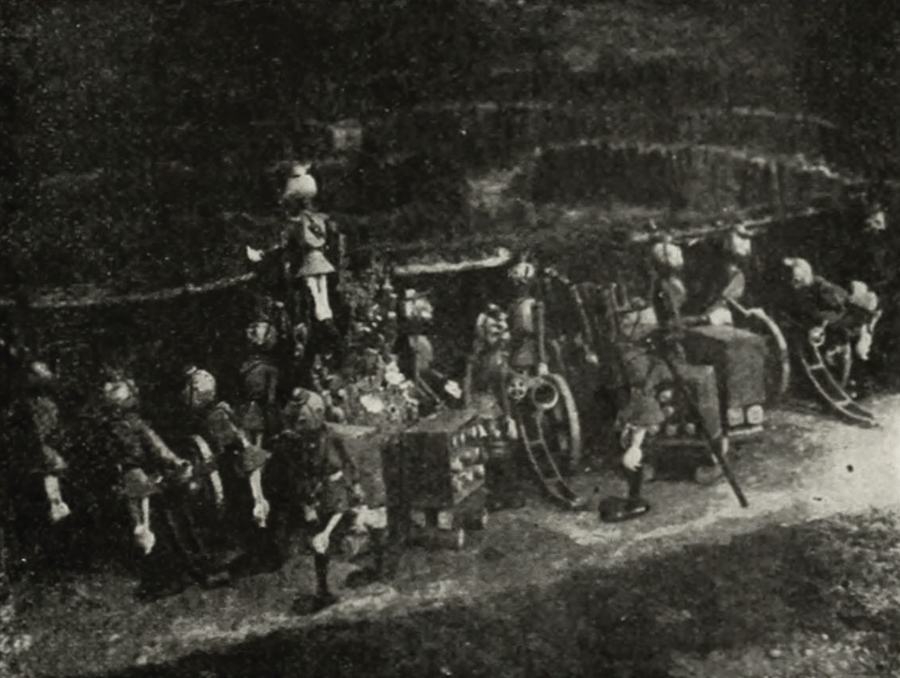
Furthermore, the film lacks the romanticized exoticism of Three Weeks or the rugged individualism of The Ne'er Do Well. Instead, it offers a collective vision of defense. The toy soldiers do not act as individuals; they act as a machine. This reflects the transition of society into a total war footing, where the individual is subsumed by the state. Even in the realm of the fantastic, the boy’s dream is governed by the rules of engagement he has learned from his father. This didacticism is far more subtle than the overt moralizing seen in The Test of Womanhood, yet it is arguably more effective because it taps into the primal imagery of play.
The depiction of the enemy in Outwitting the Hun is a masterclass in wartime semiotics. The 'Hun' is not a person but a specter, a collection of tropes and visual shorthand designed to elicit an immediate visceral response. This stands in stark contrast to the more nuanced character studies found in Die Tangokönigin or the diplomatic tensions explored in Die Prinzessin von Neutralien. In those European productions, the 'other' is often treated with a degree of sophistication or at least a recognition of shared humanity. Here, the enemy is reduced to a target in a shooting gallery, a necessary antagonist in the boy's psychological maturation.
This reductionism is central to the film's efficacy. By stripping the enemy of their humanity, the film justifies the boy's fascination with violence. The clash of arms is presented as a glorious necessity, a sentiment echoed in other contemporary works like In Treason's Grasp. Yet, the dream-logic allows for a level of abstraction that softens the blow. We are not watching men die; we are watching wood splinter and paint chip. This distancing effect is what makes the film palatable to a 1918 audience, providing a cathartic release for the pent-up anxieties of the home front.
As the boy wakes, the film concludes not with a resolution of the global conflict, but with a reinforcement of the domestic one. The dream has served its purpose: the child has been 'blooded' in the safety of his own mind. This theme of the psychological impact of war on those left behind is a recurring motif in silent cinema, though rarely handled with such imaginative flair. While The Woman Who Dared or The Boss of the Lazy Y focus on physical courage and externalized heroism, Outwitting the Hun posits that the most important battles are those fought in the imagination of the next generation.
The film’s legacy is found in its early adoption of fantasy as a tool for political commentary. It paved the way for future explorations of the child’s-eye view of war, a lineage that stretches from the silent era into the modern day. The use of miniatures and the surrealist pacing of the dream sequence remain impressive even by modern standards, showcasing a level of craft that transcends the film’s origins as a piece of wartime ephemera. Even when compared to the grit of Grafters, the stylized violence of the toy war feels remarkably potent.
In the final analysis, Outwitting the Hun is a testament to the power of the moving image to capture the intangible. It is a film about the stories we tell our children, and the ways those stories shape the world they eventually inherit. Through the lens of a boy's dream, we see the reflection of a world in agony, seeking solace in the structured, predictable victories of the nursery floor. It is a haunting, beautiful, and ultimately sobering piece of cinematic history that demands to be viewed not just as a relic, but as a profound exploration of the human condition under the shadow of total war.
IMDb —
1919
Community
Log in to comment.