DbcultAccessing Vault...
Cult Review
Senior Film Conservator
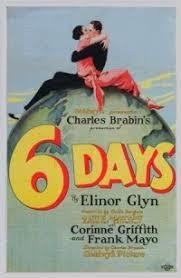
In the pantheon of silent era cinema, few names evoke the same sense of scandalous sophistication as Elinor Glyn. With Six Days (1923), Glyn, alongside the astute pen of Ouida Bergère, crafts a narrative that is as much a psychological interrogation as it is a romantic melodrama. The film, directed with a keen eye for spatial tension by Charles Brabin, transcends the typical 'thwarted lovers' trope by physically manifesting the internal pressures of its characters. Unlike the sprawling historical vistas of Christophe Colomb, Six Days opts for an agonizingly intimate canvas, utilizing the claustrophobia of a collapsed underground barrack to strip away the artifice of early 20th-century social mores.
Corinne Griffith, often hailed as the 'Orchid of the Screen,' delivers a performance of remarkable luminosity as Laline. Her portrayal avoids the histrionics common to the era, instead channeling a quiet, desperate resolve. Opposite her, Frank Mayo’s Dion provides a rugged, grounded counterpoint. Their chemistry is the film's heartbeat, a vital force that must contend with the suffocating weight of both literal tons of earth and the figurative weight of maternal expectation. The mother, played with a chilling, calculated elegance by Myrtle Stedman, represents the era's obsession with prestige—a theme similarly explored in contemporary works like What's Wrong with the Women?, though here the critique is sharpened by the life-and-death stakes of the entombment.
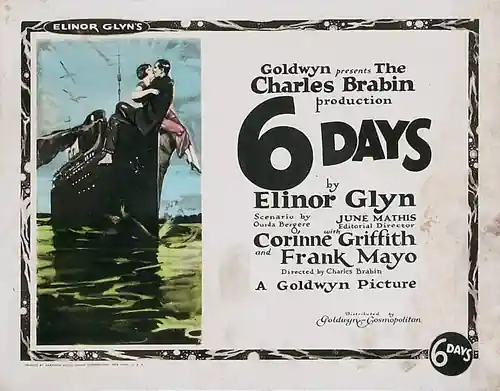
The visual language of Six Days is a masterclass in German Expressionist influence filtered through a Hollywood lens. The underground barracks are not merely a set; they are a character—a decaying, labyrinthine tomb that echoes the 'abandoned' lives of the protagonists. The lighting design utilizes stark contrasts, casting long, skeletal shadows that mimic the bars of a cage. This subterranean setting serves as a stark departure from the urban grit of Mysteries of London, focusing instead on the existential void created by isolation. The cinematography captures the dust motes dancing in the meager light, symbolizing the fragility of the human condition when removed from the oxygen of society.
The sequence of the cave-in remains one of the most visceral moments in 1920s cinema. The camera lingers on the crumbling mortar and the panicked eyes of the priest, played with a haunting gravity by Paul Cazeneuve. It is a moment of pure, unadulterated cinema that rivals the emotional wreckage found in The Havoc.

What elevates Six Days above a mere survival thriller is the inclusion of the priest. His presence transforms the barracks into a confessional. As the days tick by—marked by the dwindling of light and the sharpening of hunger—the secular concerns of wealth and status are replaced by a spiritual urgency. The film flirts with the metaphysical themes seen in Earthbound, suggesting that the true self is only revealed in the proximity of death. The 'six days' of the title evoke a biblical timeline, a period of creation through destruction, where Laline and Dion’s relationship is reborn in a form that no English aristocrat could ever buy.
This moral pivot is a hallmark of Glyn’s writing. She was never content with simple happy endings; she demanded that her characters earn their bliss through a crucible of fire—or, in this case, a crucible of stone. The contrast between the subterranean darkness and the memory of the surface world creates a rhythmic tension that keeps the audience in a state of perpetual unease. While a film like Bubbles or Pardon My French might offer escapist fluff, Six Days forces a confrontation with the uncomfortable truth that our social structures are as fragile as a limestone ceiling.
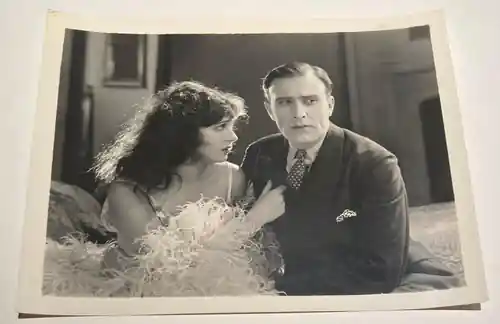
When examining Six Days alongside its contemporaries, its unique positioning becomes clear. It lacks the whimsical artifice of Feathertop or the domestic simplicity of A kölcsönkért csecsemök. Instead, it aligns more closely with the heavy, atmospheric tension of Il ponte dei sospiri. There is a European sensibility at play here, likely a result of Glyn’s own cosmopolitan background, which treats the romance not as a series of flirtatious encounters, but as a titanic struggle against destiny. The film’s handling of the 'wealthy suitor' motif is notably more cynical than in Business Is Business, portraying the pursuit of money as a form of spiritual interment even before the cave-in occurs.
Furthermore, the technical execution of the barracks scenes demonstrates a level of set design sophistication that was ahead of its time. The sense of dampness, the tactile nature of the debris, and the way the actors interact with their environment suggest a commitment to realism that was often sacrificed for glamour in other Goldwyn productions. Even in a film like Clothes, where the physical world is meant to reflect the character's status, the environment feels static compared to the shifting, menacing walls of Six Days.
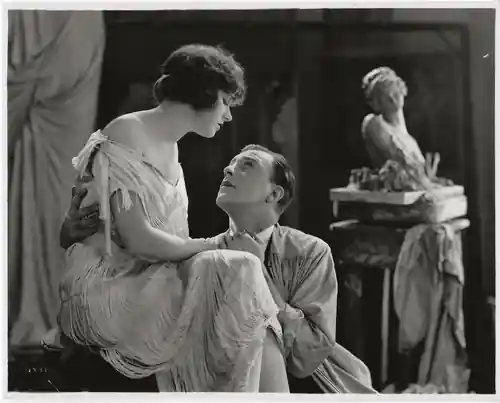
It is impossible to discuss Six Days without centering on Corinne Griffith. In 1923, she was at the zenith of her power, and this film serves as a testament to her range. Her Laline is not a victim; she is a woman in a state of radical evolution. The way she looks at Dion in the darkness—her eyes catching the last slivers of light—conveys more than pages of title cards ever could. She embodies the 'Rose of the World' archetype (referencing Rose of the World), a beauty that persists even when buried. Her performance is a masterclass in economy, proving that the most profound emotions are often the most contained.
The supporting cast, including Spottiswoode Aitken and Claude King, provide a solid foundation, ensuring that the world outside the barracks feels just as real as the one within. The transition from the 'society' scenes to the 'survival' scenes is handled with a jarring effectiveness that mirrors the characters' own shock. Unlike the more linear progression of The Book Agent, Six Days utilizes a fractured sense of time, making the six days of the title feel like an eternity of reflection and reckoning.
In the final analysis, Six Days is a haunting reminder of the power of silent cinema to explore the depths of the human psyche. It is a film that demands much from its audience—patience, empathy, and a willingness to sit in the dark—but it rewards those demands with a profound emotional payoff. It stands as a bridge between the romantic excesses of the late Victorian era and the modern psychological drama. While many films of 1923, such as Skirts, have faded into the footnotes of history, Six Days retains a visceral power. It is a cinematic tomb that, when opened, reveals a treasure trove of human emotion, still breathing, still yearning, still fighting against the encroaching silence of the earth.
A Goldwyn Production • Written by Elinor Glyn • Starring Corinne Griffith
IMDb 4
1919
Community
Log in to comment.