DbcultAccessing Vault...
Cult Review
Senior Film Conservator
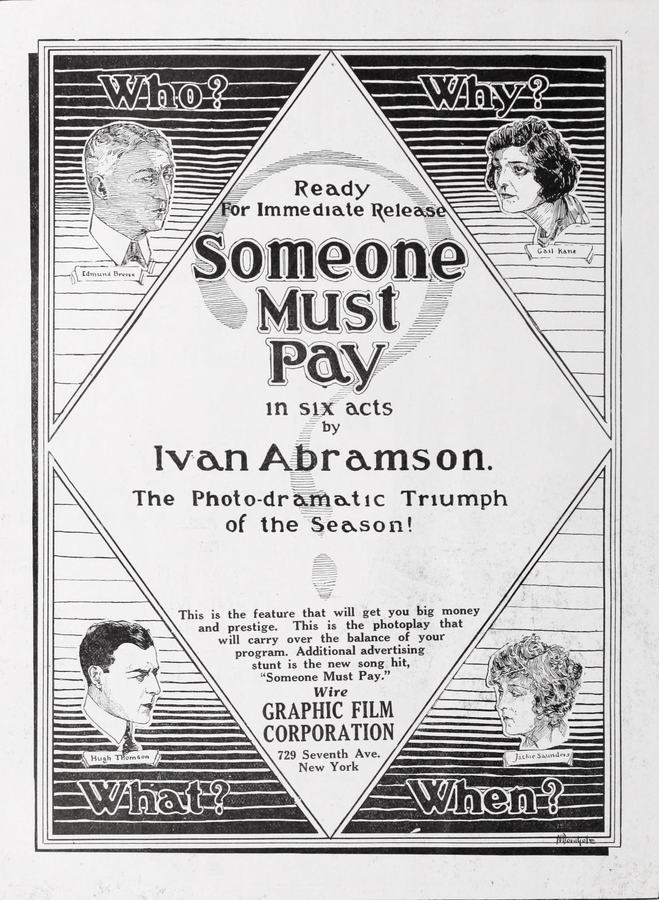
The year 1919 was a pivotal juncture for American cinema, a time when the medium was shedding its nickelodeon skin and evolving into a sophisticated vehicle for complex moral inquiry. Ivan Abramson’s Someone Must Pay stands as a quintessential example of this transition, weaving a narrative that is part financial thriller, part domestic tragedy, and part judicial procedural. At its core, the film is an indictment of the masculine ego and the fragile architecture of the nuclear family when besieged by the twin specters of jealousy and economic instability.
Henry Taylor, portrayed with a jittery, almost subterranean intensity by Hugh Thompson, represents the archetypal 'man of the era'—driven by the ticker-tape and defined by his capacity to provide. However, Thompson imbues the role with a frantic fragility that suggests Taylor’s self-worth is entirely externalized. When Charles Bryant (played with a steady, paternal gravitas by Jere Austin) enters the scene, he does not merely threaten Taylor’s marriage; he threatens Taylor’s identity as the sole provider and patriarch. The South African jeweler, with his exotic wealth and unshakeable composure, acts as a foil to Taylor’s domestic insecurity.
Unlike the more whimsical explorations of identity found in The Beloved Vagabond, Someone Must Pay treats the displacement of the self as a lethal condition. Taylor’s decision to banish Bryant is the first domino in a sequence of moral compromises. His descent into 'wild speculation' is not merely a plot device to facilitate the embezzlement; it is a psychological manifestation of his desire to 'win' back a wife he never truly lost. The cinematography here, though restricted by the technology of the time, manages to convey the claustrophobia of the trading floor, contrasting it sharply with the opulent, yet increasingly cold, Taylor residence.
Dorothy Arnold’s Regina is a figure of remarkable resilience, though the narrative frequently subjects her to the 'fallen woman' tropes common in silent melodrama. Her connection to the asylum—the place where she was 'reared'—adds a layer of Gothic determinism to the story. It suggests that Regina is a character perpetually seeking a home, only to be cast back into the institutional coldness of her youth. This cyclic journey is far more somber than the social maneuvering seen in The Heart of Rachael, where the stakes of domesticity are handled with a different tonal brush.
The scene in which Regina and Vivian are driven into the rainstorm is perhaps the film’s most visceral sequence. The use of practical effects to simulate a torrential downpour creates a sense of elemental fury that mirrors Henry’s internal state. It is here that the film shifts from a drawing-room drama into a tragedy of Shakespearean proportions. The death of Vivian is the 'payment' the title alludes to—a sacrificial offering for the sins of the father.
It is fascinating to observe the fingerprints of George S. Kaufman on this script. Before he became the legendary wit of the Algonquin Round Table, Kaufman was exploring the darker machinations of human behavior. Alongside Ivan Abramson and Larry Evans, the writing team crafts a plot that, while reliant on coincidence, maintains a rigorous emotional logic. The revelation of Bryant’s true identity—not as a suitor, but as Regina’s father—is a masterstroke of dramatic irony. It recontextualizes every previous interaction, transforming Bryant’s 'friendly attentions' from something potentially scandalous into an act of repressed paternal longing.
This use of secret identity and past crimes resonates with the themes explored in The Pursuit of the Phantom, where the past is a ghost that refuses to be laid to rest. In Someone Must Pay, the 'phantom' is Bryant’s supposed murder conviction in South Africa, a stain that forced him into exile and separated him from his daughter. The film posits that the legal system is often a blunt instrument, incapable of discerning the nuances of the human heart until it is nearly too late.

Edmund Breese, a stalwart of the era, provides a commanding presence in the trial scenes. The courtroom, a space of supposed objective truth, becomes a theater where the subjective experiences of the characters are finally reconciled. The pacing of the trial is deliberate, allowing the weight of Bryant’s confession to land with maximum impact. Unlike the more action-oriented sequences in Filibus, the tension here is entirely verbal and emotional, a testament to the actors' ability to convey complex legal and personal histories through gesture and intertitle alone.
The cinematography during the asylum sequences deserves special mention. There is a starkness to the framing—long, empty corridors and cold stone walls—that emphasizes Regina’s isolation. It stands in direct contrast to the cluttered, gilded world of the stockbroker’s office. This visual dichotomy reinforces the film’s central theme: the hollowness of material wealth when divorced from moral integrity. While films like The Quality of Faith deal with spiritual redemption, Someone Must Pay focuses on a more terrestrial form of atonement—one that requires the literal shedding of blood and the loss of a child to achieve.
When placing Someone Must Pay alongside its contemporaries, its unique blend of social critique and high melodrama becomes apparent. For instance, Every Mother's Son explores maternal sacrifice with a similar fervor, but Abramson’s film is more interested in the destructive power of the patriarch. Similarly, while The Unattainable deals with the unreachable nature of desire, Someone Must Pay suggests that what we desire is often right in front of us, obscured by our own vanity.
The inclusion of a South African backstory for Bryant links the film to a broader global context, reflecting the era's fascination with colonial wealth and the 'diamond king' archetype. This international flavor distinguishes it from more localized dramas like The New South. Furthermore, the psychological depth of Henry’s jealousy mirrors the intense internal conflicts found in European cinema of the time, such as the Russian Bogatyr dukha or the German Erträumtes, though Abramson maintains a distinctly American focus on the consequences of financial failure.
The film’s conclusion, while ostensibly a 'happy ending' through the reconciliation of Henry and Regina, is deeply tinged with melancholy. The death of Vivian remains an unhealable wound, a permanent scar on the family unit. Henry’s redemption is not a return to the status quo, but an entry into a new, more somber reality where he must live with the knowledge of his own lethal folly. The final shots of the film do not emphasize the 'lavish riches' Henry once sought, but rather the quiet, almost spectral presence of Bryant, the father who returned from the dead to save a family that didn’t know they needed him.
In the broader canon of silent film, Someone Must Pay serves as a potent reminder of the power of the domestic sphere as a site of cinematic exploration. It eschews the grand spectacles of something like How Uncle Sam Prepares in favor of the microscopic examination of a marriage in crisis. It is a film that demands much from its audience, asking them to empathize with a protagonist who is, for much of the runtime, his own worst enemy.
Ultimately, the film succeeds because it treats its characters not as puppets of the plot, but as flawed, breathing entities. Whether it is the mystery-inflected tension of O Homem dos Olhos Tortos or the reflective nature of The Mirror, Someone Must Pay incorporates these various generic elements into a cohesive, devastating whole. It is a story where the cost of living is measured in more than just stocks and bonds; it is measured in the lives of those we fail to trust. Even the lighter moments of contemporary films like Lyubovta e ludost seem worlds away from the heavy, atmospheric dread that Abramson cultivates here. Someone Must Pay remains a vital, if harrowing, piece of cinematic history that continues to resonate with anyone who has ever felt the sting of unearned suspicion or the crushing weight of a secret past.

IMDb —
1932
Community
Log in to comment.