DbcultAccessing Vault...
Cult Review
Senior Film Conservator
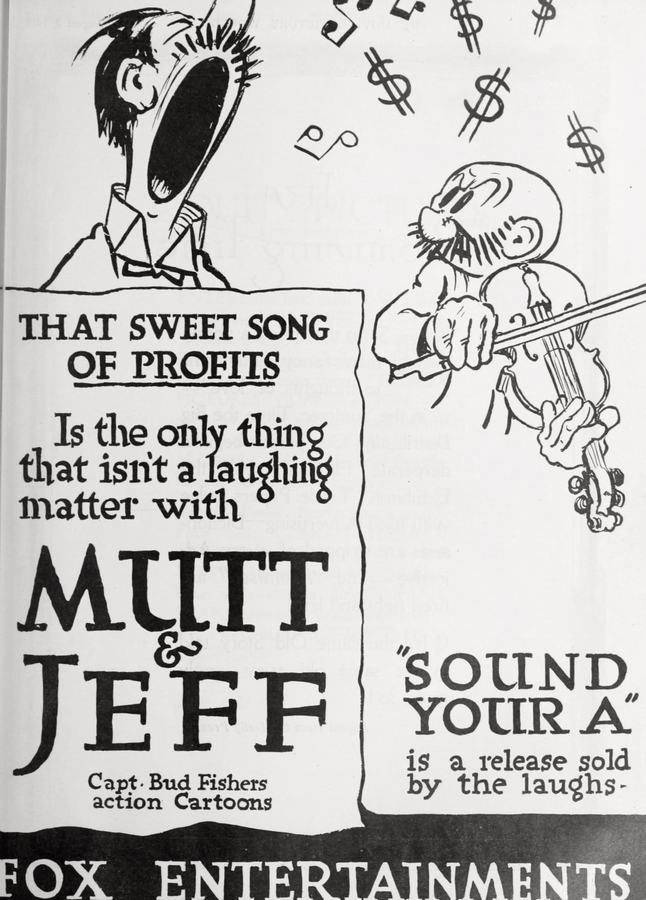
When the silver screen of the early 1920s flickered to life, filmmakers were still mapping the terrain of visual storytelling. Bud Fisher, already a household name for his syndicated comic strip, seized this experimental moment with ‘Sound Your ‘A’’, a short that daringly fuses a cartoon’s two‑dimensional antics with the palpable resonance of a live orchestra. The premise is deceptively simple: Mutt and Jeff, the lanky, long‑legged pair whose misadventures had delighted newspaper readers for years, are invited onto the stage of a theatre’s resident symphonic ensemble. Yet within that simplicity lies a sophisticated choreography of timing, sound, and visual gag that rewards repeated viewings.
From the opening frame, Fisher’s hand draws the audience into a world where the cartoon’s inked lines appear to brush against the polished wood of the orchestra pit. Mutt, ever the over‑enthusiastic impresario, brandishes a baton with the gravitas of a maestro, while Jeff, the reluctant sidekick, watches with a mixture of suspicion and resignation. The orchestra, rendered in stark black‑and‑white, is not merely a backdrop; its musicians are animated with the same kinetic energy as the protagonists, their bows and reeds moving in perfect synchrony with the on‑screen action. This visual reciprocity creates a meta‑theatrical loop: the cartoon reacts to the music, and the music, in turn, reacts to the cartoon.
The comedic beats land with the precision of a well‑tuned instrument. When Mutt attempts a flamboyant crescendo, his baton slips, sending a cascade of sheet music fluttering like startled birds. Jeff’s dead‑pan expression—eyes narrowed, mouth a thin line—contrasts sharply with the chaos, amplifying the humor through understatement. The orchestra’s musicians, oblivious to the cartoon’s slapstick, continue their performance, their earnestness heightening the absurdity. This juxtaposition mirrors the silent‑era tradition of visual comedy relying on exaggerated physicality, but Fisher adds a layer of auditory irony that was rare for its time.
Beyond the immediate laughs, ‘Sound Your ‘A’’ functions as a commentary on the evolving relationship between cinema and live performance. In an era when movie palaces often employed full orchestras to accompany silent pictures, Fisher’s decision to embed the orchestra within the narrative itself blurs the boundary between accompaniment and character. The short anticipates later experiments, such as Disney’s ‘Fantasia’, where animation and orchestral music become inseparable partners. By making the orchestra a participant rather than a silent supporter, Fisher invites the audience to consider the orchestra’s agency, turning musicians into co‑stars.
Comparatively, the film’s inventive spirit resonates with other contemporaneous works that pushed the medium’s limits. One Law for Both explores moral ambiguity through stark visual contrasts, while The Crucible of Life employs chiaroscuro lighting to underscore existential dread. Though those titles diverge in genre, they share Fisher’s willingness to experiment with form. In ‘Sound Your ‘A’’, the experiment is comedic, yet the underlying ambition—to fuse disparate artistic elements—remains consistent across the era’s avant‑garde output.
The film’s pacing is a masterclass in silent‑era timing. Each gag is allotted just enough screen time to land, then swiftly transitions to the next, mirroring the rapid tempo of a scherzo. The orchestra’s musical cues act as an invisible metronome, guiding the cartoon’s rhythm. When the brass section erupts in a blaring fanfare, Mutt’s exaggerated bowing mirrors the swell, creating a visual echo of the sound. Conversely, a sudden diminuendo coincides with Jeff’s tentative tip‑toeing away from the podium, a subtle visual pun that rewards attentive viewers.
Fisher’s animation style, while rooted in the flatness typical of early cartoons, employs a surprising depth of field when interacting with the orchestra. The foreground characters—Mutt and Jeff—are rendered with bold outlines, while the background musicians are sketched with finer lines, suggesting distance. This gradation enhances the illusion that the cartoon exists within the same physical space as the live performers, a technique that would later be refined in works like The Mystery of St. Martin’s Bridge, where layered set pieces create a three‑dimensional tableau.
The sound design, though invisible to modern viewers, would have been a crucial component of the original exhibition. The theatre’s orchestra would have performed a bespoke score, synchronizing crescendos and rests with the on‑screen action. This live synchronization required meticulous coordination, akin to a modern live‑action video game where the player’s movements dictate the soundtrack. The result is a kinetic energy that static film alone could not achieve, making ‘Sound Your ‘A’’ a precursor to immersive multimedia experiences.
From a cultural perspective, the short also reflects the era’s fascination with vaudeville and variety shows. Mutt’s flamboyant conducting gestures echo the exaggerated showmanship of vaudeville masters, while Jeff’s stoic demeanor recalls the dead‑pan humor of early film comedians like Buster Keaton. By embedding these archetypes within a cartoon, Fisher bridges the gap between highbrow orchestral art and lowbrow slapstick, democratizing the experience for a broad audience.
The film’s legacy can be traced through later works that blend animation with live performance. His Enemy, the Law and Body and Soul both experiment with integrating real‑world elements into their narratives, albeit in different genres. ‘Sound Your ‘A’’ stands out as an early, pure example of this hybridization, proving that the marriage of cartoon and concert hall was not only possible but also hilariously effective.
Internationally, the short’s inventive spirit finds kinship with A kölcsönkért csecsemök, a Hungarian piece that juxtaposes folk music with surreal visual motifs. Both films demonstrate how music can serve as a narrative catalyst, guiding the audience’s emotional response while simultaneously providing structural scaffolding for the visual story.
Thematically, ‘Sound Your ‘A’’ explores the tension between control and chaos. Mutt, the self‑appointed conductor, seeks to impose order on the orchestra, yet his over‑confidence leads to a cascade of mishaps. Jeff, the reluctant participant, embodies the audience’s perspective—caught between curiosity and skepticism. Their dynamic mirrors the broader artistic struggle of the 1920s: creators attempting to harness new technologies (sound, motion pictures) while grappling with the unpredictable outcomes of innovation.
In terms of visual humor, Fisher employs a repertoire of classic gag devices—slipping, mis‑timed entrances, and exaggerated facial expressions—yet each is refreshed by the orchestral context. For instance, when a trombone player’s slide extends too far, it collides with Mutt’s baton, producing a literal “musical clash.” The gag is not merely visual; it is sonically resonant, reinforcing the joke through both sight and sound.
The short’s brevity—typical of the era’s one‑reel format—does not diminish its impact. Instead, the concise runtime forces Fisher to distill his ideas to their purest form, resulting in a work that feels both tight and expansive. Every frame serves a purpose, whether to advance the comedic narrative or to underscore the symbiotic relationship between animation and live music.
When placed alongside other silent‑era gems such as The Perils of Pauline or Stage Struck, ‘Sound Your ‘A’’ stands out for its meta‑theatrical ambition. While Pauline’s cliff‑hanging thrills and Stage Struck’s backstage drama rely on conventional storytelling, Fisher’s short asks the audience to contemplate the very nature of performance, blurring the line between spectator and participant.
The film also anticipates later narrative techniques employed in modern cinema, such as breaking the fourth wall. Mutt’s direct eye contact with the camera, coupled with the orchestra’s obliviousness, creates a layered self‑awareness that feels ahead of its time. This self‑reflexivity invites viewers to question the artificiality of the medium, a concept later explored in films like In the Clutches of the Paris Apaches and even contemporary works that blend live action with animation.
From a technical standpoint, the animation’s fluidity is noteworthy. Despite the limitations of early cel animation, Fisher achieves smooth transitions between Mutt’s exaggerated gestures and the orchestra’s subtle movements. The timing of each frame aligns with the musical score, suggesting a collaborative rehearsal process between animators and musicians—a rare feat for the period.
The short’s influence can be felt in later experimental pieces that treat music as a character rather than mere accompaniment. In På livets ödesvägar, the soundtrack drives the narrative forward, while in Wagon Tracks, the rhythmic clatter of train wheels becomes a percussive element. ‘Sound Your ‘A’’ laid the groundwork for such symbiotic storytelling, proving that sound and image could co‑author a narrative.
The film’s cultural resonance endures because it captures a moment when cinema was still defining its language. Fisher’s willingness to experiment with form, to let a cartoon share the stage with a live orchestra, exemplifies the daring creativity that propelled the medium forward. For modern audiences, the short offers both nostalgic charm and a reminder of cinema’s boundless potential when artists dare to cross disciplinary borders.
In sum, ‘Sound Your ‘A’’ is a masterful blend of slapstick, musicality, and meta‑commentary. Its concise runtime belies a depth of craftsmanship that rewards repeated viewings and scholarly analysis alike. Whether you are a silent‑film aficionado, a student of animation history, or simply a lover of clever comedy, this short delivers a richly layered experience that still resonates a century after its debut.
IMDb 7.4
1926
Community
Log in to comment.