DbcultAccessing Vault...
Cult Review
Senior Film Conservator
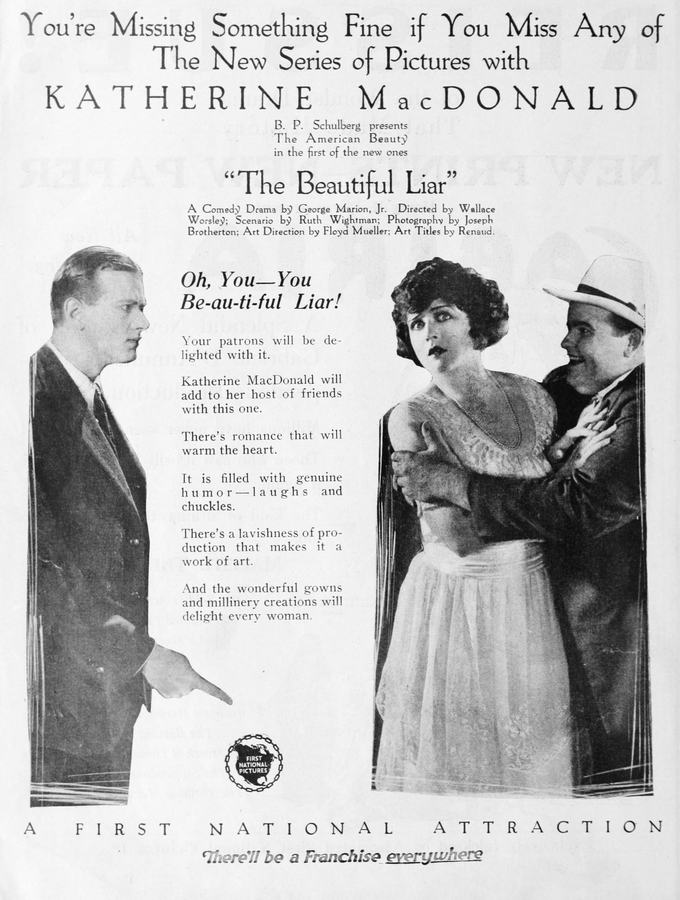
Moonlit verandas, paper lanterns trembling in Atlantic breezes, and the faint hiss of a hotel orchestra tuning for charity night—The Beautiful Liar opens like a hand-tinted postcard slipped inside a gossip column. George Marion Jr. and Ruth Wightman’s scenario, tailored for the incandescent Katherine MacDonald, pirouettes between backstage bedlam and drawing-room ardor without ever stumbling into the footlights of farce for farce’s sake.
Gaston Allegretti—played by Wilfred Lucas with the twitchy elegance of a man balancing creditors and chandeliers—must conjure Broadway’s comet Elsie Parmelee or forfeit his post. When the real star scoffs at provincial stages, Gaston plucks Helen Haynes from a ledger-lined purgatory, gambling that her mirror-image cheekbones will suffice. Enter MacGregor (Joseph J. Dowling), a kilted bookkeeper whose brogue rolls like distant thunder, eager to shepherd Helen toward a holiday she mistakes for mere respite.
From the instant Helen’s pumps click across the resort’s tessellated lobby, the film’s visual grammar shifts: low-angle shots elongate corridors into runways of possibility, while iris-in close-ups flirt with her dimples as if the camera itself were smitten. Director Charles Meredith (also essaying the besotted millionaire Bobby Bates) layers spatial gags—a mislaid prop sword, a collapsing canvas flat—into the same frame as whispered proposals, proving silent cinema can chew bubble-gum and wax poetic simultaneously.
Bobby, heir to a trolley-car fortune, arrives in nautical blazers that scream Newport; yet his gaze softens each time Helen misquotes her supposed résumé. Their courtship unfurls along a moonlit pier where cinematographer William Marshall bathes faces in a chiaroscuro of silver and umber—an effect so tactile you expect brine to mist the lens. Note the kissing close-up: rather than the customary saccharine lock, Meredith opts for a hesitant brush, Helen’s lashes flickering like semaphore as guilt pricks pleasure.
Meanwhile, offstage aristocrats—chief among them the gloriously named Mrs. Van Courtlandt–Van Allstyn (Kate Lester, slicing the air with a fan sharp enough to julienne reputations)—scheme to secure social cachet via the gala performance. Their machinations supply a secondary hum of tension: will the counterfeit comedienne collapse under scrutiny, or will the audience’s hunger for glamour blind them to artifice? Marion’s intertitles sparkle with epigrams (“Reputation is a gown best worn in the dark”), each card timed like syncopated handclaps.
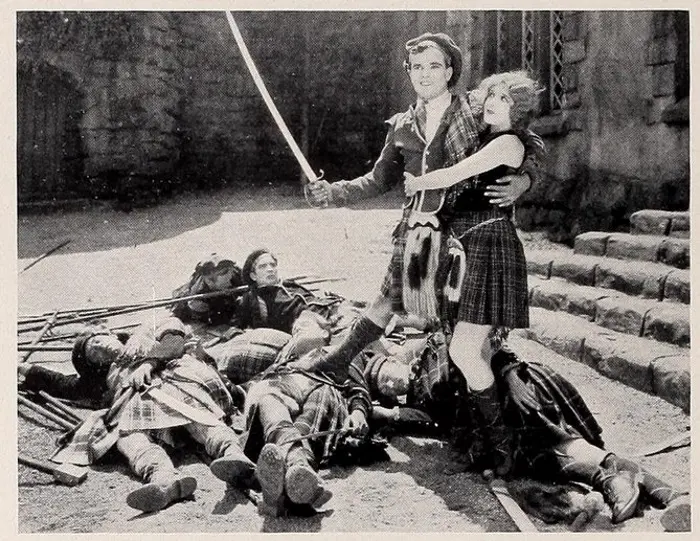
The charity farce itself—The Belle Who Bellowed—is a mise en abyme masterpiece: cardboard battlements, mistaken letters, and a trousers-role reversal that lets MacDonald lampoon her own image. Watch how her gait stiffens from doe-eyed clerk to swaggering drag swashbuckler; the transformation lampoons gendered star-system expectations while still courting the front-row guffaws. A jump-cut reveals a stagehand accidentally whisking away the painted ocean backdrop, leaving Helen poised before a black void—an inadvertent metaphor for identity stripped bare.
Disillusionment arrives when a New York critic vacations incognito, recognizes the fraud, and telegraphs the real Elsie Parmelee. Bobby’s wounded pride—expertly etched in a single tear that clings like dew to his cheekbone—feels neither maudlin nor rushed. Instead, the betrayal lands with the melancholy thud of a champagne flute toppling onto marble. The film’s tonal pivot here is fearless: from effervescent romp to bruised sincerity, all within the span of a single reel.
Salvation emerges from the least likely jester: MacGregor confesses he masterminded the swap to shield both women from exploitation. Dowling delivers the monologue in a misty stable, his burr softening as candlelight carves valleys of remorse across his face. The moment reframes the narrative—not as a cautionary tale about ambition, but as a meditation on surrogate families cobbled together under the proscenium arch.
Comparative glances enrich the experience. Where High Speed (1920) fetishizes velocity and The Law of Compensation moralizes over karmic ledgers, The Beautiful Liar pirouettes on the razor between ethics and entertainment. Its DNA shares strands with The Melting Pot’s identity flux, yet trades that film’s sociopollectrolyte for champagne bubbles.
Modern viewers may flinch at the premise’s class stratification—an heiress impersonates a working girl for sport—but the screenplay slyly inverts the paradigm. Helen’s labor-hardened fingers betray her nightly; she is never fully at ease in silk, and MacDonald’s micro-gestures telegraph that discomfort. Thus the film critiques the very gilded cage it ogles, anticipating the acerbic social eye of Where Are My Children? by half a decade.
Musically, the surviving print (thank you, Library of Congress) carries a recommendation cue sheet that calls for Joplin-esque rags during lobby scenes and Massenet strings for clinches. Contemporary accompanists should heed the tempo map: slow the pulse during Helen’s solitary balcony reverie, allow room for the rustle of her chiffon against iron railings, then accelerate into a stomp when the onstage farce erupts. The dynamic swing is the film’s heartbeat.
Visually, the tri-tone palette of amber lanterns, teal seascapes, and persimmon sunsets—recovered via tinting notes—immerses the viewer in a world perpetually suspended between dusk and dawn. Look for the mirrored shot in the hotel salon: Helen studies Elsie’s publicity still while her reflection superimposes atop the photograph, creating a ghostly palimpsest that whispers, “Which one of us is real?”
Performances ripple with silent-era semaphore. Charles Meredith the director trusts Charles Meredith the actor to underplay; his Bobby exudes affable entitlement yet retains enough vulnerability to earn forgiveness. Opposite him, Katherine MacDonald—nicknamed “the American Beauty”—proves she was more than a tableau face. Her comic timing, calibrated to the frame-rate flicker of 18 fps, lands pratfalls with Buster’s precision and throws sideways glances that could slice crinoline.
In the pantheon of 1923 releases—sandwiched between Cleopatra’s historical pageantry and The Robber’s Teutonic gloom—this modest comedy emerges as a sparkling corrective, reminding audiences that artifice, when laced with empathy, can illuminate truth more brightly than documentary grit.
Restorationists take heed: the existing 35 mm element carries moderate nitrate shrinkage along the optical track region, yet the emulsion retains a silvery sheen that digital scans often bleach into pewter. A 4K scan at 16-bit, followed by a wet-gate pass to mask base scratches, would resuscitate the shimmer without flattening grain. Color decisions should defer to the original rose-and-amber tones specified in the censorship records filed in Albany.
Scholars tracing gender fluidity in early cinema will find rich quarry here. The onstage trouser role doubles Helen’s identity play: offstage she pretends to be Elsie; onstage she pretends to be a man pretending to be a woman. The recursive masquerade anticipates the gender-bending antics of The Clown’s Little Brother yet grounds its subversion in romantic rather than carnivalesque codes.
Marketwise, the film’s accessible runtime (barely 65 minutes) positions it as an ideal opener for silent-film festivals, pairing sweetly with live ragtime ensembles. Programming it beside Wings of the Morning would yoke comedy to aviation spectacle, yielding a balanced bill that showcases the era’s tonal range.
In the end, The Beautiful Liar charms because it believes forgiveness is more photogenic than vengeance. When the final iris closes on Helen and Bobby canoodling beneath fireworks that spell “THE END” in sparkler script, we exit buoyant, reminded that even in Jazz-Age America—where everyone is selling something—the heart can still haggle its way toward grace.
IMDb —
1916
Community
Log in to comment.