DbcultAccessing Vault...
Cult Review
Senior Film Conservator
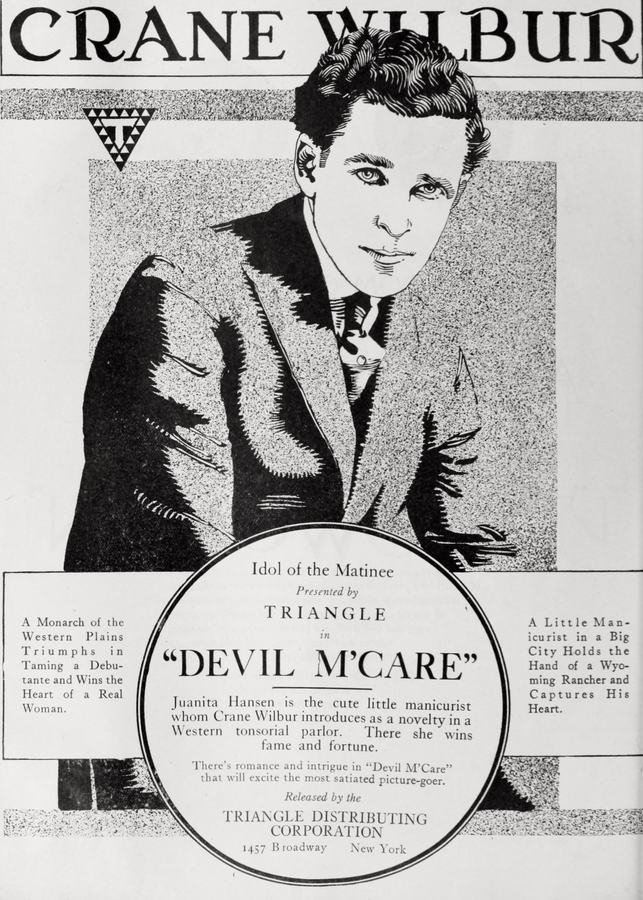
In the pantheon of early American cinema, few films capture the friction between burgeoning urbanity and the fading frontier with as much idiosyncratic charm as Devil McCare. This 1919 relic, often overshadowed by the high-budget spectacles of its era, offers a fascinating psychological blueprint of the 'New Woman' emerging from the service class into the wild unknown.
The film opens not in the sweeping vistas of the West, but in the claustrophobic, polished interiors of a city manicure parlor. Here, Juanita Hansen portrays Mary Archer with a weary grace that suggests a soul suffocating under the weight of repetitive labor. Unlike the protagonists in Painted Lips, whose struggles are often framed by moral peril, Mary’s conflict is one of existential stagnation. She is a technician of vanity, tending to the cuticles of a class that views her as an invisible fixture.
When Devil McCare (Crane Wilbur) enters this domain, the cinematography shifts. The lighting, previously flat and clinical, takes on a warmer, more directional quality. McCare is not merely a man; he is a disruption. Wilbur plays the character with a brooding vitality that justifies his namesake. He represents a world where hands are calloused by soil and rope, not softened by oils. This initial meeting is a masterclass in silent-era subtext, where the tactile exchange of a manicure becomes a bridge between two incompatible realities.
The narrative tension is catalyzed by the intrusion of wealthy society girls, who view McCare as a primitive curiosity to be conquered. This thematic thread echoes the social stratification found in Marriage, where the domestic sphere becomes a battlefield for class dominance. These women, draped in lace and entitlement, attempt to seduce McCare away from his roots, but their artifice fails against his inherent ruggedness.
McCare’s rejection of the urban elite is not just a personal preference but a political statement. He describes Sour Lake to Mary not as a place of hardship, but as a sanctuary of truth. The script, penned by J. Francis Dunbar, utilizes the intertitles to weave a poetic vision of the West that serves as a siren song for the disenfranchised Mary. Her decision to follow him is an act of radical autonomy, a theme explored with varying degrees of success in Lost and Won.
While Devil McCare leans into the romanticism of the ranch, it avoids the surrealism of European imports like Der Mandarin. It occupies a space similar to The Masked Heart, where the emotional landscape is as rugged as the physical one. The film’s pacing is deliberate, allowing the audience to feel the dust of Sour Lake and the isolation of the frontier.
Upon her arrival in Sour Lake, Mary Archer does not find a pastoral utopia. Instead, she finds a community governed by its own rigid codes and jealousies. Her transition from city manicurist to the 'Idol of Sour Lake' is handled with a nuanced touch by the director. She sets up shop in the local hotel, bringing a touch of metropolitan sophistication to the rough-hewn locals.
This shift creates a poignant rivalry with Vera, Devil’s ward. Vera represents the traditional Western woman—uncut, unrefined, and deeply rooted in the landscape. Mary’s presence renders Vera invisible, a reversal of the invisibility Mary felt in the city. The psychological weight of this displacement is palpable, reminiscent of the character dynamics in 'Twas Ever Thus. The film explores the idea that beauty and charm are relative to their environment, and Mary’s 'otherness' is what makes her a deity in this dusty outpost.
The conflict escalates with the introduction of Parson Brown. In many Westerns of this period, the clergy represents a stabilizing force of civilization. However, in Devil McCare, the Parson is a figure of repressed desire and moral hypocrisy. His obsession with Mary creates a volatile triangle. The fight between McCare and Brown is not just a physical brawl; it is a clash between the primal and the institutional.
The choreography of this fight is surprisingly modern, utilizing the natural terrain of the lake’s edge to emphasize the chaotic nature of their struggle. It lacks the stylized grace of A Daughter of the Gods, opting instead for a gritty, fumbling desperation that feels authentic to the characters' stakes. The resolution of this conflict marks Mary’s final integration into the world of McCare—she chooses the man who embraces his 'devilish' nature over the man who hides behind a veil of piety.
From a technical standpoint, the film benefits immensely from the cinematography of the era, which utilized natural light to create high-contrast imagery. The scenes in the Sour Lake hotel are particularly striking, with shadows stretching across the wooden floors, mirroring the uncertainty of Mary’s new life. The editing, while rudimentary by today's standards, effectively builds tension during the climax, a technique also seen in The Zero Hour.
The cast delivers performances that are remarkably restrained for 1919. Ethel Stewart and Frederick Vroom provide solid supporting work, creating a lived-in feel for the community of Sour Lake. Even the smaller roles, like those played by the Schillers, contribute to the sense of a world that exists outside the frame. This attention to world-building is what elevates Devil McCare above the standard 'city girl goes West' trope found in films like It's a Great Life.
As we look back at Devil McCare, we see a film that was grappling with the changing identity of the American landscape. It captures a moment when the frontier was becoming a destination for the working class, not just a site for exploration or conquest. Mary Archer’s journey is a precursor to the modern 'escape from the rat race' narrative, but it is grounded in the harsh realities of the early 20th century.
The film’s focus on the 'manicurist'—a role defined by the grooming of others—is a stroke of genius. By taking this symbol of service and placing her in a position of power and idolatry, the film subverts contemporary expectations of class and gender. It is a more grounded exploration of female agency than the dramatic heights of Dødsklippen or the mystery-driven plot of A Study in Scarlet.
Devil McCare is a vibrant, essential piece of silent cinema that deserves a place in the conversation alongside more famous Westerns. It balances melodrama with genuine psychological insight, anchored by Juanita Hansen’s luminous performance. While it may lack the sheer scale of Barranca trágica or the noir-adjacent grit of On Dangerous Ground, its intimacy is its greatest strength.
In the end, the union of Mary and Devil is not just a romantic triumph; it is a successful synthesis of two disparate American identities. It suggests that happiness is found not in the perfection of the city or the isolation of the wild, but in the courage to redefine oneself in the space between. Like the melancholic undertones of The Blues or the stark social critique in Vor, Devil McCare lingers in the mind long after the final intertitle fades, a testament to the enduring power of a simple story told with profound sincerity.
Review by the Editorial Team | Published 2024 for Silent Era Enthusiasts
IMDb —
1915
Community
Log in to comment.