DbcultAccessing Vault...
Cult Review
Senior Film Conservator
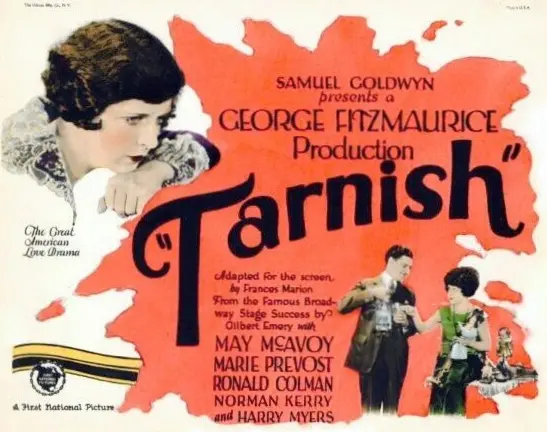
In the pantheon of 1920s silent cinema, few films manage to balance the tightrope of moralistic melodrama and gritty urban realism with the finesse of Tarnish (1924). Directed by the visually astute George Fitzmaurice, this adaptation of Gilbert Emery’s stage play transcends its theatrical origins to provide a searing indictment of the double standards and economic precariousness defining the Jazz Age. The film does not merely present a story of love and betrayal; it serves as an architectural study of the 'tarnish' that accumulates on the human soul when survival and desire collide in the shadows of New York’s high-rises. Unlike the more escapist fare seen in The Tents of Allah, Tarnish remains grounded in the soil of domestic tragedy.
The narrative engine is fueled by the catastrophic irresponsibility of Adolph Tevis, portrayed with a frustratingly effective sycophancy by Albert Gran. Adolph is the quintessential Victorian relic—a man whose self-indulgence is matched only by his obliviousness to the ruin he brings upon his household. His character stands in stark contrast to the protagonists of Gimme, where financial negotiations take on a more comedic tone. Here, the stakes are existential. Letitia Tevis, played by a luminous May McAvoy, is the sacrificial lamb at the altar of her father’s libidinous whims. McAvoy’s performance is a masterclass in restrained pathos; her eyes convey the weariness of a woman who has become the parent to her own progenitors.

"The film’s central conceit—that everyone is slightly tarnished by life’s compromises—resonates with a modernity that few of its contemporaries dared to explore."
The domestic sphere in Tarnish is depicted as a site of constant negotiation. Mrs. Russ Whytal’s portrayal of the mother adds another layer of tragic realism; she is a woman clinging to the vestiges of social standing while her husband barters away their dignity. This focus on the internal rot of the family unit echoes the thematic depth found in The Greatest Question, though Fitzmaurice trades Griffith’s rural mysticism for a more cynical, metropolitan sophistication. The claustrophobia of the Tevis apartment is palpable, a stark contrast to the expansive, albeit perilous, world of the New York workforce where Letitia finds herself.

Ronald Colman, even in this early stage of his career, possesses an effortless magnetism. As Emmet Carr, he represents the 'New Man'—industrious, empathetic, yet burdened by the inescapable shadows of his past. The chemistry between Colman and McAvoy is the film’s emotional anchor, providing a sense of hope that feels earned rather than manufactured. However, the brilliance of Frances Marion’s screenplay lies in its refusal to make Emmet a flawless knight. He is a man who has lived, and in living, has acquired his own layer of 'tarnish.' This nuanced characterization is a significant departure from the more archetypal heroes seen in films like The Fourth Musketeer.
When Emmet’s past collides with Letitia’s present in the apartment of the predatory Nettie Dark (Marie Prevost), the film shifts from a social drama into a psychological thriller. Marie Prevost is exceptional as Nettie, the manicurist whose ambition is as sharp as her tools. She represents the 'vamp' archetype but with a grounded, transactional edge that makes her far more dangerous than the exoticized temptresses of Marc'Antonio e Cleopatra. Her apartment becomes the stage for the film’s most harrowing sequence, where the visual language of the film—harsh shadows and tight framing—underscores Letitia’s disillusionment.

The collaborative synergy between director George Fitzmaurice and screenwriter Frances Marion is evident in every frame. Marion, perhaps the most prolific and powerful woman in silent-era Hollywood, imbues the script with a distinctly feminine perspective on labor and morality. Letitia’s struggle isn't just about finding a husband; it is about maintaining her autonomy in a world designed to commodify her. The cinematography captures the duality of the city—its glittering promise and its sordid underbelly. The use of light in the office scenes suggests a sterile, demanding modernity, while the nocturnal sequences in the city streets evoke a sense of moral ambiguity reminiscent of Follow Me.
Technically, Tarnish is a marvel of its time. The editing maintains a rhythmic tension that prevents the film from feeling like a mere filmed play. The pacing is deliberate, allowing the audience to feel the weight of Letitia’s fatigue. We see this attention to the mundane details of life also reflected in the social realism of Britain's Bulwarks, No. 1: Women Munitioners of England, though Tarnish applies this lens to the American middle class. The film’s ability to find cinematic beauty in the 'tarnished' aspects of life—the cracked plaster of a boarding house, the desperate look in a father’s eyes—is what elevates it to the level of high art.

When placed alongside Johanna Enlists, Tarnish appears significantly more mature. While Johanna deals with the romanticized notions of duty and patriotism, Tarnish grapples with the unglamorous duty of supporting a family that is actively sabotaging itself. The film shares a certain DNA with Os Fidalgos da Casa Mourisca in its depiction of a noble family’s decline, yet it feels more immediate, more visceral. The 'tarnish' here is not just the loss of wealth, but the loss of the illusion of purity.
Even in the more lighthearted moments, such as the character work by Snitz Edwards and Harry Myers, there is an underlying sense of the struggle for survival. This isn't the slapstick world of Casey at the Bat or the sun-drenched optimism of Smiling Jim. Instead, the humor is dry, often serving as a brief respite from the mounting pressure on Letitia. The casting of William Boyd and Priscilla Bonner in supporting roles further rounds out a world that feels lived-in and populated by people with their own complex histories.

The resolution of Tarnish is perhaps its most controversial element for modern viewers. Letitia’s ultimate realization of Emmet’s innocence and her decision to find happiness with him can be read as a traditional happy ending. However, seen through the lens of the film’s overarching metaphor, it is something much more profound. It is an acceptance of the 'tarnish.' By choosing Emmet, Letitia is not returning to a state of pristine innocence; she is acknowledging that love in the real world requires the forgiveness of past errors. It is a radical stance for 1924, suggesting that the 'tarnish' of experience is not a terminal condition but a prerequisite for genuine human connection.
In many ways, the film’s conclusion is as complex as the moral quandaries posed in Gypsy Love or the historical epics like Ashoka, where the weight of one’s past actions defines their future. Tarnish argues that while we cannot escape the consequences of our choices—or the choices of those we love—we can choose how we carry those marks. The final scenes, bathed in a softer light than the rest of the film, suggest a quiet hope, a polishing of the soul that does not erase the marks of the past but rather incorporates them into a new, more resilient luster.
Tarnish (1924) is a film that demands to be rediscovered. It avoids the easy sentimentality of Beaches and Peaches and the straightforward morality of $1,000 Reward. It is a sophisticated, adult drama that treats its audience with respect, refusing to offer simple answers to the complex problems of poverty, infidelity, and trust. The performances of May McAvoy and Ronald Colman are timeless, and George Fitzmaurice’s direction remains a testament to the power of silent visual storytelling. To watch Tarnish is to witness the birth of the modern psychological drama, a film that understands that the greatest battles are not fought on battlefields or in exotic lands, but within the confines of the human heart and the small, tarnished rooms we call home.
The legacy of this film lies in its honesty. It does not look away from the ugly realities of life, but it also refuses to succumb to nihilism. In the end, Tarnish is a celebration of the human spirit’s ability to endure, to forgive, and to find beauty in the most unexpected, and perhaps slightly stained, places.

IMDb 4.9
1933
Community
Log in to comment.