DbcultAccessing Vault...
Cult Review
Senior Film Conservator
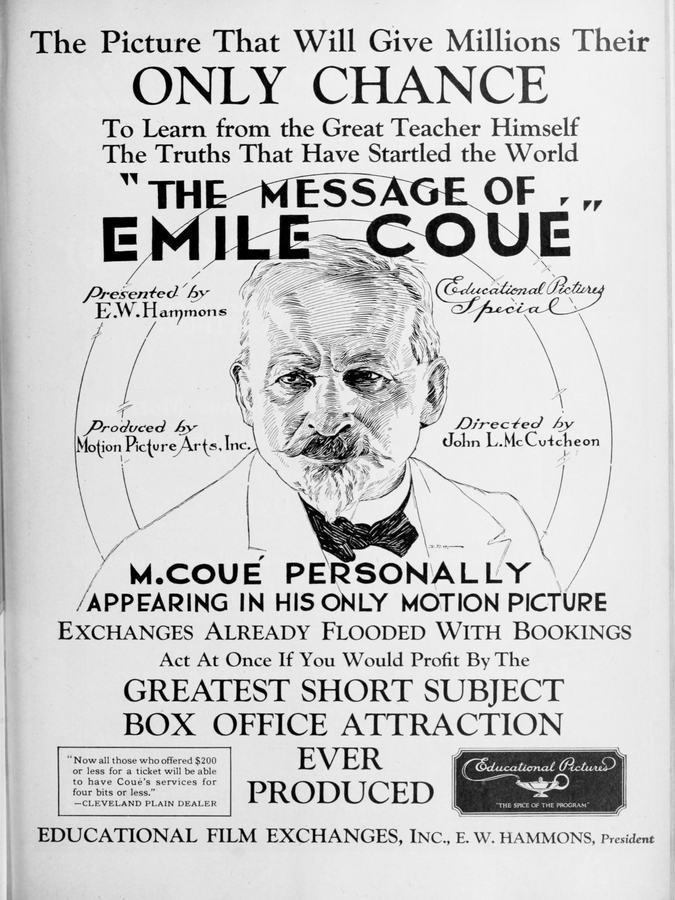
In the feverish landscape of the early 1920s, a period defined by the psychic scars of the Great War and a burgeoning fascination with the inner workings of the human psyche, The Message of Emile Coué emerged as a singular cinematic phenomenon. Far from the slapstick antics of The Star Boarder or the animated whimsy of Felix in Hollywood, this film occupied a space of profound didacticism. It was not merely a record of a man, but a transmission of a philosophy that promised a panacea for the modern soul through the rhythmic repetition of thought. As a critic, one must view this not just as a film, but as a technological extension of the lecture circuit, a means of democratizing a psychological movement that was sweeping across Europe and America.
Emile Coué, the unassuming French pharmacist turned psychological pioneer, possesses a screen presence that is remarkably understated yet undeniably magnetic. Unlike the theatrical grandiosity found in contemporaneous dramas like A fekete szivárvány, Coué’s movements are precise, deliberate, and devoid of artifice. The cinematography captures him in a series of medium shots that emphasize his gestures—the way he leans toward his audience, the steady gaze that seems to pierce the fourth wall. There is an intimacy here that feels surprisingly modern. The film creates an illusion of proximity; you aren't just watching a lecture; you are being invited into the inner sanctum of his methodology.
The involvement of Earl Hurd and Lewis Allen Browne as the creative architects behind this production is fascinating. Hurd, primarily known for his revolutionary work in animation, brings a structured clarity to the film’s pacing. One can see the animator’s touch in the way the intertitles are deployed—not merely as dialogue bridges, but as rhythmic anchors that reinforce the film's core tenets. This isn't the chaotic energy of Movie Mad; it is a clinical, almost architectural approach to narrative construction.
The crux of the film lies in its demonstration of the 'Coué Method.' The sequence where the audience is led through the 'Day by Day' mantra is a masterclass in silent film editing. By repeating the phrase across several intertitles, the film mimics the very process of autosuggestion it seeks to teach. The repetition is not redundant; it is cumulative. Each time the text appears, it carries more weight, mirroring the psychological buildup of the practice itself. In this regard, the film functions similarly to the instructional nature of Our Bridge of Ships, yet it trades industrial logistics for the logistics of the human spirit.
Consider the contrast between this earnestness and the domestic cynicism found in The Fable of Henpecked Henry. While the latter mocks the fragility of the human condition, Coué’s message is one of radical agency. He suggests that the individual holds the keys to their own neurological kingdom. The film portrays this not through flashy effects, but through the reactions of the people in the room. We see faces transform from skepticism to a quiet, focused resolve. It is a subtle form of drama, one that relies on the viewer’s ability to empathize with the search for self-improvement.
When we look at The Message of Emile Coué alongside The Web of Life, we see a broader trend in 1920s cinema: the use of film as an educational tool for social and personal hygiene. Both films utilize a direct-to-audience address that bypasses traditional narrative tropes. However, Coué’s work is more personal. It lacks the moralizing tone of The Clean-Up, opting instead for a quasi-scientific approach to wellness. It is less about societal reform and more about the micro-reform of the self.
The technical execution, while limited by the era’s equipment, is remarkably effective. The lighting is harsh, typical of the orthochromatic film stock of the time, yet it serves to highlight the textures of the faces in the crowd. These aren't the polished stars of The Bargain; these are ordinary people, which reinforces the accessibility of Coué’s message. The film suggests that if these people can achieve a state of 'better and better,' then so can the viewer. This proto-interactive element is a fascinating precursor to the participatory media of the digital age.
The closing sequence of the film is where its power truly resides. The screen is dominated by the phrase 'Tous les jours, à tous points de vue, je vais de mieux en mieux'—rendered in English for the domestic audience. The instruction for the audience to say it with M. Coué is a bold move. In the silent theater, this would have created a surreal atmosphere where the silence was broken by the collective voices of the spectators. This breaks the traditional 'spectacle' barrier. It turns the theater into a sanctuary, the film into a liturgy. It is a far cry from the rugged individualism of On the Fighting Line or the desperate survivalism of Küzdelem a Létért. Here, survival is found through internal alignment rather than external conquest.
One might argue that the film is repetitive, but that is to miss the point entirely. The repetition is the aesthetic. It is a cinematic representation of the subconscious being conditioned. In the same way that Rudd's New Selection captures a specific cultural milieu through its characters, this film captures the intellectual zeitgeist of the post-war era. It reflects a world looking for simple, actionable truths in the wake of catastrophic complexity.
Evaluating The Message of Emile Coué requires us to step outside the bounds of traditional film criticism. We cannot judge it by the standards of plot or character development. Instead, we must judge it by its efficacy as a medium of communication. In this, it succeeds brilliantly. It is a clear, concise, and compelling presentation of a complex psychological theory. It lacks the visceral tension of The Gun Runners or the atmospheric dread of Footprints, but it possesses a quiet power that lingers long after the final frame.
The film also serves as a reminder of the versatility of early cinema. Before it was strictly an industry of entertainment, film was a tool for exploration—of the world, of science, and of the self. This production sits alongside the educational shorts like Kids Is Kids as evidence of a medium still discovering its own boundaries. It is a testament to the vision of Earl Hurd and Lewis Allen Browne that they saw the potential for film to be more than just a distraction; they saw it as a mirror for the mind.
Ultimately, The Message of Emile Coué is a mesmerizing piece of history. It captures a moment when the world was beginning to understand that the stories we tell ourselves are the most powerful stories of all. The film doesn't just document Coué’s message; it becomes the message. By the time the final intertitle fades, the viewer has been subjected to the very technique being described. It is a rare example of a film that achieves its goals through the sheer force of its conviction. For anyone interested in the intersection of psychology, history, and the evolution of visual communication, this is an essential, if hypnotic, viewing experience. It reminds us that even in the silence of the 1920s, the human voice—even when only read on screen—had the power to heal, to inspire, and to transform.
Reviewer's Note: While the film's pace may seem glacial to contemporary audiences accustomed to rapid-fire editing, its rhythmic consistency is its greatest strength. It is a film that demands a quiescent mind and a willingness to participate in its central experiment.
IMDb —
1932
Community
Log in to comment.