
Cult Cinema
The Primal Deviant: How Early Cinema’s Forgotten Misfits Sculpted the Modern Cult Psyche

“Journey into the deep history of the cinematic fringe as we explore how the silent era's most obscure and transgressive works laid the foundation for today's midnight movie obsession.”
The history of cult cinema is often told as a mid-to-late 20th-century phenomenon, a product of the midnight movie madness of the 1970s or the transgressive underground of the 1960s. However, the genetic blueprint of the cult film—the obsession with the grotesque, the celebration of the social outcast, and the pursuit of the narrative uncanny—was drafted long before the term 'cult' was ever applied to a celluloid reel. To understand the modern obsession with the strange and the subversive, we must look back to the early 20th century, a period of cinematic anarchy where the rules of storytelling were still being forged and broken by a wave of forgotten misfits and genre-defying rebels.

The Genesis of the Uncanny: Artificial Life and Moral Decay
At the heart of the cult aesthetic lies a fascination with the boundaries of the human experience. One of the earliest and most profound examples of this can be found in the 1915 film Life Without Soul. Long before Boris Karloff’s iconic turn as Frankenstein’s monster, this early adaptation explored the 'disastrous results' of a young man giving life to a statue. This theme of the artificial human, the creation that lacks a spiritual core, resonates deeply within the cult canon. It is a precursor to the body horror and existential dread that would later define the works of David Cronenberg or Clive Barker. By stripping away the soul, Life Without Soul challenged the moral certainties of its era, inviting the audience to sympathize with a being that should not exist.

Similarly, the 1913 Russian masterpiece Sumerki zhenskoy dushi (Twilight of a Woman's Soul) delved into the darkness of the human psyche. When a wealthy woman's attempt to help the poor results in a tragic incident that permanently alters her life, the film moves beyond simple melodrama into the realm of psychological obsession. This 'twilight' of the soul is a recurring motif in cult cinema, where the protagonist is often forced into a marginalized existence by a single, irreversible moment of trauma or transgression.
The Gothic Melodrama: Secrets, Deformity, and Inheritance
Cult films often thrive on the 'secret'—the hidden deformity or the suppressed truth that threatens to dismantle social order. In The Lane That Had No Turning (1922), we see this manifest in the character of Louis Racine. Inheriting great wealth while harboring secrets that could strip him of his status, Racine’s story is one of passionate obsession and the fear of exposure. The gothic elements of this narrative—the contradictory will, the hidden physical flaws, and the looming threat of social ruin—are the very same ingredients that make later cult classics like Hush...Hush, Sweet Charlotte or Whatever Happened to Baby Jane? so enduringly popular among the fringe-obsessed.
The obsession with the 'discarded' is another pillar of the cult identity. In The Discarded Woman (1920), Esther Wells is abandoned by her husband on a train, only to find refuge in a cabin in the wilderness. This narrative of the woman cast out from society, forced to reinvent herself in the shadows, is a proto-feminist cult trope. It echoes the 'final girl' or the 'vengeful siren' archetypes found in later exploitation and cult horror. The narrative of resilience amidst social rejection is a siren call to the cult audience, who often see themselves as the 'discarded' of mainstream culture.
The Duality of Identity: Masks and Dopplegängers
Cult cinema has always been obsessed with the idea that we are not who we seem to be. The 1918 film My Cousin, starring the legendary tenor Enrico Caruso, provides a fascinating early study in cinematic duality. Caruso plays two roles: Tommasso, a struggling sculptor with a bushy mustache, and Caroli, a world-famous cousin without one. This play on identity, where the performer is both the high-art icon and the low-status laborer, speaks to the cult film’s love for the performative mask. It is a precursor to the camp aesthetics and identity-bending performances seen in the works of John Waters or the transformative roles of Lon Chaney.
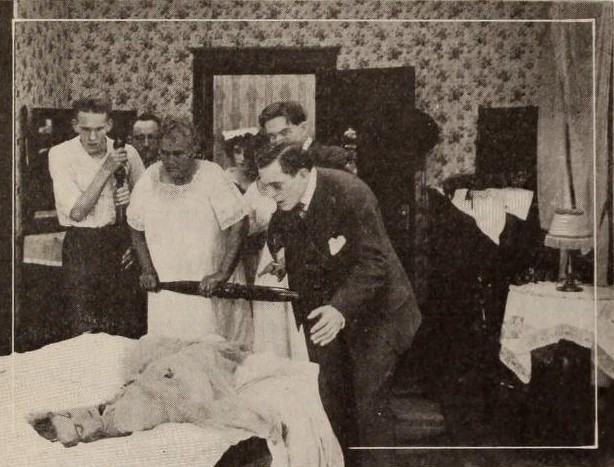
This theme of impersonation and the fluid self is further explored in the short comedy One Moment, Please, where a young man impersonates a woman to be near his sweetheart. While played for laughs, the 'complications' that arise—such as the girl's father taking a fancy to the 'shapely lady'—hint at the gender-bending and transgressive humor that would eventually become a staple of the midnight movie circuit. The ability to subvert identity through costume and performance is a radical act of rebellion against the rigid social structures of the early 20th century.
The Absurdist Edge: Satire and the Grotesque
There is a specific brand of humor that defines cult cinema—one that is often dark, absurdist, and deeply uncomfortable. We find the roots of this in films like The Kaiser's New Dentist, a Mutt and Jeff short that uses political satire and a 'ruse' to infiltrate Berlin. The idea of the bumbling idiot entering the halls of power is a timeless cult trope, one that mocks authority through the lens of the ridiculous. Similarly, Sadhu Aur Shaitan blends crime and comedy in a way that feels modern, as a taxi driver and a man accused of robbery flee the police after a body is found in a car. This chaotic energy, where the mundane and the macabre collide, is the lifeblood of the cult experience.
Even in the realm of animation and short subjects, the seeds of the strange were being sown. Screen Follies No. 2 and The Pickaninny utilized the broad, often problematic tropes of their time but injected them with a sense of unpredictable anarchy. Whether it’s a man in a bear suit encountering a real bear or a series of comical events involving moonshine bootleggers, these films prioritized the 'gag' over the logic of the narrative, creating a fragmented, surreal viewing experience that aligns with the aesthetic of later avant-garde cult works.
The International Mystique: Exoticism and the Forbidden
The cult film is often a global traveler, bringing the 'exotic' and the 'forbidden' to audiences hungry for something beyond their own borders. Early cinema was filled with these mysterious narratives, such as Mysteries of India, Part II: Above All Law and Das Geheimnis von Bombay. These films, often categorized as 'Adventure' or 'Fantasy,' offered a glimpse into a world of Princesses, palaces, and ancient deities (or thugs, as in Der Thug. Im Dienste der Todesgöttin). The fascination with the 'Other'—often filtered through a Western lens of orientalism—nevertheless provided the foundation for the 'world cinema' cult obsession that would later bring films like Suspiria or The Seventh Seal to American art houses.
In Moon Madness, we see the story of Zora, a girl of French origin raised by a Bedouin family, who feels a 'great longing' for a French artist. This narrative of cultural displacement and metaphysical yearning is a recurring theme in cult cinema, where characters are often caught between two worlds, belonging to neither. The 'madness' of the moon, the pull of the distant and the unknown, is the same force that drives the protagonists of cult classics like The Man Who Fell to Earth.
The Melancholy of the Past: Ghosts and Lost Loves
Finally, we must address the hauntological nature of cult cinema. Many cult fans are drawn to films that feel like artifacts from a lost world, and early cinema is the ultimate repository of these 'ghosts.' The Ghosts of Yesterday tells the story of an artist whose wife dies of starvation, only for him to meet a woman with a striking resemblance to her. This cycle of loss and spectral return is a fundamental cult narrative. It is about the persistence of memory and the way the past continues to haunt the present.
Films like A Sleeping Memory, where a woman is driven from her comfortable existence into a life of struggle after her father's suicide, or The Supreme Sacrifice, where a writer struggles for realism in his work, highlight the 'struggle' as a core part of the human condition. The cult film does not offer easy answers; it offers empathy for the struggle. Whether it is the 'poor Hawaiian fisherman' in The Bottle Imp trying to win the hand of royalty or the 'timid man' in No Mother to Guide Him caught in compromising situations, these characters are all searching for a sense of belonging in a world that is often indifferent or hostile to their presence.
Conclusion: The Enduring Legacy of the Maverick Vision
The films of the early 20th century, from the Western grit of The Ruse of the Rattler to the silent melodrama of Die blaue Laterne, were more than just entertainment; they were the first tremors of a cinematic revolution. By embracing the weird, the transgressive, and the misunderstood, these early filmmakers created a space for the 'misfit' in the popular consciousness. They proved that cinema could be a tool for exploring the darkest corners of the soul and the most absurd heights of the imagination.
When we watch a modern cult classic, we are seeing the echoes of Sons of the Soil, Baccarat, and Ruler of the Road. We are witnessing the continuation of a tradition that began with Algie's Romance and Fearless Dick—a tradition of maverick storytelling that refuses to be silenced by the passage of time. The cult film is not a modern invention; it is a primal urge, a flicker of light in the dark that reminds us that even the most 'discarded' stories have the power to haunt, to inspire, and to endure.
As we continue to unearth these celluloid relics, we find that the 'midnight' mindset has always been with us. It is there in the 'hard knocks' of Hard Knocks and Love Taps and the 'cured' animals of Cured. It is the spirit of the cinematic rebel, the artist who looks at the mainstream and chooses instead to walk down The Lane That Had No Turning. In the end, the cult film is a testament to the fact that the most enduring stories are often the ones that were never meant to be told in the first place.
Community
Comments
Log in to comment.
Loading comments…